What Affects Well Drilling Cost in Gresham, OR: Depth, Soil, and Season
If you own a home on a water well east of Portland, at some point you will need a number. Maybe your well stopped producing water and you are weighing repair against replacement. Maybe a water test came back ugly and someone mentioned drilling deeper. Either way, the first thing most people discover is that nobody will give them a straight answer. This guide explains the key well drilling cost factors in plain terms: depth to water, the ground your property sits on, access for the rig, and even the time of year you drill. By the end, you will know why two neighbors in Boring can get wildly different bids, and how to tell an honest estimate from a vague one.
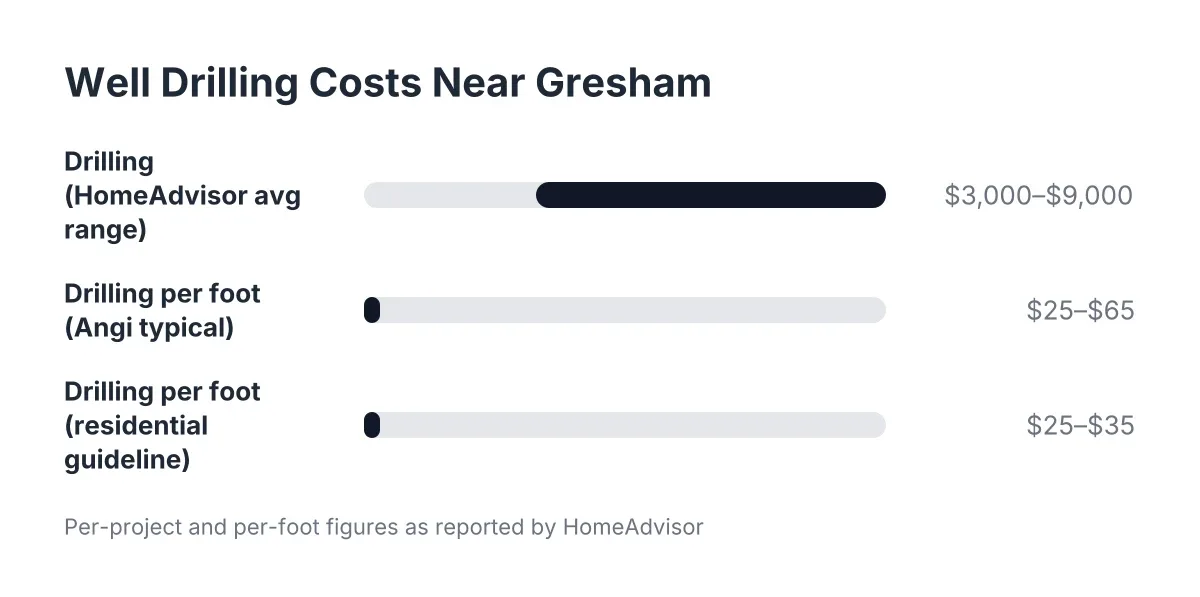
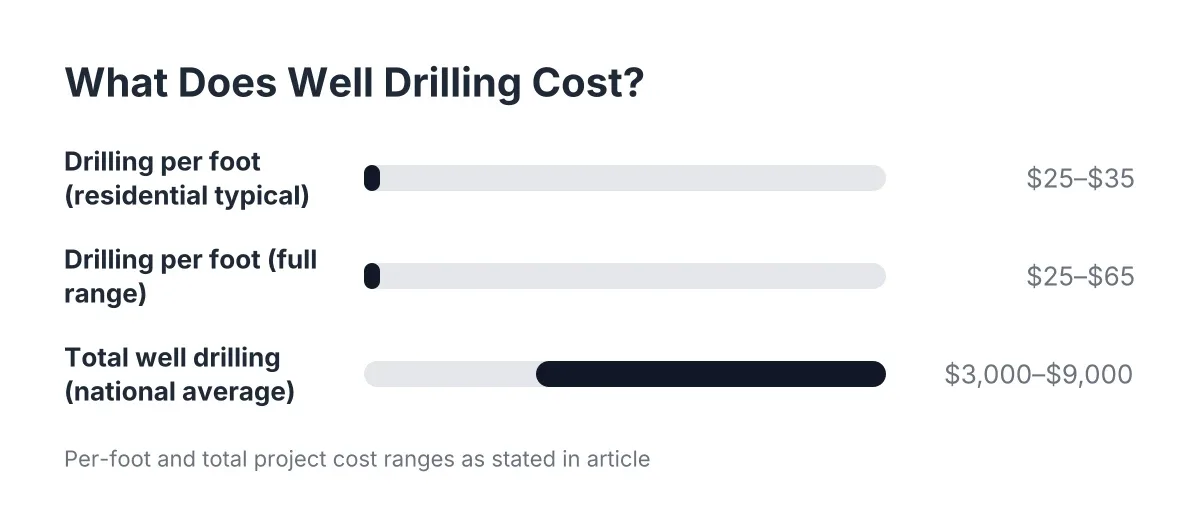
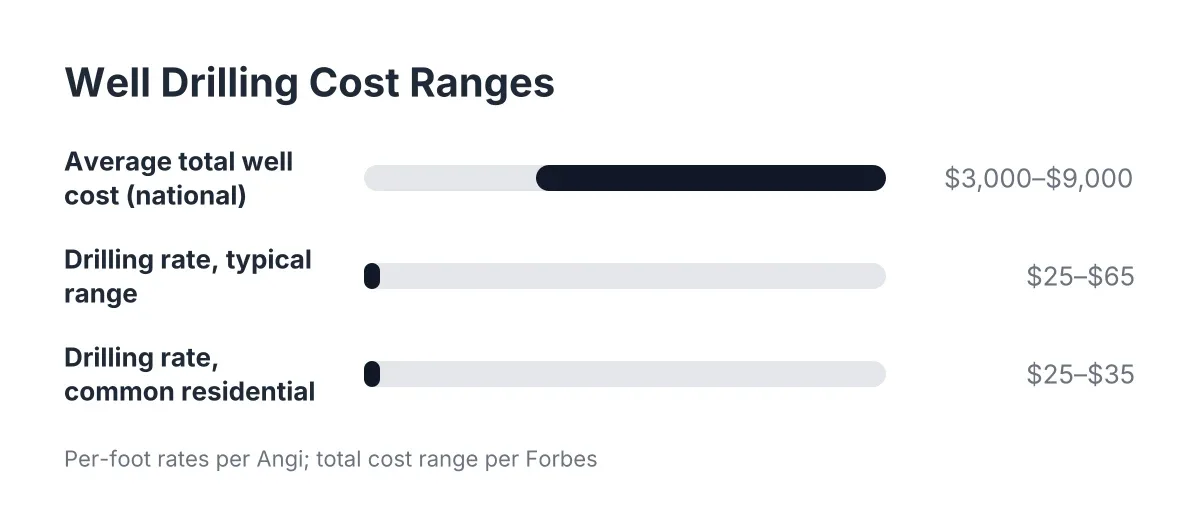
One note before we start. National sources put the average cost to drill a well at $5,625, with most homeowners spending between $3,000 and $9,000, according to Forbes. Those numbers are a starting point, not a quote. The whole reason they vary that much is the subject of this article.
Why Nobody Quotes a Flat Price for Well Drilling
A well driller cannot see underground. That is the honest answer, and any contractor who skips past it is skipping past the most important fact in the job. Drilling is priced by the foot for a reason: the driller does not know, before the bit goes down, exactly how deep the water is or what the ground will do on the way there.
Angi reports that drilling typically runs $25 to $65 per foot, with $25 to $35 per foot as a common guideline for residential work. That spread is not padding. It reflects real differences in geology, equipment, and difficulty from one property to the next.
Think about what that per-foot math means in practice. A well that hits usable water at a modest depth and a well that has to go several hundred feet into harder formations are not the same project, even if the two houses sit a mile apart. Here in the Gresham and east Multnomah County area, that mile can cross from river-deposited soils into volcanic rock. The ground changes fast on the edge of the Cascade foothills, and the price changes with it.
So when a well drilling company near you refuses to quote one flat number over the phone, that is not evasion. The companies worth trusting explain the per-foot rate, what is included in it, and which variables could move the total. The ones to be careful with are the ones who promise a suspiciously tidy price before anyone has looked at your site or the well logs from your neighborhood.
Understanding the Factors That Affect Well Drilling Cost
Four variables drive most of the price of a residential well: depth to water, the geology under your property, site access for the drilling rig, and the risk of a dry or low-producing hole. Everything else on an estimate, from casing to the pump system, hangs off those four. Understand them and you can read any bid intelligently.
Depth to water is the biggest single variable
Depth decides more of your final bill than anything else, because the job is priced by the foot. A driller's first homework on any project is figuring out roughly how deep the water sits under your specific parcel, usually by pulling well logs from nearby properties. Oregon keeps good records, and the state actively tracks groundwater; the Oregon Water Resources Department maintains more than 400 state observation wells and measures over 1,200 additional observation wells to monitor aquifer conditions.
However, nearby logs are a guide, not a guarantee. Aquifers are not flat sheets of water. They rise and fall with the terrain and the rock layers, and a property on a ridge above Corbett may need a much deeper hole than one down in the flat ground near Damascus.
Depth also matters beyond the day you drill. Shallower wells draw from shallower groundwater, which is more sensitive to drought and to surface contamination. That is part of why a driller may recommend continuing past the first sign of water. Going deeper gives sediment room to settle below the pump and can reach water that holds up better in a dry summer. It costs more per foot now, but it buys reliability later.
Dry years are not theoretical in this state. According to the U.S. Geological Survey, about 1,220 domestic wells in Oregon went dry or fell below pumping capacity between June 2021 and December 2023, and the real number is likely higher because reporting is voluntary. A well drilled to a comfortable depth is cheaper than a well drilled twice.
Soil and rock: what the ground is made of
Geology sets the pace of the job, and pace is money. Drilling through soft soil or sand goes fast. Drilling through dense clay goes slower. Additionally, drilling through basalt, which is common across the east metro area and out toward Sandy and Estacada, takes tougher bits and more time, and many drillers charge a higher per-foot rate once they are in rock. These geological differences are among the key cost factors that separate projects, even when two wells start at similar depths.
Rock changes the construction of the well too, not just the drilling speed. When a drill passes through soil and hits the top of bedrock, standard practice is to drill at least about 10 feet into that rock to seal out dirty surface water and create a proper socket for the casing, according to the New Hampshire Department of Environmental Services. That guidance comes from a different state, but the principle is universal: the well has to be built so surface runoff cannot slip down alongside the casing into your drinking water.
For a household already worried about water quality, this part of the estimate deserves attention. Casing depth and the seal around it are what stand between your tap and whatever is sitting on the surface, including septic drainfields, livestock areas, and road runoff. A cheap bid that skimps here is not a bargain. It is a future water testing problem.
Site access: can the rig even get there
A drilling rig is a large truck, and it needs a clear, stable path to the well site plus room to set up and work. On many rural properties around Gresham, that is no small thing. A steep driveway off a canyon road near Corbett, a tight tree-lined lane in Boring, or soft winter ground anywhere can all add site preparation costs before the bit ever turns.
For example, suppose a homeowner outside Estacada wants the well uphill behind the house, away from the septic field. Good instinct, and setback rules may require distance from the septic system anyway. But if reaching that spot means clearing trees or building a temporary gravel pad for the rig, those costs land on the estimate. A good contractor walks the property with you and weighs well placement against access before quoting anything, which is one reason an in-person site visit beats any phone estimate.
The risk of a dry hole, and who carries it
Sometimes a hole does not produce enough water, and how a contractor handles that possibility affects well drilling cost factors in ways that never show up as a line item. Some drillers price the risk into their per-foot rate. Others spell out what happens if the well comes up short: whether you pay for the footage drilled, what a second attempt costs, and who decides when to stop.
There is a standard decision point worth knowing about. When a hole reaches the practical limit of the rig's drill rod without strong water production, the driller measures the flow rate and puts the choice to you: stop and work with what you have, or keep going. A trustworthy contractor explains this scenario before the rig arrives, not after. If you are drilling ahead of new construction, a test well first can tell you what water access will cost before you commit the rest of the building budget.
How the Season Affects Well Drilling Costs in Oregon
The calendar changes the price of a well in Oregon through ground conditions, scheduling pressure, and groundwater levels. Summer and early fall are the busy season; winter brings soft, saturated ground that complicates rig access; and late summer shows an aquifer at its lowest, which has its own advantages. None of these make drilling impossible in any month, but they shift cost and timing.
First, demand. Dry-season months are when most people drill, which means longer waits for a rig. If your well stopped producing water in August and the house has no water today, you are competing for schedule space with every planned project in the county. That urgency is exactly why it pays to understand costs before an emergency, so a crisis bid does not catch you unprepared.
Next, ground conditions. The east metro area gets long, wet winters, and a heavy rig on saturated ground can rut a driveway, bog down, or require matting and gravel to work safely. Those access measures cost money, and some sites simply have to wait for firmer ground.
There is a flip side worth knowing. Water tables in this region tend to sit lower in late summer after months without rain. A well drilled and tested when the aquifer is at its seasonal low is proven against the worst case. A well that produces well in March, when groundwater is high, has not told you much about what it will do in September. Seasonal timing is a real trade-off: convenience and access in summer against the scheduling crunch, versus easier booking in the off-season against wetter ground.
What a Complete Well Estimate Should Include
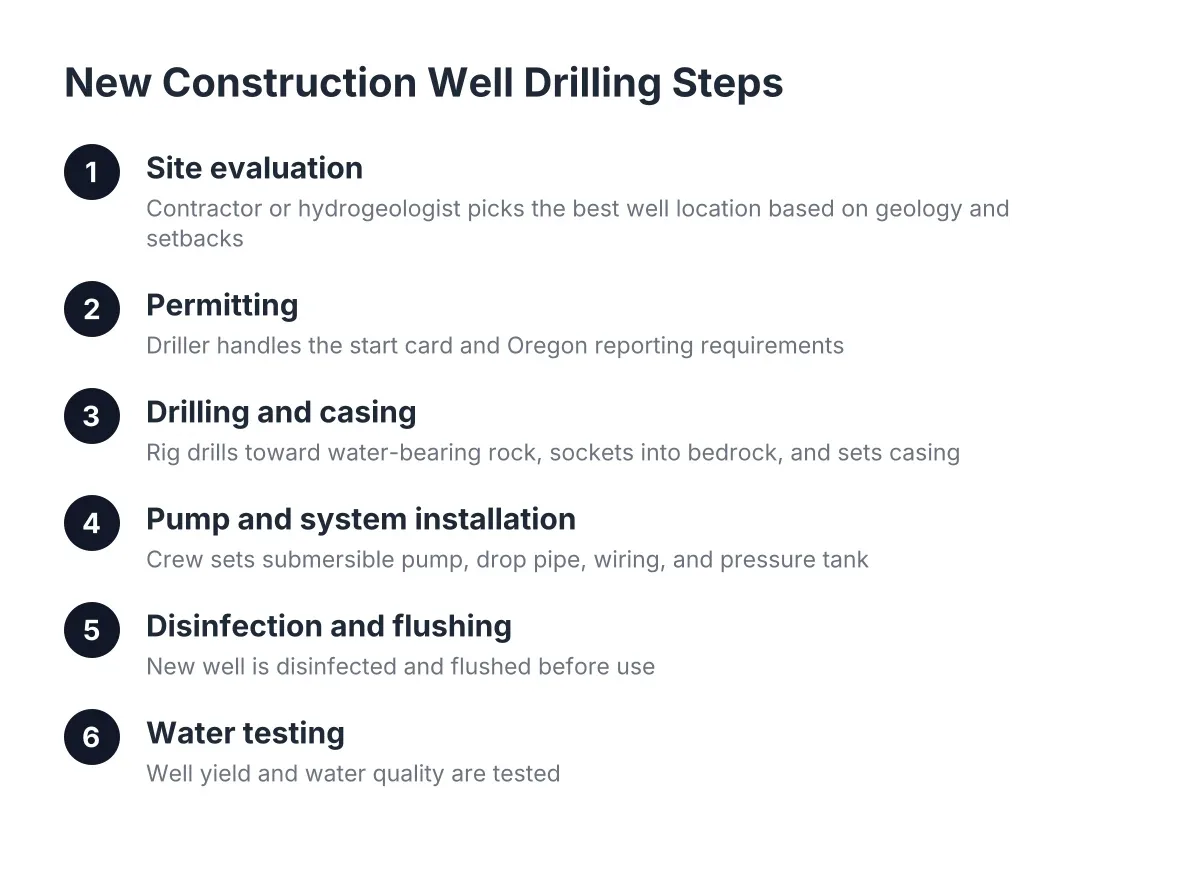
A finished water well is more than a hole. The drilling footage usually gets the headline number, but the systems that turn that hole into running water at your kitchen sink carry real cost too. When you compare bids from drilling companies near you, make sure each one covers the same scope. A low bid that quietly excludes the pump system is not a low bid.
A complete residential well project generally includes:
- Drilling, priced per foot, often with separate rates for soil and rock
- Steel or PVC casing and the sanitary seal that keeps surface water out
- Well pump installation, typically a submersible pump sized to the well's depth and your household's needs
- A pressure tank and the controls that manage water pressure in the house
- Disinfection of the new well, flushing, and a water sample for testing
- Permits and the state-required well log the driller files after completion
Two of those items deserve a closer look. Residential systems typically pair a submersible pump with a pressure tank, which may sit in the well, the house, or a crawl space depending on the layout, according to the Indiana Department of Health. Pump sizing matters; before selecting equipment, a driller sounds the well with a weighted tape to measure the standing water level and total depth, then matches the pump to what the well can deliver. An oversized pump in a modest well can draw the water down too fast, which is a common root cause behind that terrifying morning when the faucet produces air.
The disinfection and testing steps matter just as much, especially for families already concerned about water quality. After drilling, the driller treats the well and pump components with chlorine, and the system needs to run heavily to flush the residue before regular use, per the San Diego County Department of Environmental Health. Then comes the sample. The CDC notes it is standard practice to test the water from a new well, after running it enough that the sample reflects normal water quality rather than leftover disinfectant. If a bid does not mention testing, ask why.
Reading an Estimate: Honest Pricing Versus a Templated Number
An honest well drilling estimate names its assumptions; a templated one hides them. That is the single most useful filter when you compare contractors. Search for residential well drilling near me around Gresham and you will find plenty of listings with a phone number and little else. The company behind the listing may be fine, but the listing tells you nothing, so the estimate has to.
Here is what separates a real local estimate from a generic one:
- It references local ground truth. The contractor has looked at well logs near your property, or asks about your neighbors' well depths, before putting numbers on paper.
- It states the per-foot rate and what happens if rates change in rock.
- It defines the dry-hole scenario in writing: what you pay, and who decides whether to keep drilling.
- It itemizes casing, seal, pump, pressure tank, disinfection, and testing, so you can compare bids on equal scope.
- It addresses your site specifically: access, setbacks from the septic system, and where the rig will set up.
HomeAdvisor reports an average well drilling cost around $5,500, with most projects landing between $3,000 and $9,000, and notes that many wells need drilling or re-drilling every 10 to 20 years. Use figures like that to sanity-check a bid, not to replace one. An estimate far below the realistic range for your area and geology deserves more scrutiny, not a signed contract.
One honest caveat: no article can tell you what your specific property will cost. Depth, geology, and access interact in ways that only a site visit and local well records can sort out. Treat this guide as the questions to ask, and let a qualified contractor who has actually stood on your land supply the answers. For situations involving suspected contamination, a failing well during a real estate transaction, or a sudden no-water emergency, bring in a professional early rather than troubleshooting alone.
Know What Drives the Price Before You Need a Driller
The homeowners who get fair pricing on well work are the ones who understand the cost drivers before the crisis. If you are reading this with a house full of people and dry taps, the same four factors still apply; a contractor diagnosing a dead well pump or a failing well will walk the same logic of depth, geology, and equipment. Often the fix is well pump repair or well pump replacement rather than a new hole, and knowing the difference protects you from paying for drilling you do not need.
When the time comes for hiring a well driller, bring this framework with you. Ask what the per-foot rate covers. Ask what nearby well logs show about depth in your area. Furthermore, ask how rock changes the rate, what the dry-hole plan is, and whether disinfection and water testing are included. A contractor who answers those questions plainly, in writing, is showing you how they will handle the whole job.
Around Gresham, Sandy, Boring, Damascus, Estacada, Corbett, and Oregon City, the ground varies enough that local knowledge is not a nice-to-have. It is the difference between an estimate built on your geology and a number copied from a national chart. Understanding what affects well drilling cost will not drill the well for you, but it will make sure the person who does earns your trust before they earn your money.
If you need well drilling, Clackamas Well Drilling can help.
Prefer to talk it through? Call (503) 782-5215 — a quick call is usually the fastest way to get a straight answer for your situation.