Signs Your Well Pump Needs Repair vs. Replacement: Cost Breakdown for Gresham, OR
When your water slows to a trickle or stops completely, the first question is not "what broke." It is "what is this going to cost me, and is anyone going to give me a straight answer." Understanding the well pump cost breakdown—learning the signs your well pump needs repair versus full replacement—is the single best way to protect yourself from paying replacement money for a repair-level problem. This guide walks through seven specific symptoms, what each one usually means for the bill, and how to tell whether the quote you get in Gresham, OR is fair.
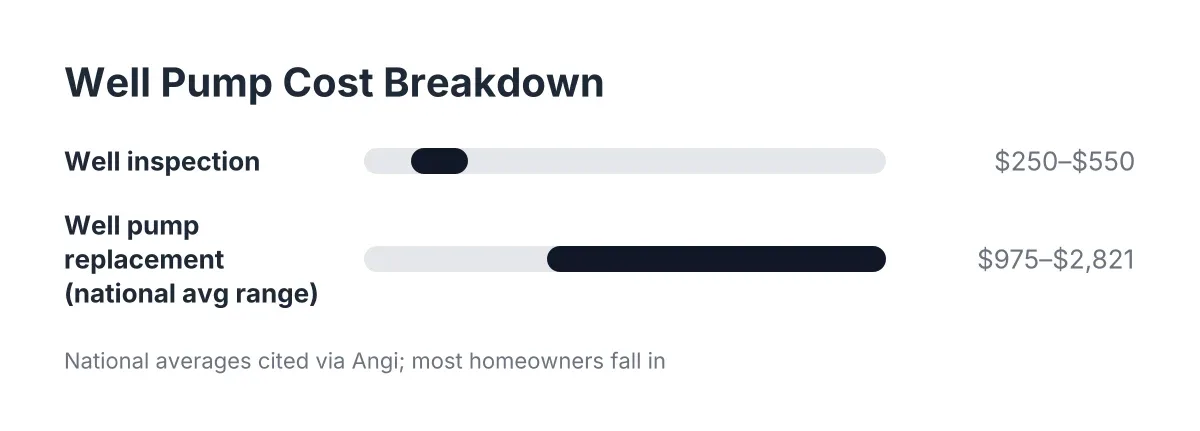
One number to anchor on before we start: according to Angi, the national average well pump replacement cost is $1,898 based on 1,339 verified projects, with most homeowners paying between $975 and $2,821. That spread exists because some "pump problems" are a $20 switch and some are a new pump plus labor to pull it from a deep well. The seven signs below sort you into the right end of that range.
1. No Water at All: Check the Cheap Stuff Before Anyone Quotes a Pump
A complete loss of water is the scariest symptom, but it is not automatically a dead pump. Tripped breakers, a failed pressure switch, or a frozen pipe section can all shut your water off and cost a fraction of what well pump replacement runs. If you want to know how to tell if your well pump went out versus a power or switch problem, start at the breaker panel, then the pressure switch near the tank.
Here is the honest cost picture for a "no water" call:
- Reset a tripped breaker or replace a fuse: often no parts cost at all
- Replace a pressure switch: a low-cost part plus a short service visit
- Replace wiring or a failed control box: a mid-range repair, usually a few hundred dollars as a rough illustrative estimate
- Replace the pump itself: the Angi figure above, $975 to $2,821 for most homeowners
One safety note that matters: if you poke at the pressure switch yourself, shut off power to the well pump circuit first. If you are not comfortable confirming power is off with a voltage meter, this is a job for a well pump repair professional, not a weekend experiment.
2. Sputtering Faucets and Air in the Lines: Repair Territory, Usually
Spitting, coughing faucets mean air is getting into your water lines. That often points to a drop pipe leak, a failing check valve, or a water level in the well that has fallen near the pump intake. These are mostly repair-level problems, not replacement-level ones, which is good news for the well pump cost breakdown.
However, sputtering is also one of the early signs your well pump is going bad from running dry. A pump that runs with no water passing through it will burn itself up, because the water is what cools it. If sputtering gets worse during heavy use, stop running water and get the well looked at before a repairable problem becomes a dead pump.
For a land buyer sizing up a property with an existing well, sputtering during a showing is a flag worth chasing. A well inspection, which Angi puts at $250 to $550 for a typical professional visit, is cheap insurance against inheriting a well that is struggling to keep up.
3. Low or Inconsistent Pressure: Could Be the Pump, Could Be the Tank
Decreased water pressure, pressure that swings up and down, or pressure that fades the longer you run water are classic signs your well pump is failing. But the pressure tank causes the same symptoms, and tanks cost less to replace than pumps. Residential well systems typically pair a submersible pump with a pressure tank, which may sit in the well, the house, or a crawl space, according to the Indiana Department of Health.
The practical difference for your wallet: a waterlogged pressure tank or a bad bladder is a surface-level fix. Nobody has to pull hundreds of feet of pipe out of the ground. A weak pump is a down-hole job, and the labor to pull it is a real part of the price. Any honest pump and well repair quote should tell you which one you are paying for and why.
Therefore, when you compare quotes, ask one question: did they test the tank's air charge and check pump amperage, or did they just quote a new pump? That answer tells you a lot about whether the estimate is fair.
4. The Pump Runs Constantly: The Sign That Costs You Twice
A pump that never shuts off is the symptom that bleeds money two ways. First, your electric bill climbs because the pump is drawing power around the clock. Second, the constant running wears out a pump that might otherwise have years left. If you are wondering how to know if your well pump is running when it should not be, listen near the pressure tank for clicking or a hum that never stops, and watch whether the pressure gauge ever reaches its cutoff point.
Common causes, roughly from cheapest to most expensive:
- A stuck or miscalibrated pressure switch
- A leak in the drop pipe or a bad check valve letting pressure bleed back into the well
- A worn pump that can no longer build enough pressure to hit the shutoff setting
- A dropping water level in the well, which is an aquifer problem, not a pump problem
Only the third and fourth items push you toward replacement-level well repair costs, and the fourth may not involve the pump at all. That is exactly why a diagnosis should come before a dollar figure, not after.
5. Short Cycling: Tank Repair, Not Pump Replacement—What the Well Pump Cost Breakdown Shows
Short cycling means the pump kicks on and off every few seconds or minutes while you run water. Nine times out of ten the villain is the pressure tank, not the pump. When a tank loses its air cushion, the pump has nothing to push against and rapid-fires on and off. The fix is recharging or replacing the tank, which costs far less than well pump replacement.
The trap here is waiting. Every short cycle is a hard start for the pump motor, and hard starts are what kill pump motors. A homeowner who lives with short cycling for a year can turn a tank-level repair into a tank plus pump replacement. If a well drilling company near you quotes a new pump for a short-cycling system without checking the tank first, get a second opinion.
6. Dirty, Cloudy, or Odd-Tasting Water: Pump Position, Well Condition, or Water Quality
Sediment and discoloration can mean the pump is sitting too low and pulling sand, the well casing or screen is degrading, or the groundwater itself has a quality issue. These three causes have wildly different price tags, so this symptom demands well water testing before anyone talks repair numbers. For households with young children, testing is worth doing on its own merits, not just as a diagnostic step.
Context from new wells shows why water clarity and wells go together. After a new well is drilled, the driller disinfects the well and pump components with chlorine, and the well gets run heavily to flush the residue out, according to the San Diego County Department of Environmental Health. It is also standard practice to run the well extensively before taking a water sample, so the test reflects normal water quality, according to the CDC. An established well that suddenly turns cloudy has skipped none of those steps; something changed down the hole, and that change needs a name before it gets a price.
If testing points to the aquifer rather than the equipment, you have moved out of pump repair and into bigger decisions, sometimes including deepening the well. That is the scenario where a few hundred dollars of testing saves you from spending pump-replacement money on a problem the pump did not cause.
7. The Pump Is Old and the Repairs Keep Stacking Up
Age is the quiet tiebreaker in every repair-versus-replace decision. A newer pump with a single failed part is almost always worth repairing. An older pump on its second or third service call is a candidate for replacement, because you are paying a service visit each time and the next failure is already loading. One useful rule: if a repair quote approaches half the cost of replacement on an aging pump, replacement usually wins the math.
One misconception worth clearing up, since it affects how you judge a pump's age: submersible pumps are built for frequent, heavy running. You do not need to ration water to "save" the pump. Normal household use does not wear it out early, so an old pump that failed did not fail because your family used too much water.
For perspective on the full lifecycle, HomeAdvisor reports homeowners spend an average of $3,000 to $9,000 to drill a well, with an average of $5,500, and most wells need drilling or re-drilling every 10 to 20 years. A pump replacement around $1,898 is a fraction of that, which is why nursing a dying pump through repeated repairs rarely pencils out.
How to Tell If Your Well Pump Quote Is Fair in Gresham, OR
A fair well pump repair quote in Gresham, OR separates diagnosis from repair, itemizes the pump, labor, and down-hole work, and explains why repair or replacement is the right call for your specific failure. If a quote is a single number with no breakdown, you cannot compare it, and that is the point of writing it that way.
Suppose a buyer closes on a few acres outside Gresham with an existing well of unknown condition, planning to build. In that scenario, the smart sequence is a well inspection and water test first, roughly $250 to $550 per Angi for the inspection, before budgeting anything for pump work. The inspection might show a sound well needing only a pressure switch, or it might show a tired pump worth replacing before construction starts, when scheduling is easy and nobody is living without water.
As of 2026, the questions that separate a fair estimate from a padded one have not changed:
- What exactly failed, and how did you confirm it?
- Is this a surface repair or does the pump need to be pulled?
- What does the part cost versus the labor?
- If you recommend replacement, what is the repair alternative and why not take it?
Well depth, access, and what the failure turns out to be all move the final number, so no article can replace an on-site diagnosis. But knowing the signs your well pump is giving you, and which end of the cost range each one points toward, means you walk into that conversation ready to judge the answer instead of just hoping it is honest.
If you need well drilling, Clackamas Well Drilling can help.
Prefer to talk it through? Call (503) 782-5215 — a quick call is usually the fastest way to get a straight answer for your situation.