Well Repair Costs in Rural Oregon: Gresham, Sandy, Boring, and Damascus
If you own a rental or family property on the rural edge of the east Portland metro, you have probably searched for answers on well repair costs in rural areas like Sandy, Boring, Damascus, or Estacada and found mostly guesswork. Maybe your tenant just called saying there is no water, and you are two hours away trying to figure out whether this is a quick fix or a five-thousand-dollar problem. This guide breaks down what actually drives pump and well repair pricing out here, what a fair quote looks like item by item, and how to authorize work from a distance without feeling like you are signing a blank check. Well repair for landlords involves understanding these costs and managing repairs remotely with confidence.
The short version: most no-water calls come down to a handful of causes, each with its own cost range, and a legitimate well repair company should be able to tell you which one you are dealing with before you approve anything expensive. The rest of this article walks through those causes, the line items behind them, and the questions that separate a fair estimate from a padded one.
Why Well Repair for Landlords Costs Run Differently in Rural Communities
Rural properties around Gresham sit on private wells instead of city water, which changes the economics of a repair in three ways. First, there is no utility to call; the whole system, from the aquifer to the pressure tank, is yours to maintain. Second, travel and access matter; a pump at the end of a long gravel drive outside Estacada takes more time to reach and service than one in a subdivision. Third, the equipment itself varies property to property, so two no-water calls a mile apart can land at wildly different prices.
That variability is exactly why well repair costs in rural settings feel so opaque. A homeowner on municipal water can look up a flat service fee. A well owner in Boring is paying for diagnosis, labor, parts, and sometimes heavy equipment, all of which depend on what is actually down the hole.
Geology plays a role too. The communities east and south of Gresham, from Corbett down through Damascus and Oregon City, sit on mixed ground. Some wells pass through soil and clay; others punch into rock. Depth, casing condition, and how the well was originally built all shape what a repair involves. None of that is visible from the surface, which is why diagnosis is the first real line item on any honest estimate.
There is also a bigger backdrop worth knowing. According to U.S. Geological Survey, about 1,220 domestic wells in Oregon went dry or fell below pumping capacity between June 2021 and December 2023, and the true number is likely higher since reporting is not mandatory. Declining yield is a real issue in parts of the state, and it changes the repair conversation from "fix the pump" to "evaluate the well itself."
The Main Failure Types and What Each One Costs to Fix
Nearly every well service call falls into one of five buckets. Knowing which bucket you are in tells you most of what you need to know about cost before anyone quotes a number.
Electrical and control problems: the cheap fixes
Electrical faults are the least expensive category of well repair, often resolved in a single short visit. A tripped breaker, a failed pressure switch, a bad capacitor in the control box, or corroded wiring can all shut down a well pump completely. The water stops, the tenant panics, and the actual fix is a small part and an hour of labor.
This is the outcome you hope for when a tenant reports no water. A good technician checks power and controls first, because it is the fastest thing to rule out and the cheapest thing to fix. If a company jumps straight to "you probably need a new pump" without checking the pressure switch and control box, that is a red flag.
Pressure tank failure: mid-range and common
A failed pressure tank sits in the middle of the cost range, more than an electrical fix and far less than pulling a pump. According to Indiana Department of Health, residential well systems typically pair a submersible pump with a pressure tank, which may sit in the well, in the house, or in a crawl space. When the tank's internal bladder fails, the pump short-cycles, pressure surges and drops, and the pump wears out early if nobody catches it.
Symptoms your tenant might describe: water pressure that pulses at the tap, a pump that clicks on and off constantly, or a tank that sounds full of water when tapped at the top. Tank replacement is predictable work with a predictable price, and a written estimate should list the tank size, the tank itself as a part, and the labor to swap it.
Well pump failure: the big-ticket repair
A failed well pump is the most expensive common repair because the pump usually sits far down the well and has to be pulled to the surface. Labor scales with depth; a deep well means more pipe, more wire, and more time. The pump itself is the other major cost, and water well pump price varies with horsepower, build quality, and whether it is a submersible or a jet pump.
Water well pump repair sometimes means fixing a component, but once a submersible pump has been pulled, replacement is often the sensible call. Pulling the pump is a large share of the total cost either way, so reinstalling an aging unit to save on the part can be false economy. For landlords evaluating well repair options, a fair well pump replacement estimate itemizes the pump, the pipe and wire if they need replacing, labor to pull and reset, and any fittings.
Wiring and drop pipe problems inside the well
Damaged wiring or a cracked drop pipe inside the well costs about as much as a pump job in labor, because the fix requires pulling everything anyway. Splices fail, pipe joints crack, and galvanized pipe corrodes over decades. The part cost can be modest; the pulling cost is not. If your well is older and the pump is coming up regardless, replacing tired pipe and wire at the same time usually beats paying the pulling labor twice in five years.
Well problems: low yield, contamination, and casing failure
Problems with the well itself, rather than the equipment in it, carry the widest and highest cost range. Sediment in the water, dropping yield, or a bacteria hit on a water test can point to a failing casing, a declining aquifer, or surface water getting into the well. The responses range from well rehabilitation to deepening the well to drilling a new one.
For context on the top end, Forbes reports the average cost to drill a well is $5,625, with typical projects running $3,000 to $9,000. HomeAdvisor puts the average around $5,500 in a similar range and notes that most wells need drilling or re-drilling every 10 to 20 years. Angi pegs drilling at $25 to $65 per foot, with $25 to $35 per foot as a typical guideline for residential work. Depth drives the bill, which is why no honest well drilling company quotes a new well without assessing your site first.
Before anyone talks about drilling, though, ask about rehabilitation. A deep well with declining output can sometimes be restored with cleaning techniques rather than replaced outright. That option is worth pricing against a new well, especially on a rental property where the numbers have to pencil out.
A Realistic Well Repair Cost Breakdown, Line by Line
A trustworthy pump and well repair estimate is itemized, not a single mystery number. Here is what each line should cover and roughly how it behaves:
- Service call and diagnosis. A flat fee or an hourly charge to come out, test the electrical system, check pressure, and identify the failure. This should be quoted before the truck rolls.
- Labor to pull and reset the pump. Priced by depth or by time. Deeper wells cost more; this is usually the largest labor line on a pump job.
- Parts. The pump, pressure tank, pressure switch, control box, pipe, wire, and fittings, each listed separately with a price. "Parts: $2,400" with no detail is not an itemized estimate.
- Equipment charges. Some deep pulls need a pump hoist or derrick truck. If equipment is on the estimate, ask why it is necessary for your well's depth.
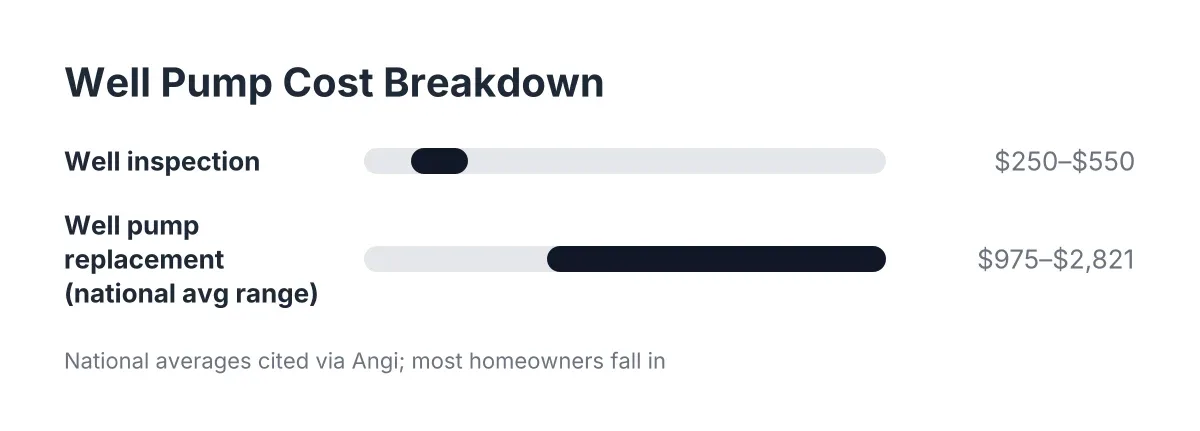
- Water testing. If contamination is suspected or the work disturbed the well, sampling and lab fees appear here. For reference, Angi reports a professional well inspection typically runs $250 to $550.
- Disinfection. Standard after work inside the well. According to San Diego County Department of Environmental Health, wells and pump components are disinfected with chlorine after work, then flushed heavily before normal use.
When you get a quote, match it against this list. Every dollar should map to a line you can question. If it does not, ask the company to break it out. A fair operator will; a padded quote tends to fall apart under that kind of scrutiny.
Managing Well Repair for Landlords From Two Hours Away
Suppose you own a rental outside Sandy and your tenant texts on a Friday that the water is out. You cannot be there, you cannot see the equipment, and you need to decide whether to authorize a repair sight-unseen. In that scenario, a few habits protect you from both overpaying and from dragging out a no-water situation that sours a good tenant.
First, authorize diagnosis only, not repair. Approve the service call fee and ask for findings before any work beyond that. A company used to working with landlords will call you with what they found, what it costs to fix, and what happens if you wait.
Next, ask for photos and the written estimate by email or text before you say yes. Photos of a waterlogged pressure tank, a corroded pump pulled from the well, or a burned control box let you verify the diagnosis from your couch. The written estimate gives you a record if there is ever a dispute, and it lets you compare against the line items above.
In addition, set a dollar threshold up front. For example, you might pre-approve anything under a few hundred dollars so an electrical fix gets done on the first visit, while anything larger requires your sign-off. That keeps small problems from needing two trips while keeping big decisions in your hands.
Finally, loop the tenant in on access and timing, but keep the money conversation between you and the company. Tenants want water back; they do not need to weigh in on whether to rehab the well or replace the pump. Clear roles make the whole repair move faster.
How to Tell If Your Well Repair Quote Is Fair
A fair well repair quote names the specific failure, itemizes parts and labor, and explains the why behind any big-ticket recommendation. If a quote is one number with no diagnosis attached, or the recommendation jumped to the most expensive outcome without ruling out cheap causes first, slow down before signing.
Use these checks, especially when you cannot be on-site:
- Does the diagnosis match the symptoms? No water with a silent pump points electrical first. Pulsing pressure points at the tank. A quote should connect the fix to what the tenant actually reported.
- Were the cheap causes ruled out? Ask directly: did you check the breaker, pressure switch, and control box? The answer should be specific, not vague.
- Is depth accounted for honestly? Pump-pull labor scales with depth. If you have the original well log or a past invoice, the depth on the quote should line up with it.
- Are parts named? Brand, model, and horsepower on a well pump, size on a pressure tank. Named parts can be price-checked; "a pump" cannot.
- Is there a repair-versus-replace explanation? On an older system, replacing pipe and wire while the pump is out may be smart. The estimate should say why, not just add lines.
- Does the total sit in a sane range for the failure type? Electrical fixes at the bottom, tanks in the middle, pump pulls higher, and well work highest. A tank-failure quote priced like a new well deserves a second opinion.
A second opinion is always reasonable on anything beyond a minor fix, and a confident company will not resent it. Keep in mind that well repair costs also shift with timing; an after-hours emergency call on a holiday weekend will run higher than the same repair on a Tuesday morning, and that premium is legitimate when it is disclosed up front.
When Repair Stops Making Sense on an Aging Well
Repair stops making sense when you are paying repeatedly to pull the pump from a well whose underlying yield or casing is failing. On a rental, this math matters more than on your own home, because every no-water event risks a vacancy and every repeat visit doubles the labor you already paid once.
Watch for these signals that the problem is the well, not the equipment:
- Yield that keeps dropping even after a pump replacement
- Sediment or discoloration that returns after the well has been cleaned
- Repeated bacteria hits on well water testing despite disinfection
- A casing or well age that predates you, with no well log to confirm construction
At that point, a well inspection and an aquifer and well depth assessment give you the real picture: whether rehabilitation can restore the well, whether deepening is possible, or whether drilling a new well is the honest answer. It is standard practice to test the water after any new drilling too; according to CDC, the well should be run extensively before sampling so the test reflects normal water quality rather than lingering disinfectant.
One honest caveat: no article can diagnose your specific well. Depth, geology, and construction vary so much across the Gresham, Sandy, Boring, and Damascus area that the figures here are context for evaluating quotes, not substitutes for an on-site diagnosis by a licensed well professional. Anything involving the well structure itself, electrical work at the wellhead, or suspected contamination belongs in professional hands.
The Bottom Line on Rural Well Repair Pricing Near Gresham
Well repair costs in rural areas east of Portland are not random; they track directly with failure type, well depth, and access. Electrical and control fixes sit at the bottom of the range. Pressure tanks land in the middle. Pump pulls cost more because labor scales with depth, and problems with the well itself carry the widest range of all, up to the cost of drilling new.
For a landlord managing from a distance, the playbook is simple. Authorize diagnosis first, demand an itemized written estimate with photos, pre-approve a threshold for small fixes, and check any large quote against the failure-type ranges above. Do that, and a 2026 no-water call from your tenant becomes a manageable expense with a paper trail, not a blind bet on a number you cannot verify.
If you need well drilling, Clackamas Well Drilling can help.
Prefer to talk it through? Call (503) 782-5215 — a quick call is usually the fastest way to get a straight answer for your situation.