Submersible vs Jet Pump: Which Well Pump Replacement Cost Is Lower?
If your well pump just quit, the question in your head is simple: what is a fair well pump replacement cost, and does the type of pump change the answer? It does. Around Gresham and the rural edge of Multnomah and Clackamas County, homes run on two different kinds of pumps, and the price to replace them is not the same. This guide breaks down submersible pump costs versus jet pump (centrifugal) costs, item by item, so you can look at a quote and know whether it is fair before you say yes to anyone.
That matters whether you are a homeowner with no water at the tap this morning, or a land buyer pricing out a new well before you build. Both of you need the same thing: a straight answer about what each piece costs and why.
The Two Pumps That Run Wells Around Gresham
Before you can compare costs, you need to know which pump you actually have. Most people do not, and that is normal. Nobody thinks about the pump until the water stops.
A submersible pump sits down inside the well itself, near the bottom of the casing, though not at the very bottom. It pushes water up to the house through a drop pipe using a stack of small pump stages. You will never see it unless someone pulls it out of the well.
A jet pump is a type of centrifugal pump that sits above ground, usually in a well house, basement, or crawl space. Instead of pushing water up from below, it pulls water from above using suction. That is also its limit. Suction can only lift water so far, so jet pumps only work on shallow wells. Deep wells need a submersible; there is no choice to make.
If you are wondering how these systems fit together, here is the short version of how wells work: the pump moves groundwater from the aquifer up the well, a pressure tank stores that water under pressure, and a pressure switch turns the pump on and off as you use water. The pressure tank might be in the well, in the house, or in a crawl space depending on how the home was built. When any one of those three parts fails, the tap goes dry, and the repair bill depends heavily on which part it was.
Around Gresham, Sandy, Boring, Damascus, and out toward Corbett and Estacada, you will find both setups. Older homes on shallow wells often still run jet pumps. Newer or deeper wells run submersibles. The pump type sets the baseline for everything that follows in your quote.
Well Pump Replacement Cost Breakdown
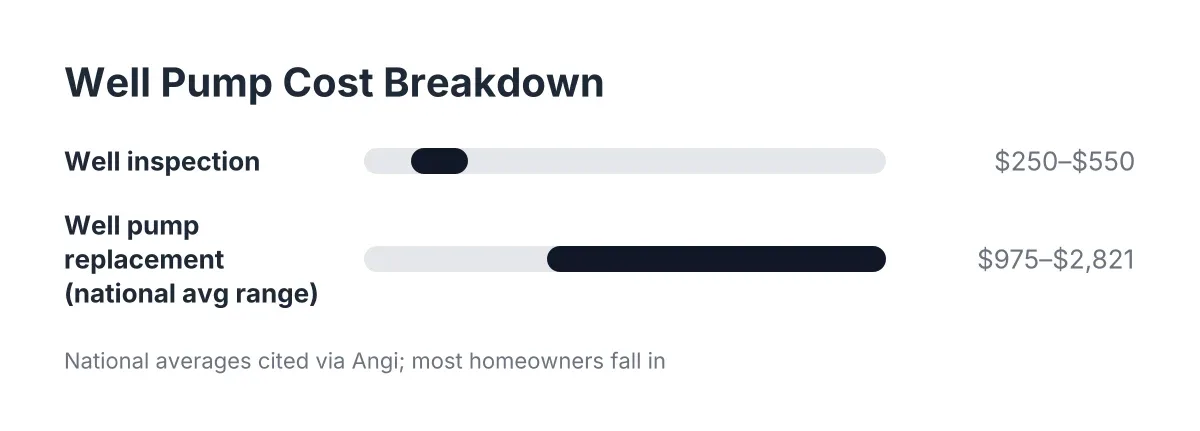
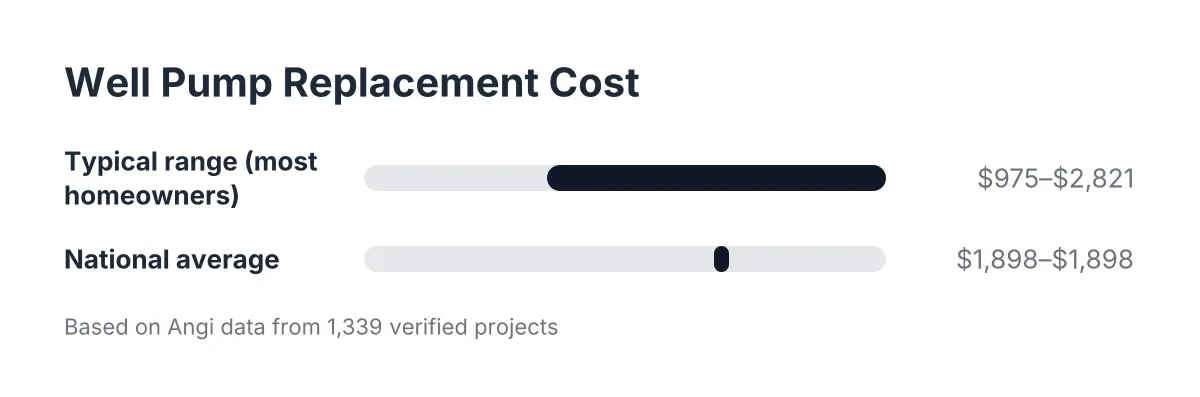
A fair well pump replacement quote has a few distinct pieces, and you should be able to see all of them. According to Angi, the national average well pump replacement cost is $1,898 based on 1,339 verified projects, with most homeowners paying between $975 and $2,821. That range is wide because the pieces below vary from well to well.
Here is what an itemized quote should show:
- The pump itself. Water well pump cost varies by type, horsepower, and build quality. Jet pumps generally cost less as hardware than submersibles of similar horsepower.
- Labor to pull and set. Submersibles have to be hauled up out of the well and lowered back down. Jet pumps get swapped above ground. This is the biggest cost difference between the two types.
- Drop pipe and wire. A submersible hangs on pipe with electrical wire running the length of the well. If that pipe or wire is old or damaged, replacing it adds material and labor.
- Pressure tank and switch. Often the pump is fine and one of these smaller parts failed instead. Sometimes they get replaced along with the pump if they are near the end of their life.
- Fittings, check valves, and wellhead parts. Small line items, but they should still be listed.
- Water testing after the work. A smart step any time the well is opened up.
When you get a quote that is one lump number with no breakdown, ask for the itemized version. A contractor who works on pump and well repair every day can produce that list without hesitation. If they cannot, that tells you something.
Why Jet Pump Replacement Usually Costs Less
Replacing a jet pump usually costs less than replacing a submersible for one plain reason: everything is above ground. The pump sits in a well house or basement where a technician can reach it, unbolt it, and set the new one in an afternoon. There is no pulling equipment, no drop pipe to handle, and no wire running hundreds of feet down a casing.
The hardware is often cheaper too. Jet pumps are simpler machines. For a shallow well, a straightforward jet pump swap is one of the lower-cost repairs in the well world, often landing near the bottom of that Angi range rather than the top.
However, cheaper to replace does not mean cheaper to own. Jet pumps only work where the water is shallow. They lose efficiency as lift increases, and they can struggle in dry-summer months when the water level in a shallow well drops. If your jet pump keeps losing prime or short-cycling every August, you may be paying for repeat service calls on a system that is at the edge of what it can do.
That is when the conversation shifts from repair to conversion, which we will get to below, because the conversion is where costs genuinely diverge.
Submersible Pump Replacement Cost Factors
Replacing a submersible pump costs more mainly because of labor and access, not because the pump is exotic. The pump hangs deep in the well on a string of drop pipe with wire taped along its length. To replace it, a crew has to pull all of that up, disconnect the old pump, set the new one, and lower the whole assembly back down.
Depth drives the labor. A pump hanging on a short string of pipe comes out fast. A pump set deep in the well takes longer, needs more pipe and wire handled, and may need a truck with a hoist. Access matters too. A wellhead in an open gravel driveway is easy. A wellhead under a deck, inside a small pump house, or beneath low tree cover means pulling pipe in short sections, cutting, and repeating, which adds hours.
There is also more that can need replacing while the well is open. Old galvanized drop pipe, brittle wire insulation, or a corroded check valve are all things a technician finds only once the pump is out. Therefore a fair submersible quote should state which of these are included and which would be extra if found.
Here is the trade-off that makes the higher price easier to accept. Submersibles are built for hard, continuous use. You do not need to baby one or ration water to make it last. They also handle depth that no jet pump can touch, which is why they are the default on most modern wells around Gresham.
Is a Submersible or Jet Pump Cheaper Overall?
For a straight swap, a jet pump is cheaper to replace than a submersible, mostly because of labor. The jet pump sits above ground and the submersible has to be pulled from the well. Over the life of the system, though, a submersible on a properly built well often costs less per year of reliable service.
Think of it in three scenarios.
First, jet-for-jet replacement on a shallow well. Lowest cost of the three. Above-ground labor, simpler hardware, done fast. If your shallow well produces reliably year round, this is a reasonable path.
Second, submersible-for-submersible replacement. Higher cost because of pulling and setting, plus depth and access variables. Still a routine job for any experienced well and pump crew, and the new pump should run for many years without special care.
Third, converting a jet pump system to a submersible. This is the expensive one, and the one where quotes surprise people. You are not just buying a pump. The crew has to run new drop pipe and wire down the well, often working in tight overhead clearance where pipe comes up and goes down in short cut sections. The wiring at the wellhead may need updating. In addition, a submersible moves water through the casing with more force than the old jet pump did, which can stir up iron buildup on the well walls that sat undisturbed for decades. Suppose a homeowner in Boring converts an old shallow-well jet system to a submersible and suddenly sees orange-tinted water. The well did not get worse; the new pump revealed iron that was always there. That can mean adding a filter, which belongs in the cost conversation up front, not as a surprise afterward.
So the honest answer to "which is cheaper" is: jet pumps win on replacement day, submersibles usually win over ten years, and the conversion between them is a project you should price carefully with someone who has pulled pumps in your specific area.
How to Tell If Your Well Pump Quote Is Fair
A fair quote for well pump repair or replacement names the pump type, the depth or setting of the pump, and every major line item. It should distinguish between the pump, the pipe and wire, the pressure tank, and labor. A single unexplained number, especially quoted over the phone before anyone has looked at your well, deserves a second opinion.
Use this checklist when a quote lands in your inbox:
- Does it name the pump type and horsepower? Submersible versus jet changes everything about the price.
- Is labor separated from parts? Pulling a deep submersible legitimately costs more in labor. You should see that stated, not buried.
- Does it address pipe and wire? On a submersible job, ask whether the drop pipe and wire are being reused or replaced, and what happens to the price if they turn out to be bad.
- Is the pressure tank and switch checked? Sometimes the pump is healthy and a failed pressure switch or waterlogged tank caused the outage. That repair can run in the low hundreds instead of the low thousands, as a rough illustrative range. Never let anyone work on a switch without shutting off power to the pump circuit first.
- Is the pump sized to the well? A common mismatch is a pump set deeper than its rated capacity, oversized on depth and undersized on flow. A properly sized pump costs a little more up front and fails less.
- Does it compare to the market? Against Angi's reported national average of $1,898 for well pump replacement, a quote several times that number needs a written explanation: unusual depth, hard access, failed pipe and wire, or a conversion. Those reasons exist, but they should be on paper.
For example, say a landlord managing a rental near Damascus gets a no-water call from a tenant and receives a same-day quote well above that national range with no itemization. The right move is not to panic-approve it. The right move is to ask for the breakdown and, if the answer is vague, get one more set of eyes on the well. Understanding well repair costs before that phone call is exactly what keeps an urgent day from becoming an expensive one.
One caution on the other side: the cheapest quote is not automatically the fair one either. A price that skips replacing tired wire or reuses a corroded check valve saves money today and puts you back in the same no-water situation sooner. Fair means complete, not just low.
What Land Buyers Should Budget Beyond the Pump
If you are buying land around Gresham, Corbett, or Estacada to build on, the pump is only one line in a bigger water budget. The well itself comes first, and well drilling is priced by depth. According to Angi, drilling averages $25 to $65 per foot, with $25 to $35 per foot typical for most residential projects. HomeAdvisor puts the total average around $5,500, with most homeowners spending $3,000 to $9,000 to drill a well.
Depth is the variable nobody can promise you in advance, and anyone who quotes a firm total before drilling is guessing. What a well drilling company can do is give you an aquifer and well depth assessment based on nearby wells and local ground conditions, so your budget has a realistic range instead of a hope. As general practice, when a drill reaches bedrock after passing through overburden, drillers plan to go at least about 10 feet into that rock to seal off dirty surface water and set casing properly, according to the New Hampshire Department of Environmental Services. Details like that are why depth, not the pump, dominates new well installation cost.
On a new build, the pump decision is usually made for you. A deep drilled well needs a submersible, full stop, because the depth exceeds what any suction-based jet pump can lift. Budget for the submersible, the drop pipe and wire, the pressure tank, the pressure switch, and well water testing before you drink from it. If you are buying land with an existing well of unknown condition, a well inspection typically costs $250 to $550 according to Angi, and it is the cheapest insurance in this whole process. It tells you whether you inherited a working system or a future well pump replacement cost you did not plan for.
The Bottom Line on Pump Type and Price
Jet pumps are cheaper to swap because they sit above ground. Submersibles cost more to replace because someone has to pull them out of the well, but they handle depth and heavy use that jet pumps cannot, and they tend to be the better long-term value on most Gresham-area wells. The conversion from one to the other is the job where prices climb, and it deserves an itemized quote and a conversation about your well's iron content before anyone starts.
Whichever pump you have, the protection against overpaying is the same. Know your pump type, ask for line items, compare against the published averages above, and treat any lump-sum number with no explanation as an invitation to ask questions. Diagnosing which component actually failed still takes a professional with pump-pulling equipment and a meter, so use this guide to check the quote, not to replace the visit. A working well is not complicated to price fairly. It just requires someone willing to show you the math.
If you need well drilling, Clackamas Well Drilling can help.
Prefer to talk it through? Call (503) 782-5215 — a quick call is usually the fastest way to get a straight answer for your situation.