Emergency Well Repair Costs: What to Expect When Your Pump Fails
You turned on the faucet and nothing came out. Now you are standing in the kitchen trying to figure out two things at once: who can fix this today, and what emergency well repair costs actually look like when you have no time to shop around. This guide walks through both. By the end, you will know what a fair bill is made of, which repairs land where on the price scale, and how to spot a quote that is padded because someone knows you are desperate.
One thing up front: most sudden no-water calls in the Gresham area are pump and well repair problems, not dead wells. The well itself, the hole in the ground reaching the aquifer, rarely fails overnight. What fails is the equipment: the pump, the pressure switch, the wiring, or the pressure tank. That matters for cost, because equipment repairs sit in a different price world than drilling.
First, Figure Out What Actually Broke
Before anyone talks money, you need a rough idea of what failed. You do not need to diagnose it yourself, but knowing the common failure points helps you follow the conversation when a technician explains the bill.
A typical residential well system uses a submersible pump down in the well paired with a pressure tank, which may sit in the well, in the house, or in a crawl space, according to the Indiana Department of Health. Water loss can come from any link in that chain:
- Pressure switch or electrical controls. The cheapest and most common fix. A stuck or burned switch means the pump never gets the signal to run.
- Pressure tank. A waterlogged tank makes the pump cycle on and off constantly, which can burn out the motor if it runs long enough.
- The pump itself. Submersible pumps are built for heavy use, but motors do burn out, especially after a power surge, a lightning storm, or years of short cycling.
- Wiring or drop pipe. The wire running down the well can fail, or a pipe fitting can let go and drop the water column.
- The well. Lowered groundwater, a collapsed section, or sediment problems. This is the least common cause of a sudden outage.
Here is a useful pattern. If your water pressure had been fading for weeks and then quit, the pump was probably dying slowly. If everything was fine last night and dead this morning, suspect the electrical side first: breaker, pressure switch, or control box. Those are the cheap fixes, so do not assume the worst while you wait for the truck.
One quick check you can do safely: look at your breaker panel. A tripped well breaker is worth resetting once. If it trips again immediately, leave it off and tell the technician; a repeatedly tripping breaker usually points to a failing motor or a wiring short, and forcing it can make the damage worse. Also, never let a pump run if you suspect the well has no water in it. Running dry burns up a pump fast, and that turns a modest repair into a full well pump replacement.
What Emergency Well Repair Costs Are Made Of
Every emergency bill breaks down into the same handful of pieces. When you can see the pieces, you can judge whether the total is fair. Here is the itemized view a straight-shooting well drilling company should be able to walk you through on the phone:
- Diagnostic or service call fee. Covers the trip out and the testing to find the failure. This should be a stated flat amount before anyone leaves the shop.
- After-hours or emergency premium. Evenings, weekends, and holidays often carry a surcharge. Reasonable, but it should be named as a line item, not buried in inflated parts pricing.
- Labor. The big variable. Pulling a submersible pump from a deep well takes equipment and time; swapping a pressure switch at the tank takes neither.
- Parts and equipment. A switch costs little. A new pump motor, drop pipe, and wire for a deep well cost real money. Pump brand and horsepower matter here; if you are pricing a replacement, a common unit like a Goulds well pump has published list prices you can check yourself.
- Depth and access. Deeper wells mean more pipe, more wire, and more pulling time. Tight access, like a wellhead under a deck or a pump house with low overhead clearance, slows everything down.
Notice what is not on that list: the age of your house, the panic in your voice, or the fact that you called at 7 a.m. on a Saturday. The emergency premium should be one visible number. Everything else should cost what it would cost on a calm Tuesday.
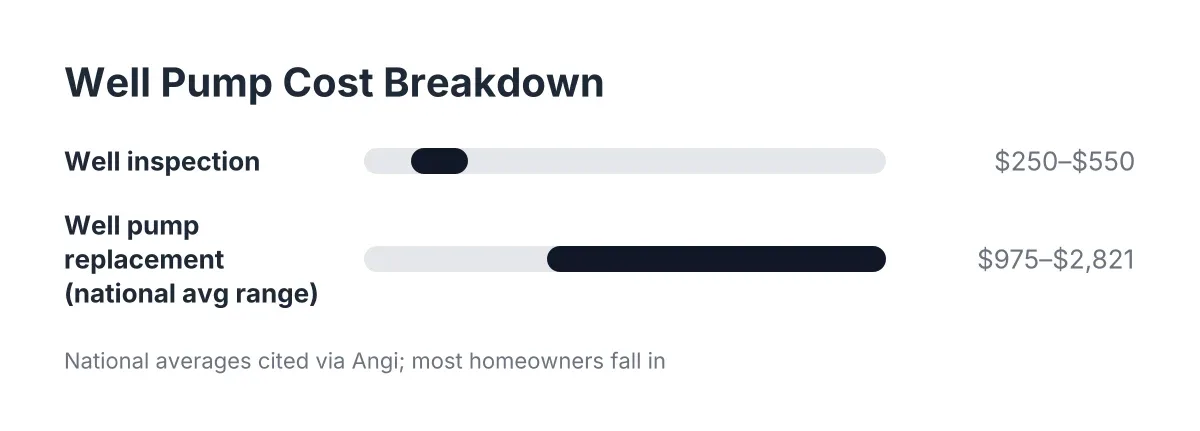
For scale, the national average well pump replacement cost is $1,898 based on 1,339 verified projects, with most homeowners paying between $975 and $2,821, according to Angi. That is replacement, the upper end of repair work. Smaller fixes, like a switch, a control box, or tank adjustments, usually land well below the bottom of that range.
Where Emergency Well Repair Costs Land by Failure Type
Emergency well repair costs scale with what failed, not with how urgent you are. A pressure switch is a low-cost fix whether you call Monday morning or Sunday night; a burned-out submersible pump in a deep well is a four-figure job either way. The emergency timing adds a surcharge, but the failure type sets the base price.
Think of the price scale in three tiers:
Tier one: controls and switches. Pressure switches, capacitors, control boxes, and fittings at the tank. These are above-ground, fast to swap, and cheap in parts. Many no-water emergencies end here, and the total bill is mostly the service call plus a modest part.
Tier two: pressure tank and above-ground plumbing. A failed pressure tank costs more in parts and takes longer to replace, but no one has to pull the pump. Mid-range work.
Tier three: anything down the well. Pulling a submersible pump to replace a motor, drop pipe, or wiring is the expensive tier. The cost tracks with depth, because every added foot means more pipe, more wire, and more pulling labor. This is where that $975 to $2,821 range from Angi lives, and deep wells with difficult access can run past it.
Here is an illustrative scenario to make it concrete. Say a homeowner outside Boring wakes up to dry taps after a windstorm knocked the power out overnight. The technician finds a pressure switch that welded shut during the power flicker. In that scenario, the bill is the emergency service call, a short labor charge, and an inexpensive part; the homeowner braced for thousands and paid a few hundred. Now suppose the same storm instead burned out a pump motor deep in the well. That job means pulling the entire pump assembly, replacing the pump and possibly the drop pipe and wire, and the bill lands in the four-figure replacement range. Same storm, same symptom at the faucet, wildly different cost. That is why no honest company can quote a firm number before diagnosing.
How to Tell If Your Emergency Quote Is Fair
A fair emergency well repair quote itemizes the service call, any after-hours premium, labor, and parts as separate lines, and the diagnosis matches your symptoms. If the quote is one lump number, jumps straight to full replacement without testing, or the emergency surcharge is vague, you have reason to slow down and ask questions.
Fear of being overcharged is the most common worry in a no-water emergency, and it is a fair one. You cannot comparison-shop with a house full of people and zero water. However, you can run a quick fairness check even under pressure. Ask these questions before authorizing work:
- What is the diagnostic fee, and does it apply toward the repair if I go ahead?
- What exactly failed, and can you show me the failed part?
- Is the after-hours charge a separate line item, and how much is it?
- If you are replacing the pump, what brand and horsepower, and why that size for my well?
- Is any of this repairable instead of replaceable, and what is the trade-off?
That last question matters because repair versus replacement is a judgment call on older systems. Replacing one worn part in a pump that is near the end of its life can mean paying for two service calls within a year or two. A good technician will tell you when a cheap fix is a bad bet, and when it is the right call. Be suspicious of anyone who only ever has one answer.
Watch for one specific upsell during an emergency: the leap from pump failure to "you need a new well." A new well is a different project with a different budget entirely; homeowners spend an average of $3,000 to $9,000 to drill a well, with an average around $5,500, according to HomeAdvisor. Nobody should reach that conclusion without evidence, such as a measured water level, signs of a collapsed casing, or a well that cannot recover after pumping. If someone proposes drilling before testing the well's recovery, get a second opinion. Most sudden outages are equipment, not aquifer.
Quality of the fix matters as much as the price. For example, in deep wells, the pump hangs on the drop pipe with its full weight of pump, pipe, water, wire, and safety rope. A flimsy splice held by a couple of clamps can fail and drop the whole assembly down the well, which turns a repair into a retrieval job. A slightly higher quote from someone who does the rigging right is cheaper than a dropped pump.
Keeping Emergency Repair Costs Down While Water Is Off
You cannot control what broke, but you can control a few things that affect the final bill and how fast water comes back.
First, clear access to the wellhead and the pressure tank before the truck arrives. Move the firewood, unlock the pump house, and trim back the blackberries if you can. Access problems add labor hours, and in an emergency those hours bill at the premium rate.
Next, gather what you know about the system. The well log from when the well was drilled, the age of the current pump, and any past repair invoices all help the technician size replacement parts correctly on the first trip. A pump sized wrong for the well's depth and yield is a common and expensive mistake; a pump rated far beyond its working depth, or undersized for it, sets up the next failure.
In addition, describe the symptoms precisely on the phone. "No water at all since this morning, breaker has not tripped, pump is silent" points toward controls. "Grinding noise for a week, then nothing" points toward the pump. The more the company knows before rolling the truck, the more likely they bring the right parts and finish in one visit instead of two.
Finally, once water is restored, think about prevention, because the cheapest emergency is the one that never happens. A professional well inspection typically costs $250 to $550, and overall well maintenance runs $200 to $900 per year, according to Angi. That is a fraction of one tier-three emergency. An inspection catches a waterlogged tank or a short-cycling pump while it is still a scheduled daytime fix at standard rates. For context on non-emergency pricing across every failure type, our broader guide to well repair costs breaks down the full range from switch swaps to pump system installs.
When the Problem Is the Well, Not the Pump
Sometimes the diagnosis comes back harder: the pump is fine, but the well is not keeping up. Dry summers on the rural edge of Clackamas and Multnomah County, from Sandy and Damascus out to Estacada and Corbett, can pull groundwater levels down, and an older or shallower well may struggle to recover.
This is where a proper assessment earns its fee. A recovery test, where the technician pumps the well down, shuts off, and times how fast the water level comes back, separates a tired well from a mismatched pump. Sometimes the answer is lowering the pump deeper in the existing well. Sometimes it is a constant pressure system with dry-run protection that shuts the pump off before it damages itself and lets the well recover. Only occasionally is the answer deepening or replacing the well.
If drilling does become the conversation, the economics shift completely. Drilling runs about $25 to $65 per foot for most residential projects, according to Angi, and the total depends on depth to a reliable aquifer and the ground conditions between here and there. Drillers in rocky ground also plan to socket the casing into bedrock; the New Hampshire Department of Environmental Services notes that drillers go at least about 10 feet into rock to seal out dirty surface water. The point for an emergency homeowner is simple: do not let anyone rush you from a no-water morning into a drilling contract the same afternoon. That decision deserves a water level measurement, a recovery test, and a written estimate you can sleep on.
A caution on limits: this article gives you ranges and reasoning, not a quote for your well. Depth, access, equipment age, and local ground conditions move the numbers, and electrical faults in particular need a qualified technician; never open a pump control box or test well wiring yourself.
The Short Version for a No-Water Morning
When you are searching for a water well pump near me with no water in the house, here is the whole playbook in six steps:
- Check the breaker once. If it trips again, leave it off.
- Do not run the pump if you suspect the well is dry.
- Call a well pump repair specialist, not a general plumber, and describe the exact symptoms.
- Ask for the diagnostic fee and the after-hours premium as stated numbers before the truck rolls.
- Get the failed part identified, and the repair quoted as itemized lines: service call, surcharge, labor, parts.
- Compare any pump replacement quote against the national picture; Angi puts the average at $1,898, with most jobs between $975 and $2,821.
Emergency well repair costs feel scary because you are buying under pressure with no benchmark. With the tiers and the line items above, you have the benchmark. Most no-water mornings in the Gresham area end with a tier-one or tier-two fix and water back the same day. The expensive outcomes are real but less common, and even then, an itemized quote and a clear diagnosis keep the bill honest.
If you need well drilling, Clackamas Well Drilling can help.
Prefer to talk it through? Call (503) 782-5215 — a quick call is usually the fastest way to get a straight answer for your situation.