What a Well Inspection Reveals About Water Quality, Safety, and Cost
If you are buying a home on a private well near Gresham, or you already own one and have never had the water checked, the question usually comes down to two things: what will the inspection actually tell me, and what is a fair well inspection cost? Both questions deserve straight answers. A professional well inspection is not a sales pitch for a new well. Done right, it is a documented, neutral look at the condition of the well, the pump, and the water itself, with a written report you can hand to a lender, an agent, or a seller.
This matters more than most buyers realize. According to the U.S. Environmental Protection Agency, more than 23 million U.S. households rely on private wells for drinking water, and a USGS study of 2,100 private wells found that about one in five produced water with at least one contaminant above a human-health benchmark. Nobody regulates the water coming out of a private well except the person who owns it. The inspection is how you find out what you are actually drinking, or what you are about to buy.
This guide walks through what a water well inspection covers, what the water quality results can reveal, what drives the cost, and how to use the report during a real estate transaction without blowing your closing date.
Why Water Quality Is the Heart of a Well Inspection
A well is a hole in the ground that connects your faucet to an aquifer. Everything between the surface and that groundwater, the casing, the seal, the cap, the surrounding soil, either protects the water or lets problems in. So while an inspection looks at mechanical parts like the pump and pressure tank, the real question underneath all of it is simple: is this water safe, and will it stay safe?
Here on the rural edge of the east Portland metro, in places like Sandy, Boring, Damascus, Estacada, Corbett, and the outskirts of Oregon City, homes sit on private wells drilled decades apart, into different ground, by different drillers. Two neighboring properties can produce different water. One can test clean for years while the one next door picks up bacteria after every heavy rain. The only way to know which situation you are in is to test, not guess.
That is why a serious inspection treats water sampling as a required step, not an add-on. It is the same logic drillers follow when a new well is completed. According to the CDC, standard practice after drilling a new well is to run the well extensively and then take a water sample for lab testing, so the sample reflects normal water quality rather than lingering disinfectant. If a brand-new well has to prove itself with a lab test before it goes into service, a 30-year-old well on a property you are about to buy deserves at least the same scrutiny.
What a Professional Well Inspection Covers
A full water well inspection has two halves: the physical system and the water itself. Skipping either one leaves you with half an answer.
The physical system
The inspector works from the top of the well down and from the wellhead into the house. Expect the visit to cover:
- The well cap and seal. The cap sits at the surface opening and keeps out debris, insects, and small animals. A cracked or loose cap is one of the most common ways bacteria gets into otherwise clean well water.
- The casing. The casing is the pipe that lines the well bore. Cracks or corrosion in the casing can let dirty surface water seep into the well instead of forcing it to filter down through the ground. Periodic casing checks exist for exactly this reason.
- The surrounding grade and setbacks. Water should drain away from the wellhead, not toward it. The inspector also looks at distance from the septic system, livestock areas, and anything else that could contaminate groundwater.
- Static water level and well depth. The inspector sounds the well with a weighted tape to measure how far down the water sits and how deep the well goes. These numbers matter for pump selection and for judging whether the well has room to spare in a dry summer.
- The pump and pressure tank. Most residential systems around Gresham use a submersible pump down in the well paired with a pressure tank, which may sit in the well, the house, or a crawl space, a setup the Indiana Department of Health describes as typical for residential wells. The inspector checks pressure switch behavior, tank condition, and how the pump cycles under load.
- Flow and recovery. A flow test runs the well for an extended stretch to see whether it can keep up with household demand, and how fast the water level recovers afterward.
The water quality tests
Then comes the lab work. A standard sample package usually screens for total coliform bacteria and E. coli, nitrates, and often arsenic, lead, iron, manganese, and hardness. Each result tells a different story:
- Bacteria points to a pathway problem. A failed cap, a cracked casing, or a compromised seal is letting surface water in.
- Nitrates often trace back to septic systems or agricultural runoff, a live concern on acreage properties with older septic fields.
- Arsenic and other naturally occurring minerals come from the rock the aquifer sits in. They are not a sign anything is broken; they are a sign the water needs treatment.
- Iron, manganese, and hardness are less about safety and more about staining, taste, and the lifespan of your fixtures and water heater.
For sellers and owners doing routine checks between transactions, a well water testing kit from a hardware store can flag obvious problems. However, for a real estate deal, lenders and agents want lab results from an accredited laboratory with a documented chain of custody, not a color strip read in the kitchen. Regular lab testing is also smart maintenance for any well owner, because it catches changes in water quality before they become health problems.
What Drives Well Inspection Cost
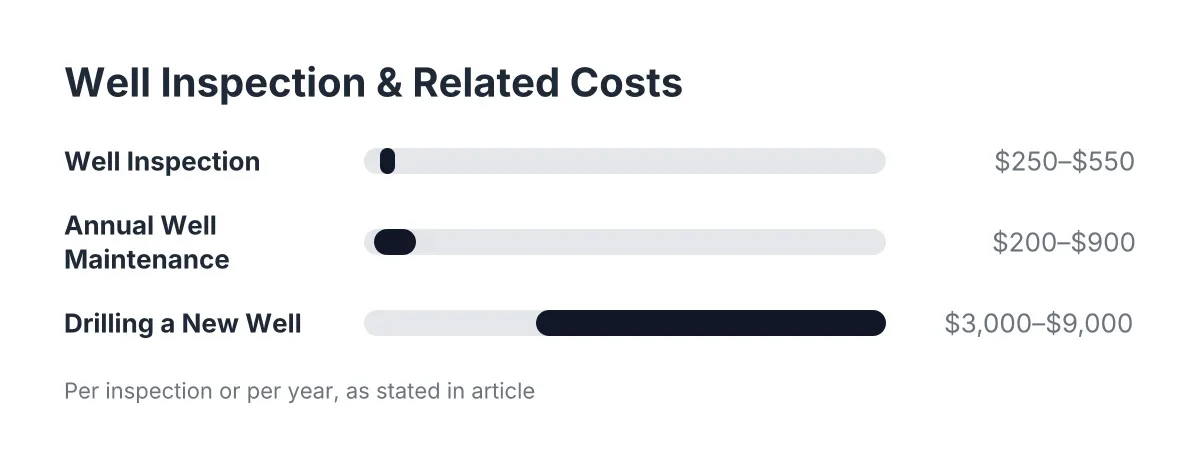
The cost of a well inspection depends mostly on how much testing you order and how hard the system is to evaluate, not on the size of the house. According to Angi, a typical professional well inspection runs $250 to $550, within broader annual well maintenance costs of $200 to $900. Where your inspection lands in that range comes down to a handful of factors.
First, the scope of the water testing. A basic bacteria-and-nitrate panel costs less than a full package that adds arsenic, lead, and minerals. Buyers in escrow usually order the fuller panel once, because retesting later means a second trip and a second lab fee.
Second, the flow test. A real flow and recovery test takes time on site. An inspector who runs the well for a sustained period learns far more than one who opens a spigot for five minutes, and that time shows up in the price.
Third, accessibility and system condition. A wellhead buried under landscaping, a pressure tank in a tight crawl space, or an old well with no records all add time. If the well has no visible identification tag and the original drilling log cannot be found, the inspector has to measure and infer more than usual.
Fourth, travel and scheduling. Searching "well inspection cost near me" returns wildly different numbers partly because rural properties take longer to reach. A well outside Estacada or up toward Corbett is a different trip than one ten minutes off the highway.
The honest trade-off: a cheaper inspection that skips the lab work or the flow test is not a bargain. It is a partial answer at a discount, and the part it skips, the water quality, is the part that affects your family's health.
Well Inspection Costs Compared to What They Protect You From
A few hundred dollars for an inspection is small next to what it can save you from walking into. Consider the downstream numbers. According to Angi, the national average well pump replacement cost is $1,898, with most homeowners paying between $975 and $2,821. If the well itself is failing, the stakes jump an order of magnitude: HomeAdvisor reports homeowners spend an average of $3,000 to $9,000 to drill a well, with an average price of $5,500, and Forbes puts the average cost to drill a well at $5,625.
Suppose a buyer is in escrow on a two-acre property outside Sandy with a well of unknown age. Say the inspection, with a full water panel and flow test, comes in around $500 as an illustrative figure. The flow test shows the well keeping up fine, but the lab results come back with coliform bacteria, and the inspector's report traces the likely cause to a deteriorated well cap and shallow casing damage. In that scenario, the buyer now has leverage. The fix might be a cap replacement, disinfection, and a retest, a repair measured in hundreds of dollars that the seller can credit at closing. Without the inspection, that same buyer moves in, the kids drink the water all summer, and the problem surfaces as a mystery stomach bug instead of a line item on a report.
The reverse scenario matters too. A clean report with strong flow numbers and clear lab results is proof the well is an asset, not a liability. Sellers who order an inspection before listing take the well off the table as a negotiating weapon.
Using the Inspection Report in a Real Estate Deal
Real estate deadlines do not wait for lab turnaround, so timing is the first thing to get right. Order the well inspection early in your contingency window, not the week before closing. Bacteria cultures take time at the lab, and if the first sample fails, you may want a disinfection and retest before you sign anything.
A good well and pump inspection report should give you, in writing:
- The measured well depth and static water level.
- Flow test results and recovery behavior.
- The condition of the cap, casing, visible seal, and wellhead area.
- Pump and pressure tank condition, with age estimates where records exist.
- Lab results for every contaminant tested, with the health benchmark next to each number.
- A plain-language summary of any defects and what category of fix they call for.
Notice what is not on that list: a quote for a new well. A neutral inspection documents conditions; it does not steer you toward the most expensive outcome. If the report flags a problem, the fix is often well pump repair, a new cap, disinfection, or a treatment system, not well drilling. Buyers rightly worry that calling a well drilling company near me for an inspection invites a sales pitch. The written, itemized report is your protection, because it ties every recommendation to a measured condition you can verify or get a second opinion on.
One honest limitation: an inspection is a snapshot. Water quality shifts with seasons and rainfall, and a well that tests clean in a dry August can pick up bacteria in a wet February. That is why a failed result, an old well, or any unexplained change in taste, smell, or pressure is a reason to bring in a professional rather than retest with a kit and hope.
How Age, Depth, and Local Ground Conditions Shape the Results
How old is this well, and how deep is it? Those two questions shape everything else in the report. Older wells were often drilled with shallower casing and looser standards than today's work. Modern practice, as the New Hampshire Department of Environmental Services describes it, has drillers continue at least about 10 feet into bedrock after passing through the overburden, both to get past dirty surface water and to create a proper socket for the casing. A well drilled 40 years ago may not have that protection, which is exactly the kind of thing an inspection surfaces.
Depth also drives both performance and the economics of any future work. Depth to water is one of the main variables behind well drilling cost, which is why drilling estimates are usually quoted per foot. An inspection that documents actual depth and static water level gives you real numbers instead of guesses if you ever need to size a replacement pump or budget for a deeper well.
Around Gresham and the Clackamas and Multnomah County rural edge, ground conditions change over short distances. Some areas produce iron-heavy or mineral-rich water that is safe but hard on fixtures; in those cases, owners of deeper wells commonly add sediment filters, water softeners, or UV purification to bring the water up to standard. An inspection report that identifies which minerals are present lets you price the right treatment system instead of buying filtration you do not need.
A Practical Checklist Before You Order an Inspection
To get full value from the visit, line up a few things in advance:
- Pull the well log if one exists. Oregon keeps records of drilled wells; the log shows original depth, casing details, and the date drilled.
- Ask the seller for maintenance history. Past pump replacements, past water tests, and any disinfection work all help the inspector read the system.
- Clear access to the wellhead and pressure tank. Time spent digging out a buried cap is time not spent testing.
- Decide your test panel up front. For a purchase, order the full panel once rather than a minimal panel you have to repeat.
- Build lab turnaround into your contingency timeline. A failed bacteria test followed by disinfection and a retest can add a week or more.
Well inspection costs are one of the smaller line items in a rural home purchase, and one of the few that can rewrite the deal. The report tells you whether the water is safe today, whether the system that delivers it is sound, and what it will take to keep both true. For a buyer standing in a kitchen in Boring or Damascus wondering what is at the bottom of that well, a documented answer beats an optimistic guess every time.
If you need well drilling, Clackamas Well Drilling can help.
Prefer to talk it through? Call (503) 782-5215 — a quick call is usually the fastest way to get a straight answer for your situation.