How to Choose a Submersible Well Water Pump for Your Gresham Home
If your well stopped producing water this morning, or your old pump is grinding its way toward failure, you need to pick a replacement that actually fits your well. A submersible well water pump is the standard choice for most homes around Gresham, Sandy, Boring, Damascus, and the rest of the Clackamas and Multnomah County rural edge. But "submersible" is a category, not a spec. The right pump depends on your well depth, your household's water demand, and what your well can actually deliver. This guide walks through the selection steps in order, the same way a pump installer would think through them standing at your wellhead.
One note before we start: according to the U.S. Geological Survey, about 1,220 domestic wells in Oregon went dry or fell below pumping capacity between June 2021 and December 2023, and the true number is likely higher because reporting is not mandatory. That matters here. Some "pump problems" are actually well problems, and the first step below exists to catch that before you spend money on new equipment.
Step 1: Confirm the Problem Is the Pump, Not the Well
Before you size or buy anything, make sure the pump is what failed. A dry tap can mean a dead pump, a tripped breaker, a failed pressure switch, a waterlogged pressure tank, or a well whose water level has dropped.
Check the simple things first. Look at the breaker panel. Listen at the pressure tank for the pump kicking on. Tap the pressure gauge and see if it moves. If the pump runs but no water arrives, the problem may be a broken drop pipe, a failed check valve, or a low water level in the well.
However, if the well itself is the issue, no pump will fix it. Oregon tracks aquifer conditions through more than 400 state observation wells, plus over 1,200 additional wells it measures, according to the Oregon Water Resources Department. Groundwater levels shift, and a well that produced fine for decades can slow down. A well inspection or an aquifer and well depth assessment settles the question before you commit to new equipment. If the well has genuinely declined, the conversation shifts from well pump replacement to deepening or well drilling, which is a different budget entirely.
Step 2: Jet Pumps vs. Submersible Well Water Pumps
For most wells in the Gresham area, a submersible pump is the practical answer. The deciding factor is depth. A jet pump sits above ground and pulls water up by suction, and suction has a hard physical limit. Once the water level sits deeper than a jet pump can lift, you need a pump that pushes from below instead of pulling from above.
A submersible water pump hangs down inside the well casing, near the bottom but not at it, and pushes water upward through a series of pump stages. Pushing is far more efficient than pulling, which is why deep wells require submersibles rather than jet pumps.
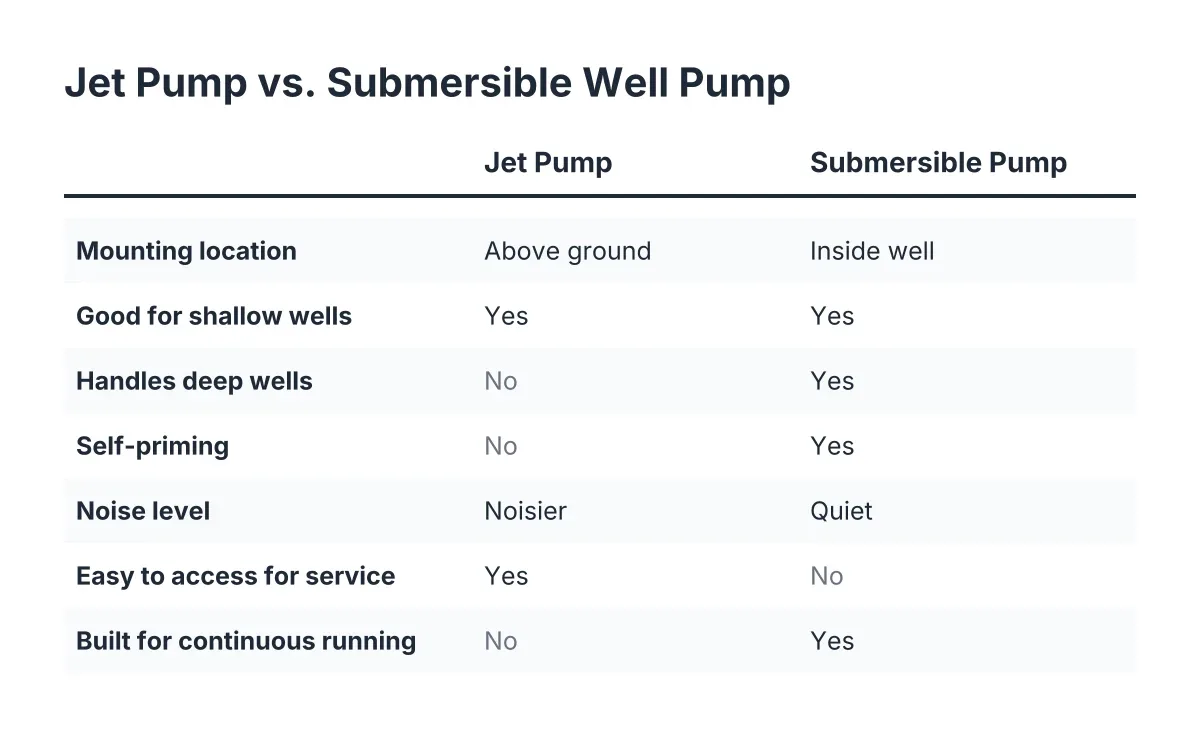
Here is how the two compare in plain terms:
- Jet pump: mounted above ground, easier to access for service, limited to shallow wells, can lose prime, often noisier.
- Submersible well water pump: sits down in the well, handles any practical residential depth, self-priming by design, quiet, and built for frequent or continuous running without wearing out early.
That last point matters for daily life. Submersible pumps are built for heavy use. You do not need to ration laundry loads or stagger showers to protect the motor.
In addition, if you are converting from an old jet pump system to a submersible, expect extra labor. The drop pipe and wiring often come up in short sections when overhead clearance at the wellhead is tight, cut and repeated many times. It is routine work, but it adds time to the job.
Step 3: Match Horsepower and Depth, Not Just One or the Other
This is where most do-it-yourself pump purchases go wrong. Horsepower, flow capacity, and depth rating work together, and a common mismatch is buying a pump rated for extreme depth while undersizing its flow and horsepower for the actual lift.
A pump's rated maximum lift is a hard limit, and it is also a design target. Hang a pump far deeper than the depth it is built to work at, and it will never move water efficiently from that level; the system never reaches its potential. Conversely, an underpowered pump set deep in the well will strain to deliver usable pressure at the house.
For a typical household on a moderately deep well, a submersible well pump in the 1 HP range is a common fit, but that is a starting point for the conversation, not a rule. Big-box listings for a submersible well water pump, including 220V models advertised for 500 feet of head, tell you what the pump can survive, not what your well needs. Sizing from the shelf tag is how homeowners end up with low pressure upstairs or a motor that short-cycles itself to death.
The inputs that actually drive the sizing decision:
- Static water level: how deep the water sits in the well when the pump is off.
- Drawdown: how far the level drops while the pump runs.
- Total lift: depth to water plus the elevation rise to the pressure tank and fixtures.
- Household demand: bathrooms, people, irrigation, and livestock all add gallons per minute.
- Well yield: what the well can sustainably produce, which caps everything else.
On that last point, there is a useful safety valve. When a well's sustainable yield exceeds the pump's rated flow, the system balances out and the pump draws only what the well supplies. A right-sized pump will not pump a healthy well dry.
Step 4: Size the Pump to Your Household, Not the Catalog
Flow capacity, measured in gallons per minute, should match peak demand, which is the busiest stretch of your household's day, not the average.
Suppose a family of five in Damascus has two and a half bathrooms, a dishwasher, and summer garden irrigation. Say their morning peak hits two showers, a toilet, and the washing machine at once. That household needs noticeably more flow than a retired couple in Corbett on the same well depth. Same well, different pump. In that scenario, an installer would size for the family's peak draw, confirm the well yield supports it, then pick the horsepower that delivers that flow at the well's total lift.
A deep well water pump for a house is therefore sized from two directions at once: enough flow for the people, enough power for the depth. Get one side wrong and you feel it every day, either as weak pressure or as a pump that cycles constantly and fails early.
One more sizing consideration for this area: backup power. East Multnomah and Clackamas County storms knock power out, and a generator sized too close to the pump's running wattage will bog down and pulse even if it never trips a breaker. If outage backup matters to you, tell your installer so the pump and generator plan match.
Step 5: Complete Submersible Well Water Pump Installation Planning
The pump is one component in a system. According to the Indiana Department of Health, residential well systems typically pair a submersible pump with a pressure tank, which may sit in the well, the house, or a crawl space depending on the layout. A proper well pump installation covers the whole chain.
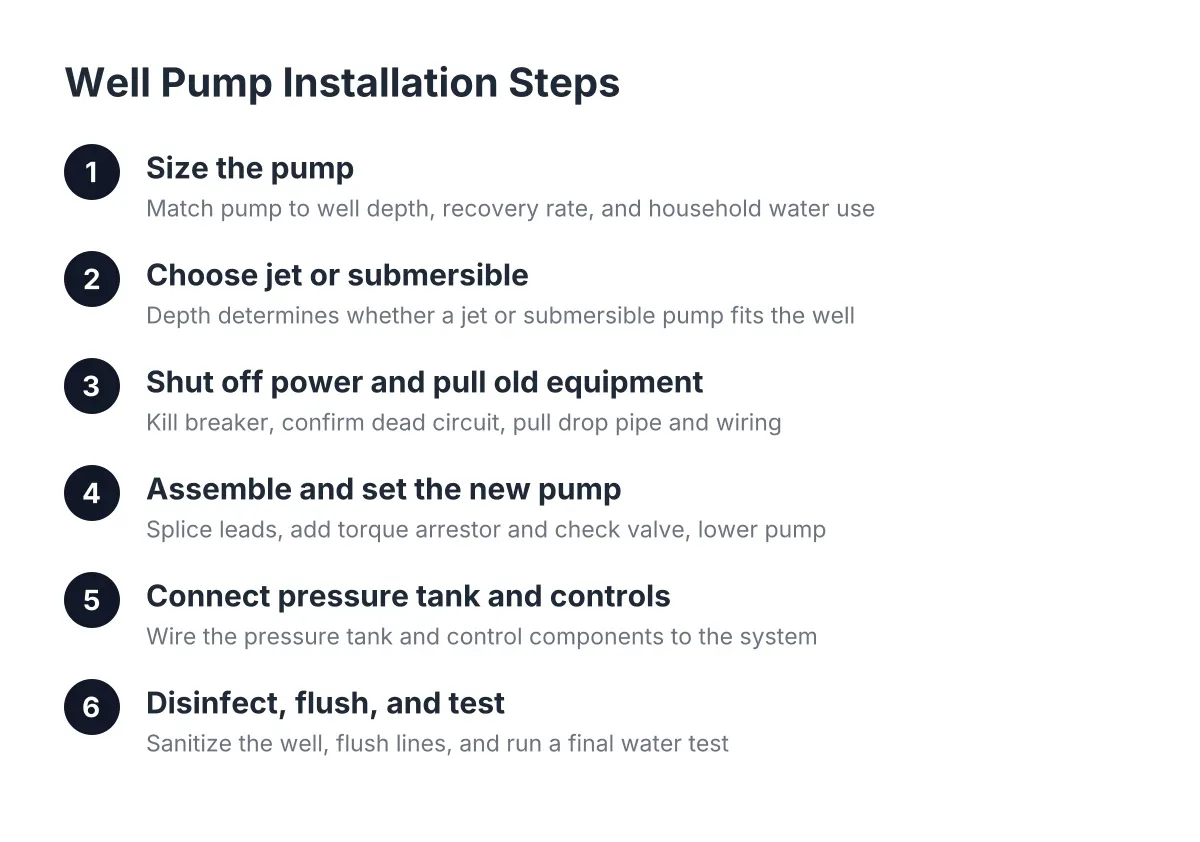
A complete scope of work from a qualified installer usually includes:
- Pulling the old pump, drop pipe, and wiring, and inspecting what comes up.
- Setting the new pump at the correct depth, above the well bottom with room and extra wire for connections, never resting on the bottom where sediment collects.
- New drop pipe, safety rope, waterproof wire splices, and a check valve.
- Checking or replacing the pressure tank, pressure switch, and controls.
- Disinfecting the well, then flushing it heavily before normal use. Sampling for water quality after flushing is standard practice, according to the CDC.
Expect some temporary water quality changes after the swap. A submersible pump agitates the water column harder than a jet pump, and that force can knock loose iron buildup on the casing walls that was never flushed out before. Cloudy or rusty water for a short stretch after installation is common and usually clears with running.
On cost, the national average well pump replacement runs $1,898, with most homeowners paying between $975 and $2,821, according to Angi. Depth, horsepower, access, and whether the pressure tank and wiring need replacement all push a specific job up or down within and beyond that range. Most straightforward replacements are a one-day job once the crew and pump are on site, though converting systems or troubleshooting well problems takes longer.
Step 6: Know When to Call a Pro, and What to Ask Before You Hire
Checking breakers, the pressure switch, and the tank gauge is homeowner territory. Pulling a submersible pump is not. The pump hangs on heavy pipe deep in the casing, carries 220V wiring, and one dropped connection can send equipment to the bottom of your well. Diagnosing whether the real problem is the pump, the pressure system, or the well itself also takes instruments and experience. If you have no water today, or the pump is grinding, cycling rapidly, or tripping breakers, stop troubleshooting and call for well pump repair.
When you search for well repair near me or a well drilling company near me, three questions separate a specialist from a listing:
- Will you measure before you size? A fair installer checks static water level, drawdown, and yield rather than selling the pump on the truck.
- What does the quote include? Pump, drop pipe, wiring, fittings, tank check, disinfection, and testing should be itemized, not bundled into one vague number.
- If it turns out to be the well, not the pump, then what? You want someone who handles both pump and well repair and well drilling, so a wrong first guess does not mean starting over with a second company.
A fair quote explains what drives the price in your specific well. Be cautious of anyone quoting a firm number without knowing your depth or demand, and of anyone pushing a new well before ruling out a pump or pressure system fix.
Get the Right Pump Set Right the First Time
A submersible well water pump sized to your well's depth, your well's yield, and your family's actual demand will run quietly for years. One sized off a shelf tag will remind you of the mistake every morning. If you are in Gresham or the surrounding communities, from Estacada to Corbett to Oregon City, and you need a pump diagnosed, replaced, or a new system sized for a new well, reach out and describe what your water is doing. A short conversation about your well and your household is enough to start an honest estimate, and if you have no water right now, that call is the fastest route back to a working tap.
If you need well drilling, Clackamas Well Drilling can help.
Prefer to talk it through? Call (503) 782-5215 — a quick call is usually the fastest way to get a straight answer for your situation.