Well Water Testing Kit vs. Lab Analysis: Accuracy, Cost, and When Each Makes Sense
If you are buying a home on a private well near Gresham, or you have lived on one for years and never checked the water, you have two basic paths: pick up a well water testing kit and run it yourself, or send a sample to a certified lab, usually as part of a professional well inspection. Both have a place. When considering a test kit vs lab for well water analysis, a DIY kit is cheap and fast. A lab test is slower and costs more, but it is the only result a lender, a health department, or the other side of a real estate deal will take seriously. Here are eight things to know before you choose, written from the perspective of a well drilling and pump outfit that acts on test results rather than just handing over paperwork.
1. A DIY well water testing kit is a screening tool, not a verdict
A home well water testing kit from a hardware store or online retailer uses test strips or small reaction vials to flag the obvious stuff: pH, hardness, chlorine, nitrates, iron, and sometimes a basic bacteria indicator. It answers one question well: is something clearly off with this water right now. It does not tell you how much of a contaminant is present with any precision, and it cannot certify anything.
Think of it like a tire pressure gauge. Useful for a quick check, no substitute for a mechanic when you are about to drive the car across the country. If a strip test comes back clean, that is mildly reassuring. If it comes back dirty, you still need a lab test to know what you are actually dealing with.
2. Lab analysis is the only result that counts in a real estate transaction
If you are under contract on a rural property in Sandy, Boring, Damascus, or Estacada, a well water testing kit result will not satisfy anyone at the closing table. Lenders, especially on FHA, VA, and USDA loans, want a certified lab report, and so should you. Oregon also has specific requirements around well water testing when a property with a well changes hands, so the seller side typically needs lab results regardless.
For a buyer, the lab report does two jobs. First, it documents water quality on a specific date, which protects you if problems show up later. Second, it gives you a negotiating tool. A strip test from a drugstore kit gives you neither.
3. What a well water test kit vs lab option checks for, and what a DIY kit misses
Most consumer kits cover a similar short list. Here is the typical lineup and the gaps:
- Usually covered: pH, total hardness, iron, nitrates, nitrites, chlorine, and sometimes copper or a presence-or-absence bacteria test.
- Sometimes covered: lead, pesticides, and total dissolved solids, depending on the kit.
- Almost never covered properly: coliform bacteria with a confirmed count, E. coli confirmation, arsenic at low detection levels, manganese, and anything requiring incubation or instrumentation.
The misses matter. Bacteria in well water is the most common health concern for private wells, and arsenic and nitrates are the contaminants Oregon health guidance flags most often for rural groundwater. Those three are exactly where cheap kits are weakest. A kit might show "bacteria negative" simply because the sample was not handled or incubated correctly.
4. Where DIY kits lose accuracy: sampling, timing, and interpretation
The chemistry on a test strip is fine. The problem is everything around it. Accuracy breaks down in three places:
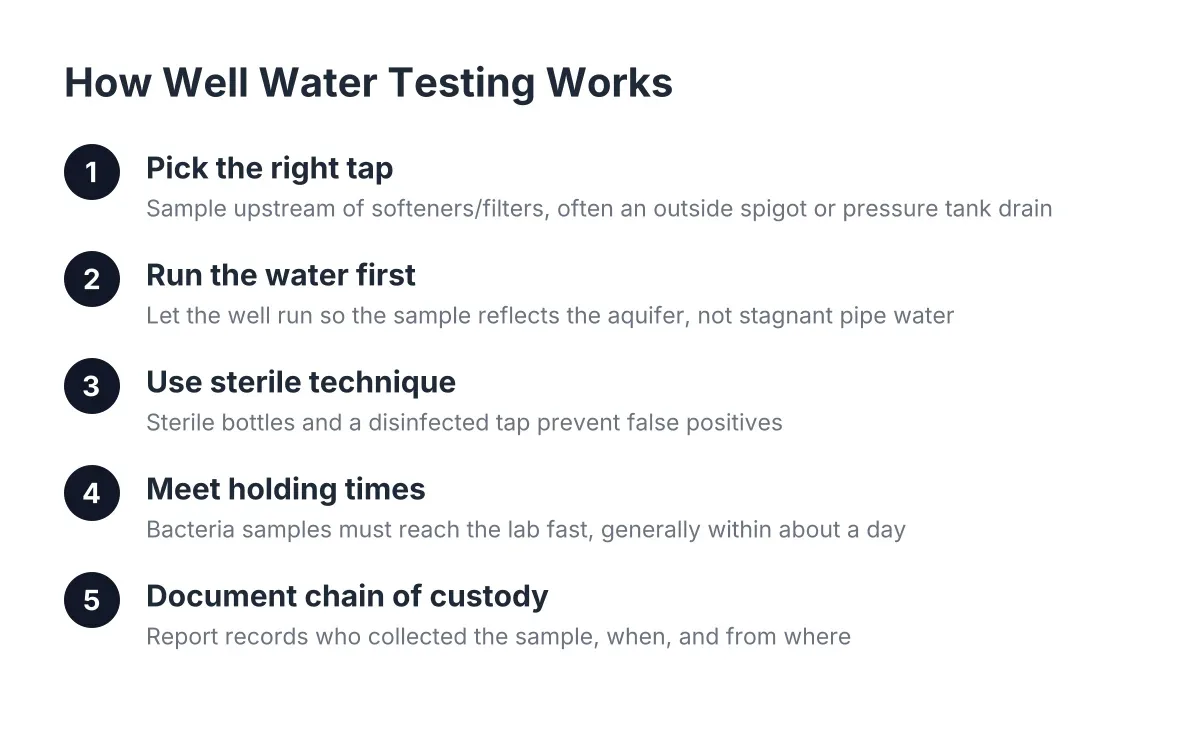
- Sampling. Bacteria tests require a sterilized container, a flame-disinfected or cleaned tap, and a sample that gets processed within hours. A kitchen glass filled from an aerator-clogged faucet will skew results.
- Timing. Water quality in a well changes with the seasons and with use. One sample on one afternoon is a snapshot, and shallow wells can test clean in August and show coliform after heavy fall rain.
- Interpretation. A strip tells you "nitrates present." It does not tell you whether the level is a nuisance, a problem for an infant in the house, or a sign of a failing septic system uphill from the wellhead.
A certified lab controls the first two and reports exact numbers for the third. That is the accuracy gap in a nutshell, and it is why the two options are not interchangeable.
5. Cost comparison: test kit vs lab options in 2026
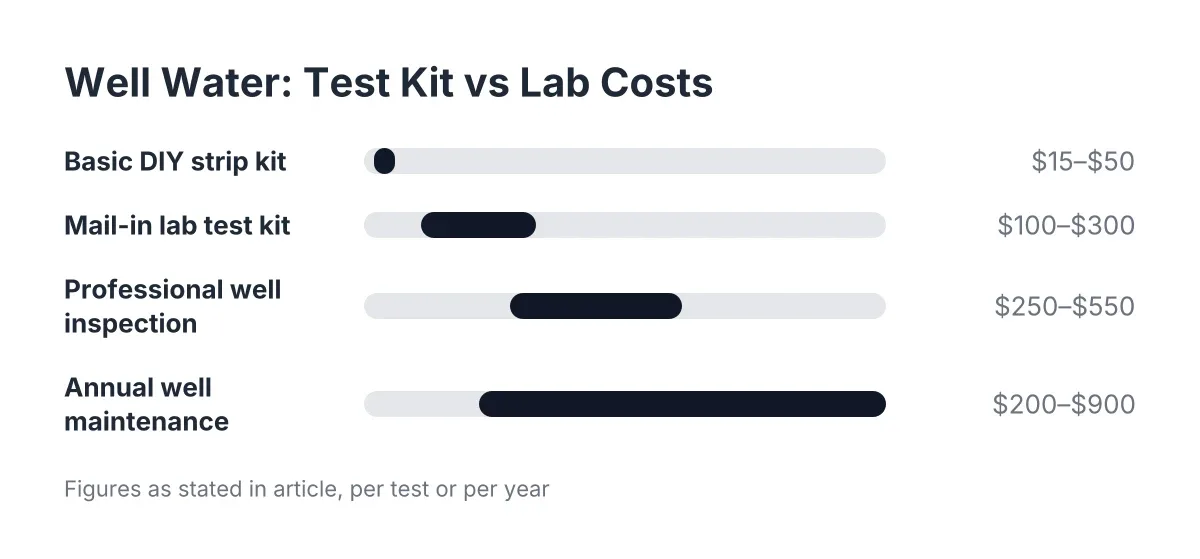
DIY kits are the cheap end. A basic strip kit runs in the ballpark of $15 to $50 at a hardware store, and mail-in kits that send your sample to a certified lab typically land somewhere between $100 and $300 depending on how many contaminants they screen, as a general estimate. Those mail-in kits are a legitimate middle ground; the analysis is real lab work even though you collect the sample yourself.
Professional testing usually rides along with a full well inspection, which covers the pump, pressure tank, wellhead, and flow alongside the water sample. According to Angi, a typical professional well inspection costs $250 to $550, and overall well maintenance runs homeowners $200 to $900 per year. For a pre-purchase decision on a property worth hundreds of thousands of dollars, that inspection range is small money for documented answers.
6. For a home purchase, test the whole system, not just the water
A clean water sample from a well with a dying pump is a half-answer. Residential well systems typically pair a submersible pump with a pressure tank, which may sit in the well, the house, or a crawl space, according to the Indiana Department of Health. A proper well inspection looks at all of it: pump performance, pressure tank condition, wiring, the well cap and seal, and flow over a sustained draw.
Here is a hypothetical that comes up constantly on the rural edge of the Portland metro. Say a buyer is under contract on five acres outside Estacada with a well of unknown age. The seller says the water is fine, and a DIY well water testing kit even backs that up. However, an inspection finds a 25-year-old pump drawing high amps and a waterlogged pressure tank. According to Angi, the national average well pump replacement cost is $1,898, with most homeowners paying between $975 and $2,821. In that scenario, the water test alone would have missed a four-figure negotiating point.
7. Is well water safe to drink without testing it?
No. Well water is not automatically safe to drink, because private wells are not treated or monitored by anyone but the owner, and the most serious contaminants, including coliform bacteria, nitrates, and arsenic, have no taste, smell, or color. The only way to know whether a specific well is safe is to test it, ideally through a certified lab.
Clear, good-tasting water proves nothing either way. Plenty of wells with harmless iron staining taste worse than wells carrying bacteria you would never notice. This is also why "the neighbors' well tested fine" is weak evidence; two wells a quarter mile apart can draw from different depths in the aquifer and carry different water.
8. Testing frequency and when to use a DIY test kit vs lab
For routine ownership, test annually for coliform bacteria and nitrates through a lab, and run a broader panel every few years or whenever something changes: new taste, odor, staining, a flood near the wellhead, or work done on the well or pump. It is also standard practice to test after any new well is drilled, and according to CDC, the well should be run extensively first so the sample reflects normal water quality rather than leftover disinfectant. That matters because drillers disinfect a new well and its pump components with chlorine, which has to be flushed out before the water represents what you will actually drink, per the San Diego County Department of Environmental Health.
A DIY kit earns its keep between lab tests. Use one to spot-check after heavy rain, to monitor a known iron or hardness issue, or to decide whether a change in the water justifies paying for a full lab panel. One quirk worth knowing: equipment changes can surface problems that were always there. A well with high iron may look fine under a low-flow jet pump, then show rusty water after switching to a higher-velocity submersible pump stirs up sediment. That is a water chemistry issue revealing itself, not a bad pump install, and a lab test sorts out which is which.
The honest bottom line for Gresham-area well owners and buyers
Use both, for different jobs. A well water testing kit is a $20 to $50 early warning system. Certified lab analysis, ideally bundled with a full pump and well inspection, is what you rely on for health decisions, a home sale, or any repair conversation. If you are buying, the lab-plus-inspection route is not optional; it is the only version that produces a report you can put in front of a seller.
One trade-off to be clear about: a lab report tells you what is in the water, not what to do about it. Interpreting a positive coliform result, deciding between shock chlorination and a treatment system, or tracing nitrates back to a wellhead seal problem takes someone who works on wells, not just someone who mails envelopes. If results come back with red flags, bring in a local well and pump professional before you spend money on treatment equipment the water may not need.
If you need well drilling, Clackamas Well Drilling can help.
Prefer to talk it through? Call (503) 782-5215 — a quick call is usually the fastest way to get a straight answer for your situation.