Well Water Safety Testing Explained: Bacteria, Nitrates, and What Results Mean
If you are buying a house on a private well near Gresham, or you own rental properties on wells in Sandy, Boring, Damascus, or Estacada, water quality testing is the one step you cannot skip. A well can look fine, run strong, and still carry bacteria or nitrates you cannot see, smell, or taste. This guide walks through what a well water safety test actually screens for, how the sampling happens, what the lab report means in plain English, and what to do when a result comes back bad. It is written from the perspective of a water well specialist who can fix what the test finds, not just hand you a lab report and wish you luck.
That distinction matters more than most buyers realize. A lab tells you what is in the water. A well and pump company tells you why it is in the water, and what it will cost to fix. When a closing deadline is bearing down, you need both answers in the same week.
Why Water Quality Testing Matters on a Private Well
City water in Gresham proper gets tested constantly by the utility. A private well gets tested when the owner decides to test it, and that is the whole story. According to the U.S. Geological Survey, more than 43 million people, about 15% of the U.S. population, rely on private wells for their drinking water, and that water is not regulated under the federal Safe Drinking Water Act. Nobody is checking your well but you.
The numbers on what those tests find are sobering. According to the U.S. Environmental Protection Agency, a USGS study of 2,100 private wells found that about one in five contained at least one contaminant above a human-health benchmark. That is not a reason to panic. It is a reason to test before you close on a property, before you put a tenant in a unit, and on a regular schedule after that.
For the rural edge of Multnomah and Clackamas counties, this is everyday reality. Homes in Corbett, Oregon City, and the hills around Estacada sit on private wells, not city mains. If you are under contract on one of those homes, the seller's word that "the well is fine" is not documentation. A lab report with a sample date is.
What a Well Water Test Checks For
A standard well water safety screen checks for coliform bacteria, E. coli, and nitrates at minimum, because those three tell you whether anything from the surface or from septic systems is reaching the water. Broader panels add arsenic, lead, iron, manganese, hardness, pH, and sodium. The right panel depends on why you are testing.
Here is what the common targets mean in practice:
- Total coliform bacteria. These bacteria live in soil and on surfaces. They are not usually harmful themselves, but their presence means surface water is getting into the well, and surface water can carry things that are harmful.
- E. coli. This is the serious one. E. coli comes from human or animal waste. A positive result means the well is directly connected to a contamination source, often a septic system or livestock runoff, and the water should not be consumed until the problem is found and fixed.
- Nitrates. Nitrates come from fertilizer, septic systems, and animal waste. They matter most for infants and pregnant women. Elevated nitrates in a rural well often point to land use around the property, which is exactly the kind of thing a buyer wants to know before closing.
- Arsenic. Arsenic occurs naturally in some Oregon groundwater. You cannot taste it, and the only way to know is a lab test.
- Iron and manganese. These are nuisance minerals more than health threats. They stain fixtures, discolor laundry, and give water a metallic taste. They also tell a well professional something about the aquifer the well draws from.
- Hardness and pH. Hard water scales up water heaters and fixtures. Low pH water can corrode plumbing and leach metals from pipes. Neither shuts down a sale, but both affect the cost of owning the property.
Real estate transactions usually require at minimum bacteria and nitrates, and lenders on some loan types require arsenic as well. If you are testing for a home sale in Oregon, ask which panel the transaction requires before you order anything, because re-sampling later burns days you may not have.
How Water Quality Testing Works, Step by Step
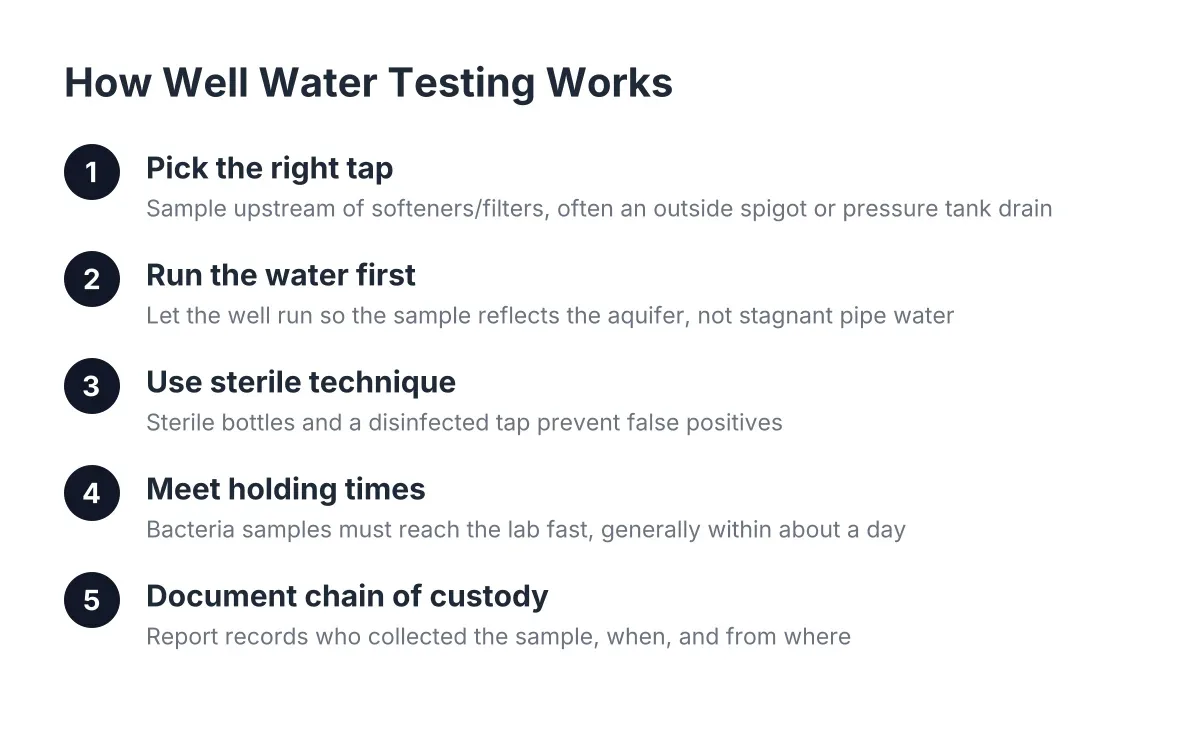
A professional water quality test on a well follows a specific sequence: a trained sampler collects water from the right point in the system using sterile containers, delivers the sample to a certified lab within the holding time, and the lab returns a written report, typically within several business days depending on the panel. The sampling part sounds simple. It is where most do-it-yourself tests go wrong.
Here is the sequence a careful sampler follows:
- Pick the right tap. The sample needs to represent the well, not the house plumbing or a filter. That usually means a tap upstream of any softener or treatment equipment, often an outside spigot or a pressure tank drain.
- Run the water first. The well should run long enough that the sample reflects the aquifer, not water that sat in the pipes overnight. This matters double on a vacant listing where the well has not run in weeks.
- Sterile technique. Bacteria samples use sterile bottles, and the tap gets flamed or disinfected before collection. One stray fingertip on the bottle rim can produce a false positive that stalls your closing for no real reason.
- Holding times. Bacteria samples have to reach the lab fast, generally within about a day. A sample that sits in a hot truck is worthless.
- Chain of custody. For a real estate transaction, the report should document who collected the sample, when, and from where. A buyer's lender and a seller's agent both need that paper trail.
This is also why a water well testing kit from a hardware store, or a professional water test kit shipped by mail, works fine for a curious homeowner but falls short for a transaction. A home water quality tester strip can flag hardness or give a rough pH reading. It cannot certify bacteria results to a lender, and it cannot tell you why the result is what it is. For a purchase decision or a tenant-occupied rental, use a certified water quality testing lab and a documented sample.
Reading the Results Without Panicking
Lab reports are written for regulators, not for homebuyers. Here is the plain-language version of the three outcomes you are most likely to see.
Bacteria present
A total coliform positive with no E. coli is the most common bad result, and it is usually fixable. Often the cause is physical: a cracked well cap, a casing that ends too close to grade, a missing or failed well seal, or surface water pooling around the wellhead. The standard response is to inspect the wellhead, correct the entry point, shock chlorinate the well, flush it, and re-test.
An E. coli positive is more serious. Stop drinking the water, and treat it as a system problem, not a one-time fluke. The source has to be found, whether that is a septic drainfield too close to the well, a damaged casing, or an old, shallow, poorly sealed well that should be evaluated for replacement. This is a case where a well inspection and a water test together tell you far more than either one alone.
Nitrates elevated
Nitrates do not go away with chlorination because they are dissolved, not living. The fixes are treatment, such as reverse osmosis at the kitchen tap, or addressing the source, or in stubborn cases drilling a new, deeper well into a protected aquifer. For a buyer, an elevated nitrate result is a negotiation item with a knowable cost, not automatically a dealbreaker.
Minerals and nuisance issues
Iron staining, a rotten egg smell, or scale on fixtures point to iron, sulfur, or hardness. These are quality-of-life and maintenance-cost issues. Treatment equipment such as sediment filters, softeners, or iron filters handles most of them. One wrinkle worth knowing: a well can hide an iron problem under a low-flow pump, then show it after a well pump replacement, because a higher-velocity submersible pump stirs up sediment the old pump never moved. A good well and pump company will flag that risk before the swap, not after your laundry turns orange.
One honest limitation: a single water test is a snapshot. Groundwater quality shifts with seasons and rainfall, which is why a clean result in August does not guarantee a clean result after a wet Pacific Northwest winter. If a result sits near a health benchmark, or if the property has an older well with unknown construction, have a professional interpret it rather than calling it good on your own.
Water Quality Testing Before You Buy a House on a Well
For a pre-purchase inspection, order the water test and the well inspection together, early in your contingency window, because a bad bacteria result needs time for a fix and a re-test before closing. Suppose you are under contract on a home outside Boring with a 10-day inspection contingency. In that scenario, sampling on day two leaves room for results, a shock chlorination if needed, and a confirming re-test before your deadline. Sampling on day eight does not.
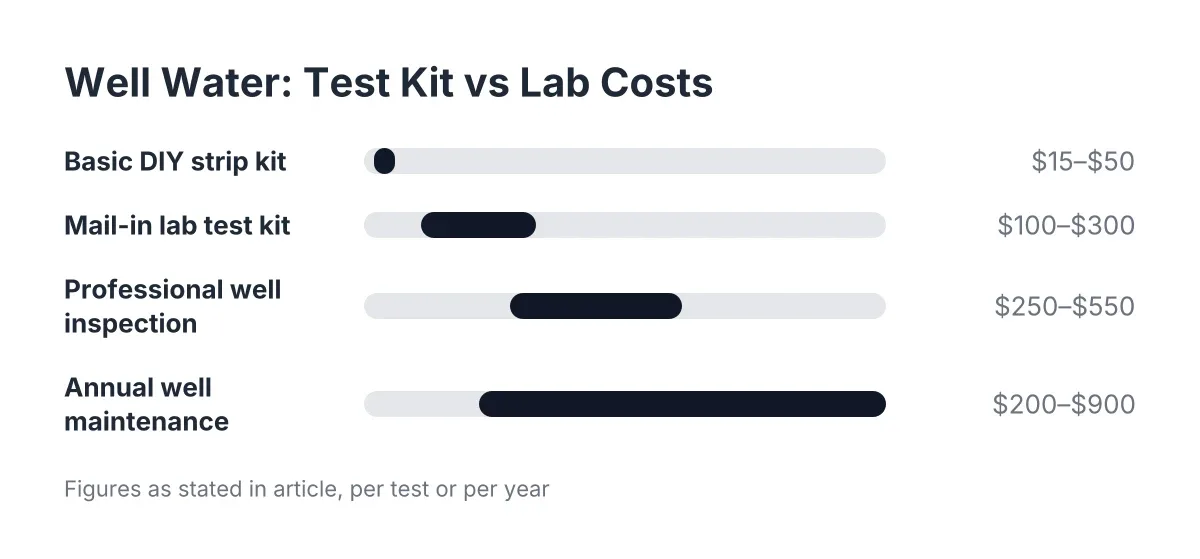
Pair the test with a full well inspection: wellhead and casing condition, pump performance, pressure tank operation, and a flow check. Residential well systems typically pair a submersible pump with a pressure tank, which may sit in the well, the house, or a crawl space, according to the Indiana Department of Health. The water can test clean while the pump is on its last legs, and only the inspection catches that. For rough budgeting, a typical professional well inspection runs $250 to $550 according to Angi, with the lab panel priced separately depending on what it covers.
For landlords with several well-served rentals around Sandy or Damascus, the same logic scales. A documented test at every tenant turnover protects you twice: it confirms the water is safe before someone moves in, and it creates a paper record if a dispute ever comes up. Many multi-property owners put all their wells on one annual testing and inspection cycle so nothing slips between turnovers.
How Often Should You Test Well Water?
Test well water at least once a year for bacteria and nitrates, and run a broader panel every few years or whenever something changes. Annual well water testing is the baseline because groundwater conditions move; Oregon's Groundwater Hydrology Section tracks aquifer conditions through more than 400 state observation wells and measures more than 1,200 additional wells across the state, according to the Oregon Water Resources Department, and those levels change year to year.
Beyond the annual check, test any time one of these happens:
- The water changes in taste, smell, or color, especially a rotten egg odor or new staining on fixtures.
- Anyone in the household has unexplained stomach illness.
- Flooding or heavy runoff reaches the wellhead.
- Work is done on the well or pump. Pulling and reinstalling a pump stirs iron and manganese sediment, and the water can run reddish or dark until repeated flushing clears it; a test after it clears confirms you are back to normal.
- A new well is drilled. Standard practice is to disinfect the new well with chlorine, run it heavily to flush the residue, then sample for the lab before the well goes into regular service. Testing is the final gate before a new well counts as done, and it is standard practice to run the well extensively first so the sample reflects normal water quality rather than lingering disinfectant, per CDC guidance.
- A septic system nearby is repaired or replaced, or land use around the property changes.
Choosing Who Tests Your Well
The practical choice in 2026 is between a mail-in kit, a standalone lab, and a well company that samples, interprets, and can fix what it finds. All three have a place. For routine peace of mind on a home you already own, a mail-in kit or a trip to a water quality testing lab near you is a reasonable middle ground. For a purchase, a refinance, or a rental turnover, hire a professional who can also stand behind the fix.
Ask any provider three questions before you book:
- Does a certified lab analyze the sample, and will the report hold up for a lender or a real estate file? If the answer is vague, keep looking.
- Who collects the sample, and how? Proper sampling technique is the difference between a real result and a false positive that costs you a week of escrow.
- If something fails, can you fix it, and will you explain the options before quoting anything? A tester who cannot act on findings hands you a problem. A well drilling and pump repair company hands you a plan: shock chlorination, a wellhead repair, treatment equipment, or in the worst case an assessment of whether the well itself needs replacement.
A fair proposal separates the pieces: the sampling visit, the lab panel, and any repair work as its own line item after results come back. Be cautious of anyone who quotes a treatment system before the lab report exists. The test should drive the fix, never the other way around.
The Bottom Line for Gresham-Area Wells
A private well is an asset when it is documented and a question mark when it is not. Testing turns the question mark into numbers: safe or not safe, fixable or structural, negotiate or walk. For a buyer, that is leverage and peace of mind in the same envelope. For a landlord, it is the cheapest insurance you will buy all year.
If you are under contract on a well-served property around Gresham, Sandy, Boring, Damascus, Estacada, Corbett, or Oregon City, or you have a rental turnover coming and the last test is more than a year old, get the well inspection and the water test scheduled together. Reach out to a local well and pump company that tests, interprets, and repairs, and you will walk into closing, or your next lease, knowing exactly what is in the water and what it will cost to keep it that way.
If you need well drilling, Clackamas Well Drilling can help.
Prefer to talk it through? Call (503) 782-5215 — a quick call is usually the fastest way to get a straight answer for your situation.