Well Drilling Companies Near Gresham: Local Drillers vs. Out-of-Area Contractors
If you're searching for well drilling companies around Gresham, OR, you've probably noticed the results are a mess. You get national directories with no real information, bare homepages with a phone number and nothing else, and contractors based hours away who may or may not know the ground east of Portland. If you just bought land in Boring, Damascus, Sandy, or out toward Corbett and need a water well before the county will permit your house, that's a frustrating place to start.
This FAQ walks through how to tell a real local operator from a listing, what a local driller actually brings to a new well project, and the questions that separate the two. It's written for someone deciding whom to trust with a five-figure hole in the ground, not someone casually researching groundwater.
Why does it matter if a well drilling company is local to Gresham?
A well drilling company that regularly works the Gresham area has drilled through this specific ground before. Aquifer depth, soil, and rock vary from one road to the next, and a driller who has set wells in Damascus or Estacada has a far better sense of what your site will take than a contractor driving in from two counties away.
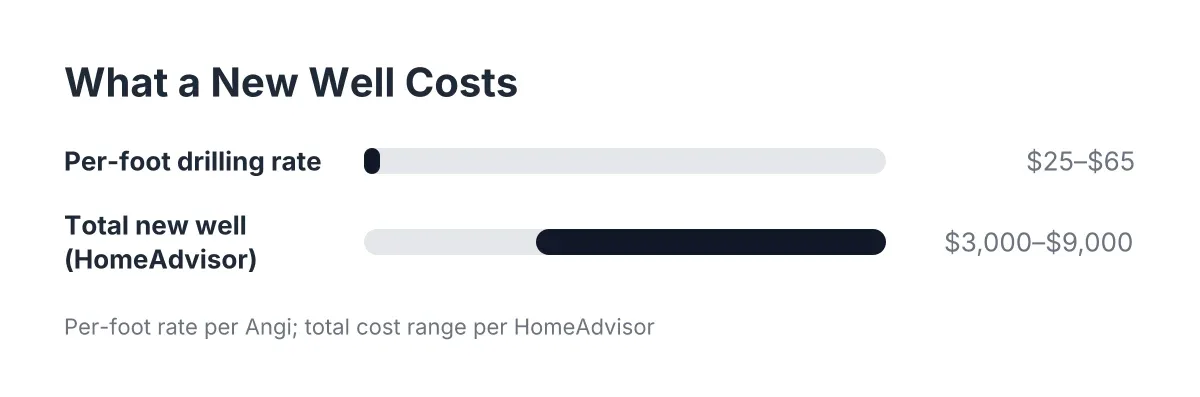
That local knowledge shows up in the estimate. Well drilling is priced heavily by depth, and depth depends on local geology. According to Angi, drilling typically runs $25 to $65 per foot, so a driller who can make an informed depth estimate for your specific area gives you a more honest picture of total cost before you commit.
An out-of-area contractor isn't automatically bad. However, they're guessing more, mobilizing a rig farther, and they won't be around the corner later when your well pump needs repair or replacement.
How do I tell a real local driller from a directory listing?
A real local well drilling company has a specific service area, talks about local conditions, and can describe wells they've drilled in nearby communities. A directory listing or lead-generation site collects your contact information and sells it to whichever contractor pays for it, which may be nobody local at all.
Here are the tells when you're comparing search results for well drilling contractors near me:
- Directories list dozens of companies in dozens of states. If the same site covers well drilling in Florida, Maine, and Nevada, it's a middleman, not a driller.
- Templated city pages read generic. If you could swap "Gresham" for any other town and nothing changes, nobody behind that page has worked here.
- A real operator answers questions about depth and cost factors. They explain what drives the number instead of hiding everything behind a form.
- A real operator can talk about the whole system. Drilling, casing, well pump installation, the pressure tank, water testing, and the paperwork your county wants.
If a company can't tell you anything specific about groundwater conditions in eastern Multnomah or northern Clackamas County, keep looking.
What should a complete new well installation include?
A complete new well project covers siting the well, drilling and casing the borehole, installing the pump system, disinfecting the well, and testing the water. Any well drilling company quoting you should be able to walk through each of those steps, because a hole in the ground is not a working water well.
In practice, the scope usually looks like this:
- Site evaluation. The contractor evaluates the land for the best well location, factoring in geology, setbacks from your septic system, permitting requirements, and whether the rig can physically get to the spot.
- Drilling and casing. The crew drills to water-bearing rock. When the drill hits bedrock, the standard practice is to continue at least about 10 feet into the rock to seal out dirty surface water and create a proper socket for the casing, according to the New Hampshire Department of Environmental Services.
- Pump and tank installation. Residential systems typically pair a submersible pump with a pressure tank, which may sit in the well, the house, or a crawl space, according to the Indiana Department of Health.
- Disinfection and flushing. After drilling, the driller disinfects the well and pump components with chlorine, and the well gets run heavily to flush the residue out, per the San Diego County Department of Environmental Health.
- Water testing. It's standard to take a water sample after the well has run long enough that the sample reflects normal water quality, not leftover disinfectant, according to the CDC.
Watch for quotes that cover only the drilling. Pump installation, electrical hookup, trenching to the house, and well water testing are often priced separately, and that's where "cheap" bids balloon.
How much does a new well cost, and why won't anyone give me a firm number?
Homeowners spend an average of $3,000 to $9,000 to drill a well, with an average around $5,500, according to HomeAdvisor. Forbes puts the average at $5,625. Nobody can quote a firm total up front because the biggest cost driver, depth, isn't fully known until the rig is turning.
That uncertainty is why land buyers get vague answers. An honest driller will give you a per-foot rate, an expected depth range based on nearby wells, and a clear explanation of what changes the number: hitting rock early, difficult site access, or needing to go deeper to reach reliable groundwater. A driller who promises an exact total before touching your land is either padding the price or planning to renegotiate mid-job.
One useful move for a land buyer: treat the well as a test of the property. Drilling before you finalize your build budget tells you what water access costs on that specific parcel, so you're not committing to house plans on land with an expensive water problem.
What questions should I ask before hiring a well driller?
Ask about local experience, licensing, and what the written estimate covers. Those three questions expose most of the difference between a trustworthy local operator and a contractor who shouldn't be on your land. Hiring a well driller is one of the few decisions in a new build you can't easily undo, so slow down here.
Specifically:
- Have you drilled wells near my property, and what depths did you hit? They can't promise your depth, but they should know the area.
- Are you licensed to drill in Oregon, and will you handle the well log and permits? Oregon requires wells to be documented; a legitimate driller treats that paperwork as routine.
- What exactly is in the quote? Per-foot rate, casing, pump installation, disinfection, water testing, and what counts as an extra.
- Who services the well afterward? A local well and pump company can come back for well pump repair or a well inspection years later. An out-of-area rig can't.
Red flags: cash-only deals, no written estimate, no mention of permits, and pressure to sign before they've seen the site.
Do site conditions on my land change which company I should hire?
Yes. Drilling rigs are large trucks that need a clear, reasonably level path to the well site. Dense trees, steep slopes, soft ground, or rock near the surface can add site preparation costs before drilling starts, and an experienced local crew will flag that at the walk-through instead of on the invoice.
For example, suppose a buyer has five wooded acres outside Estacada with a rough gravel drive. A local contractor who has worked that terrain will tell you up front whether the rig can reach the staked location or whether you need clearing first. A distant company quoting from photos finds out the hard way, and you pay for the surprise. Timing matters too; in the Pacific Northwest, wet winter ground can limit rig access, so drillers often schedule outdoor drilling for drier months and handle pump and well repair work in the off season.
I'm buying land with an existing well. Do I still need a well drilling company?
Yes, but for inspection and testing rather than drilling, at least at first. A well inspection and water test tells you whether the existing well produces enough water, whether the pump and pressure tank are sound, and whether the well water is safe. That matters for your lender, your county, and your family.
This is not a guaranteed pass. In Oregon, about 1,220 domestic wells went dry or fell below pumping capacity between June 2021 and December 2023, and the true number is likely higher since reporting isn't mandatory, according to the U.S. Geological Survey. An old well on paper is not the same as a working water well. A company that handles both well inspection and drilling can tell you honestly whether the existing well is worth keeping, needs a new pump, or needs replacement. One caveat: if an inspection turns up contamination or a failing aquifer, you'll want a licensed professional involved before making any purchase decision; that's not a judgment call to make from a water test kit alone.
The bottom line on choosing between local and out-of-area drillers
Choose the company that knows your ground, puts the full scope in writing, and will still be nearby when the pump needs attention in ten years. For most Gresham-area land buyers, that points to a local water well specialist over a directory lead or a contractor trucking in from far away. More than 43 million Americans rely on private wells for drinking water, according to the National Ground Water Association; the ones who have the fewest problems hired someone who treated the well as a long-term system, not a one-day job.
If you're planning a build in Gresham, Sandy, Boring, Damascus, Corbett, or Oregon City and need a straight answer about whether your land can support a well and what it will cost, reach out for a site evaluation and estimate. A short conversation about your parcel beats weeks of guessing from search results.
If you need well drilling, Clackamas Well Drilling can help.
Prefer to talk it through? Call (503) 782-5215 — a quick call is usually the fastest way to get a straight answer for your situation.