Water Pressure Drops After Well Pump Repair: 8 Causes and What to Do Next
You paid for a well pump repair, the water came back on, and now the water pressure drops after repair, leaving you wondering what went wrong. That feels like a betrayal, but it is a common and usually fixable situation. Sometimes the drop is normal settling. Sometimes it points to a second problem the repair uncovered. And sometimes it means the repair itself needs a warranty follow-up.
This matters double if you are evaluating a home before buying it. Suppose the seller's disclosure says "well pump replaced last year," but the shower still surges and sputters during your walkthrough. That gap between "repaired" and "working right" is exactly what a well inspection is for, and it is worth understanding before you close.
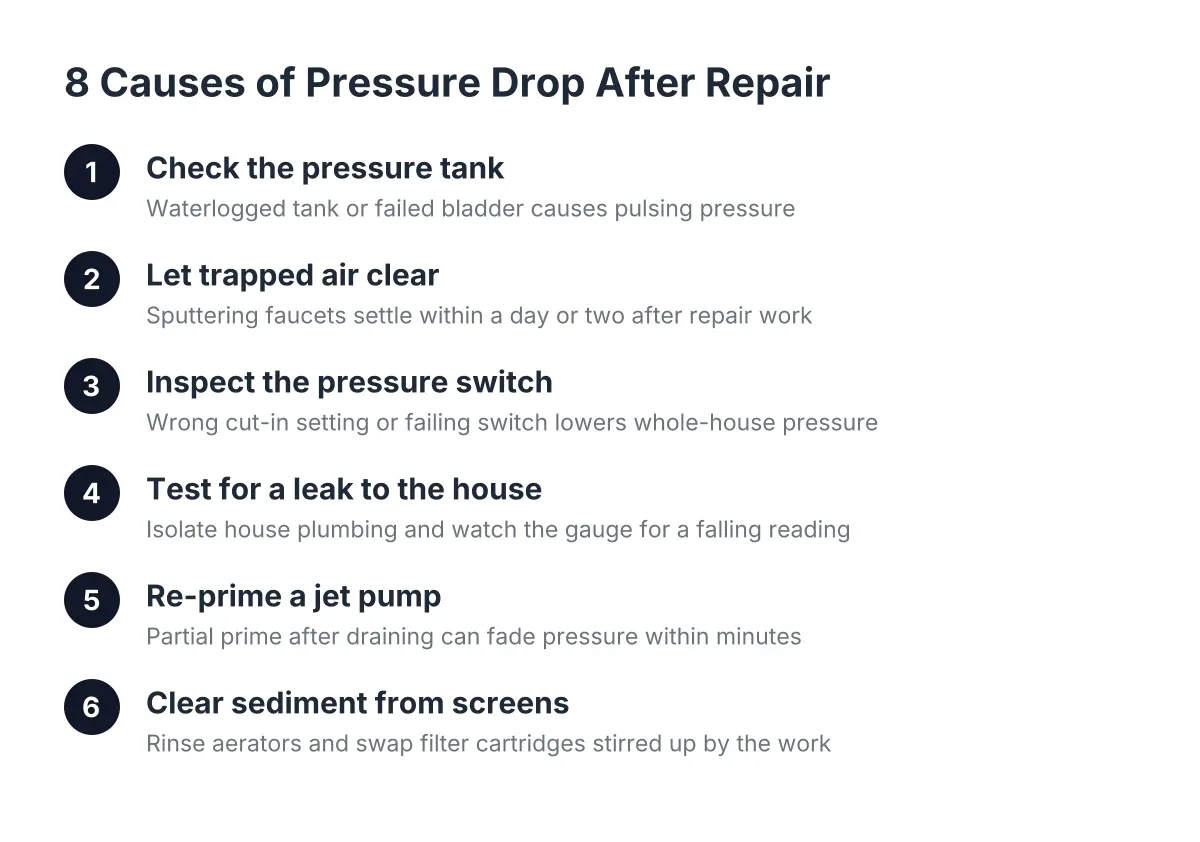
Here are eight reasons water pressure drops after pump work, roughly in the order a well and pump technician would check them, plus how to handle the warranty conversation without a fight.
1. The Pressure Tank Was Never Recharged or Has a Failed Bladder
A waterlogged pressure tank is the single most common reason pressure surges and drops after a pump repair. Residential well systems typically pair a submersible pump with a pressure tank, according to the Indiana Department of Health, and that tank does the steady-pressure work between pump cycles. If the tank's internal bladder has failed, the pump kicks on and off rapidly, and you feel it as pulsing pressure at the shower or kitchen sink.
Here is the catch: a new pump will not fix a bad tank. If the repair addressed only the pump, a tired tank can make the whole system feel broken again within days. Ask whoever did the work whether they checked the tank's air charge; a good pump and well repair visit includes that check as standard practice.
2. Air Is Still Working Its Way Out of the Lines
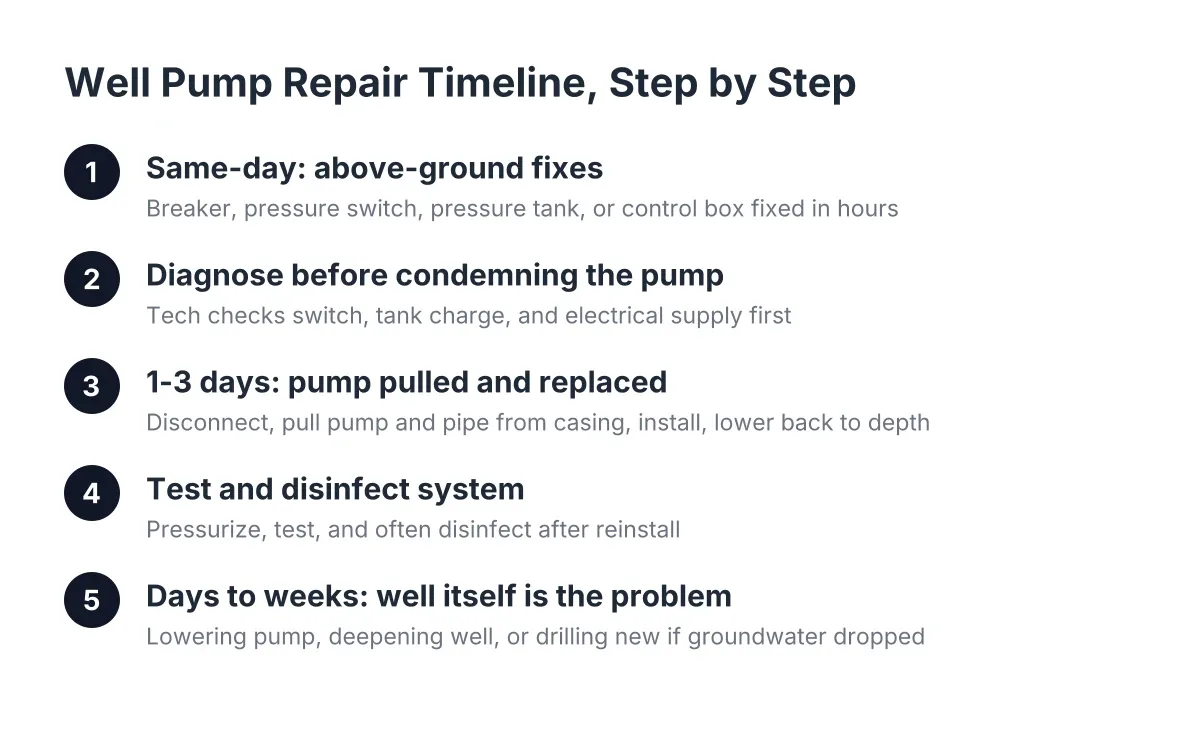
After any pump replacement or repair that opened the system, air gets trapped in the drop pipe and household plumbing. For the first day or so, faucets sputter, pressure jumps around, and the water may look milky before clearing in a glass. This is normal and resolves as you run water.
However, if the sputtering continues past a couple of days, air is getting in somewhere it should not, often through a leak in the drop pipe or a check valve problem. At that point it stops being a settling issue and becomes a callback issue. Note when it started and how often it happens; that detail helps the technician find it faster.
3. The Pressure Switch Is Set Wrong or Failing
The pressure switch tells the pump when to turn on and off. If it was replaced or disturbed during the repair and set to a lower cut-in point than before, your whole house runs at lower pressure than you were used to. That reads as a failed repair when it is really a five-minute adjustment.
A failing switch causes a nastier version of the same symptom. An intermittent switch can make the pump cycle on and off rapidly, which stresses the motor during its highest-draw startup phase. If you hear rapid clicking near the tank while water runs, shut the system down and call for service; continuing to run it can shorten the life of the pump you just paid for.
How Pressure Drop After Repair Relates to Switch Settings and Failures
Watch the pressure gauge next to the tank while someone runs a faucet. A steady climb to a set point, then a clean shutoff, suggests the settings are simply lower than before. Erratic clicking, pressure that never reaches the cutoff, or the pump hammering on and off every few seconds points to a failing switch or waterlogged tank.
4. A Leak Between the Well and the House
Sometimes a repair fixes the pump but reveals a leak that was hiding behind the old failure. If your water pressure drops after a few minutes of steady use and the pump seems to run constantly, water may be escaping between the wellhead and the house.
There is a simple test a technician will run, and you can understand it even if you do not do it yourself. Close the shutoff valve just downstream of the pressure tank to isolate the house plumbing, then watch the gauge. If pressure still falls with the house cut off, the leak is on the well side, in the drop pipe, pitless adapter, or supply line. If pressure holds, the problem is inside the house, which usually means a plumber rather than a well repair company.
5. A Jet Pump That Lost Its Prime
Not every well runs a submersible well pump. Older or shallower wells around Gresham, Boring, and Damascus sometimes use an above-ground jet pump, and jet pumps must stay full of water to move water. If the repair involved draining the system, a partial prime can produce decent pressure at first that fades to nothing within minutes.
Re-priming is a defined process: power off, priming cap removed, clean water poured in until it floods the suction line back to the source. On restart, the outlet valve gets cracked open slowly while watching the gauge; if pressure crashes to zero, the valve closes, pressure rebuilds, and the cycle repeats until the prime holds. If your installer skipped that patience, the symptom shows up as pressure that dies shortly after startup.
6. Sediment Stirred Up by the Work Is Clogging Screens and Filters
Pulling a pump stirs up the well. Fine sediment that settled over years gets suspended in the water column, and for a few days after the repair it lands in faucet aerators, whole-house filter cartridges, and the pump's own intake screen. Each clogged screen shaves off pressure at that fixture.
First, unscrew and rinse the aerators on your most-used faucets. Next, check any sediment filter cartridge; a repair week is a fair time to swap it even if it is not due. If pressure recovers after those two steps, you found the problem for the cost of a cartridge.
7. The Well Itself Is the Weak Link, Not the Pump
A new pump can only deliver what the well and the aquifer give it. If groundwater recovery in the well is slow, a strong pump can outrun the well, draw the water level down, and trigger low-flow protection. You experience it as good pressure that fades, then returns after the well rests, which mimics a bad repair.
This is not a rare Oregon problem. The U.S. Geological Survey reports about 1,220 domestic wells in Oregon went dry or fell below pumping capacity between June 2021 and December 2023, and the true number is likely higher since reporting is not mandatory. When the well is the limit, the fixes are different: lowering the pump setting, adding storage, or in some cases deeper well drilling. An aquifer and well depth assessment tells you which one applies before you spend more money on pump parts.
8. Confusing Normal Cycle Behavior With a Failing System
Every pressure-tank system has a built-in swing between the pump's cut-in and cut-off points. Pressure that dips when a toilet flushes while the shower runs, then recovers, is that cycle working as designed. If your old pump was failing slowly, you may have gotten used to constant weak pressure, and normal cycling now feels strange.
The tell is timing and consistency. Water pressure that drops after flushing a toilet and rebuilds within a minute is the pump cycle. Pressure that drops after a few seconds at every fixture, every time, and never fully recovers is a real problem worth a callback.
What Water Pressure Drops After a Repair Mean for a Warranty Callback
A pressure drop within days of a well pump repair almost always justifies a warranty call, and a reputable well and pump company expects them. The repair either needs adjustment, missed a second component like the tank or switch, or exposed a well problem that is a separate job. Your goal on the call is to sort out which, calmly and with notes.
Before you call, gather five things:
- The invoice, with the parts replaced and any warranty terms listed
- When the pressure problem started relative to the repair date
- Whether the drop is constant, or comes and goes with use
- The reading on the pressure gauge when the problem happens, if you can see it
- Any sounds near the tank, especially rapid clicking or nonstop pump running
Therefore, the conversation becomes specific instead of adversarial. "Pressure drops to a trickle after about three minutes of running the shower, the gauge falls below 20, and the pump never shuts off" gives a technician a diagnosis path before the truck rolls. A quality shop finished the original job by running the system, watching the tank build pressure, and checking every fitting for leaks; a follow-up visit repeats that process with fresh eyes.
One honest limitation: if the callback reveals the well itself is failing rather than the repair, that is new work, not warranty work. No pump warranty covers a declining aquifer. A written diagnosis explaining which side of that line you are on is a fair thing to ask for.
For Homebuyers: Why Repair History Belongs in Your Well Inspection
If you are under contract on a well property near Gresham, Sandy, Estacada, or Corbett, a recent pump repair on the disclosure deserves scrutiny, not reassurance. A repair receipt proves money was spent; it does not prove the system holds pressure, the tank is sound, or the well recovers fast enough for a family's use.
For example, say a buyer in Damascus finds "submersible pump replaced" on the seller's disclosure from eight months ago. A well inspection that includes a flow and pressure test, a tank and switch check, and well water testing turns that unknown into a documented report. According to Angi, a typical professional well inspection runs $250 to $550, which is small next to the cost of discovering a slow-recovering well after closing. For context, Angi also puts the national average well pump replacement at $1,898 based on 1,339 verified projects, with most homeowners paying between $975 and $2,821, so knowing the pump's real condition has direct negotiating value in 2026.
Water quality belongs in the same visit. A USGS study of 2,100 private wells found about one in five contained at least one contaminant above a human-health benchmark, according to the U.S. Environmental Protection Agency. Pressure tells you the system works; testing tells you the well water is safe to drink. Get both in writing before you sign, and you close on facts instead of the seller's word.
If you need well drilling, Clackamas Well Drilling can help.
Prefer to talk it through? Call (503) 782-5215 — a quick call is usually the fastest way to get a straight answer for your situation.