Submersible Pump Repair vs. Replacement: How to Make the Right Call in Gresham
Water Well Pump: Repair or Replace — Your Decision Guide
Your tenant just called, or you turned on the tap at your Sandy or Boring property and got nothing. The submersible pump down in your water well has quit, and now you face the question every well owner dreads: whether you need to repair or replace the pump. This guide walks you through the decision step by step, so you know what is actually wrong, what a fair fix looks like, and how to get water flowing again without paying for work you did not need.
This matters double if you own a rental property and manage it from a distance. You cannot stand at the wellhead and look at the pump yourself. Therefore, you need a clear process you can follow over the phone, plus the right questions to ask before you authorize anything in writing.
Step 1: Confirm the Problem Is Actually the Pump
Before anyone pulls a pump out of a well, rule out the cheap stuff. A surprising share of no-water calls turn out to be electrical, not mechanical.
Walk through this checklist yourself, or have your tenant do it while you are on the phone:
- Check the breaker panel. Find the breaker labeled for the well pump and see if it has tripped. Reset it once. If it trips again, stop; that points to a wiring or motor problem and repeated resets can make it worse.
- Look at the pressure switch. It is usually a small gray box near the pressure tank. If the contacts are burned or the switch is stuck, the pump never gets the signal to run.
- Check the pressure tank gauge. If the gauge reads normal pressure but no water comes out, the problem may be a valve or a frozen line, not the pump.
- Listen at the wellhead. A pump that hums or clicks but never builds pressure is telling you something different than a pump that is completely silent.
According to the Indiana Department of Health, residential well systems typically pair a submersible pump with a pressure tank that may sit in the well, the house, or a crawl space. Knowing where your tank is helps you troubleshoot faster, and it is the first thing to tell a repair company on the phone.
If the breaker holds, the switch works, and there is still no water, the problem is likely down the well. That is when you move to Step 2.
Step 2: Call a Well and Pump Professional for a Real Diagnosis
A submersible pump sits near the bottom of the well, sometimes hundreds of feet down, pushing water upward through multiple pump stages. Nobody can diagnose it from the surface with certainty. A pump and well repair crew will test the wiring at the wellhead, check amperage draw on the motor, and, if needed, pull the pump to inspect it.
Pulling a deep well pump is not a DIY job. The drop pipe, wiring, and pump together are heavy, and dropping the assembly down the well turns a repair into a recovery project. This is the point where even handy homeowners in Damascus or Estacada should hand it off. Attempting well pump repair yourself on the electrical side also carries real shock risk, since these are 240-volt circuits running into standing water.
For example, say you own a rental outside Estacada and your tenant reports no water on a Friday morning. In that scenario, a good company will talk your tenant through the breaker check by phone, schedule the visit directly with them, then call you with the diagnosis and a written estimate before touching the pump. You should never have to drive two hours just to stand in a driveway.
Step 3: Deciding to Repair or Replace Your Submersible Pump
When to Repair or Replace a Pump
Repairing rather than replacing a submersible pump makes sense when the failure is above the pump itself: a bad pressure switch, a failed check valve, a split drop pipe, or damaged wiring in the well. These parts fail more often than the motor does, and fixing them costs a fraction of a full pump swap. If the pump is under about ten years old and the motor tests healthy, repair is usually the right call.
Common repairable failures include:
- Pressure switch or control box failure at the surface
- Wire splice failure or chafed wiring inside the casing
- A leaking or broken drop pipe that lets water fall back down the well
- A stuck or failed check valve causing rapid on-off cycling
You may hear about a submersible pump repair kit for seals and small parts. Those exist, but they only pay off when the labor to pull the pump is already spent and the motor is sound. For a deep well, the pull itself is most of the cost, which changes the math.
When replacement is the smarter spend
Replacement wins when the motor windings have failed, the pump has run dry and overheated, or the unit is 15 to 20 years old. Here is the practical rule: once the pump is out of the ground, you have already paid the most expensive part of the job. Reinstalling an old, tired pump to save a few hundred dollars often means paying for the same pull again within a couple of years.
Sizing matters too. A common mistake is installing a pump rated for far less depth than the well requires, or oversizing depth while undersizing horsepower. Deep well water pumps have a hard limit on how far they can lift; a mismatched pump never delivers the pressure the system was designed for. If your current pump was wrong for the well, replacement is your chance to fix that permanently.
One reassuring point: submersible pumps are built for heavy, frequent running. You do not need to ration water to protect a properly sized pump. If yours failed young, the cause was likely sizing, sediment, or electrical trouble, not overuse. When you do decide to replace the pump, a professional can ensure the new unit matches your well's requirements exactly.
Step 4: Get the Cost Picture in Writing Before You Authorize Work
What does submersible well pump replacement cost?
Submersible well pump replacement runs about $1,898 on average nationally, with most homeowners paying between $975 and $2,821, according to Angi. Your actual price depends on well depth, pump horsepower, drop pipe condition, and how hard the pump is to access. Deeper wells cost more because pulling and setting the pump takes more labor and heavier equipment.
Repairs at the surface, like a pressure switch or control box, land at the low end of that range or below it. A full replacement in a deep well, with new drop pipe and wiring, lands at the high end or above. Ask for the estimate broken into pump, materials, and labor so you can see where the money goes.
For landlords managing from a distance, insist on three things before saying yes: a written estimate, photos of the pulled pump and any damaged parts, and a plain explanation of why replacement beats repair in your case. Any well repair company worth hiring near Gresham will do all three without being asked twice.
How long does submersible pump repair or replacement take?
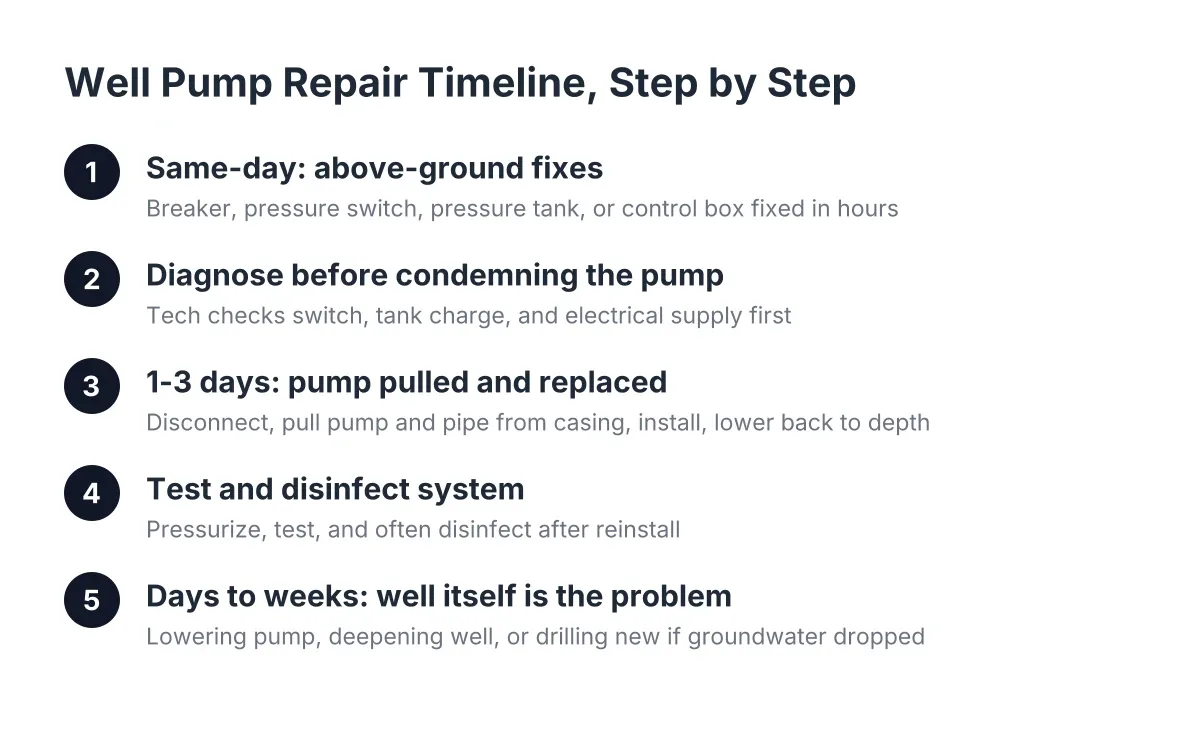
Most single-visit submersible pump repair and replacement jobs finish the same day once the crew is on site, assuming the replacement pump is in stock. Surface repairs like a switch or control box often take an hour or two. A deep pull with new drop pipe and wiring is a longer day, and an unusual pump size can add a parts wait.
Turnaround matters most when a tenant has no water. Tell the company up front that the property is a rental; a good one will coordinate access with the tenant directly and keep you in the loop by phone or text.
Step 5: Protect the New Pump and the Well
Once the repair or replacement is done, spend one more hour making sure it lasts.
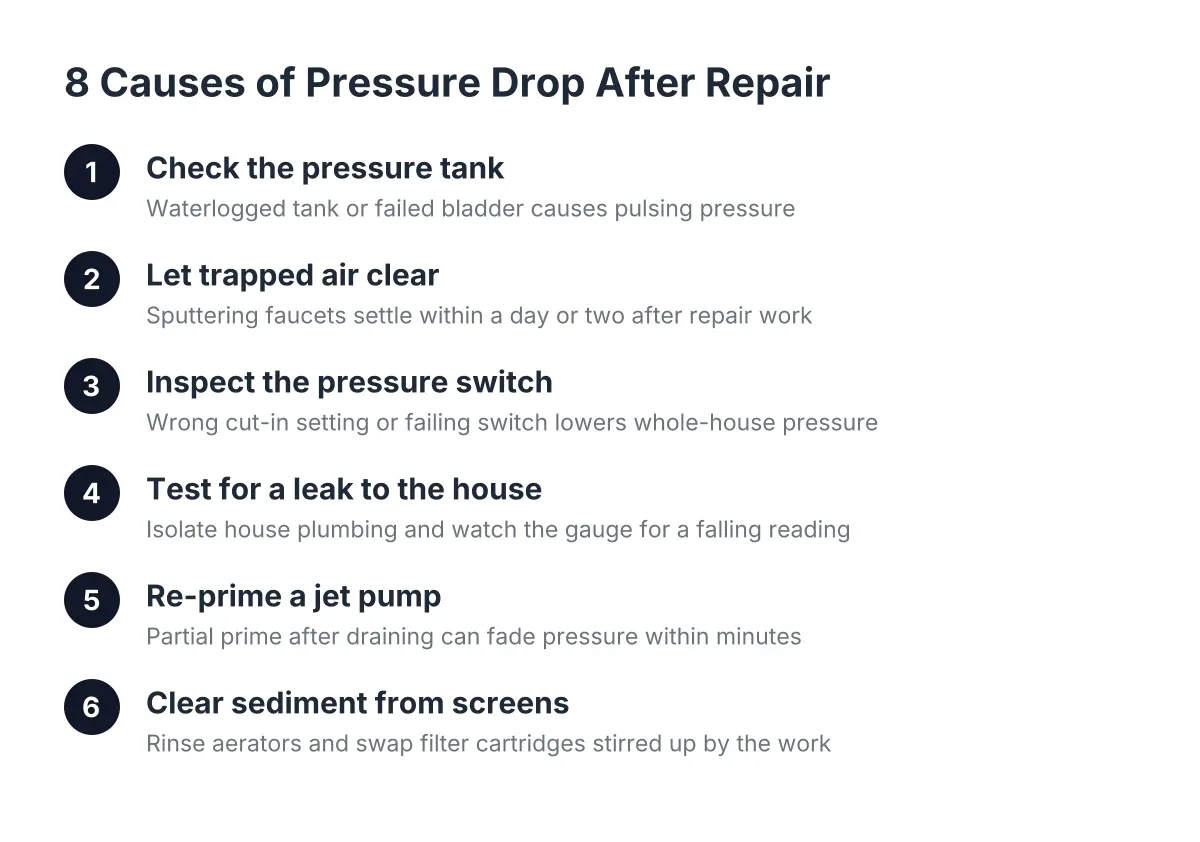
First, run the water hard for a while after the work. Reinstalling a pump stirs up sediment, and a new submersible pump agitates the water column with more force than the old unit did, which can dislodge iron buildup on the casing walls. Expect cloudy or rusty water briefly; flush it through an outside spigot, not your water heater.
Next, test the water. It is standard practice to sample well water after work in the well, and the CDC notes the well should be run extensively first so the sample reflects normal water quality. Well water testing after a pump job is cheap insurance, especially before a new tenant moves in.
In addition, one operating rule protects the pump for its whole life: never leave a submersible pump powered on with its output valve closed. Running against a closed valve with no flow can damage the pump. Keep the valve open any time the pump has power.
Finally, put the well on a schedule. Angi reports a typical professional well inspection costs $250 to $550, and annual well maintenance runs $200 to $900. For a rental, an inspection at tenant turnover catches a weakening pump before it becomes a midnight no-water call.
Step 6: Know When the Problem Is the Well, Not the Pump
Sometimes a pump keeps failing because the well itself is the problem. A dropping water level in the aquifer, heavy sediment, or a collapsing casing will kill pump after pump. If your well is decades old and this is the second or third pump failure, ask for an aquifer and well depth assessment before buying another pump.
At that point the comparison shifts from repair versus replacement of the pump to pump work versus a new well. Drilling a new well averages $5,500, with most projects between $3,000 and $9,000, according to HomeAdvisor. That is a bigger decision, and it deserves a well drilling company that will show you the groundwater picture for your property, not just quote a pump swap.
Around Gresham, Corbett, and the Clackamas County rural edge, well conditions vary from one road to the next, so no article can tell you exactly what your well needs. A proper well inspection can.
Get a Straight Answer Before You Spend Anything
If your pump has quit, or your tenant is calling about no water, the fastest path is a real diagnosis: breaker and switch check first, then a professional test at the wellhead, then a written repair-or-replace recommendation with photos and a cost breakdown. Reach out to a local Gresham well and pump service for an estimate. Whether the answer turns out to be a $150 switch or a full submersible pump replacement, you will know why before you approve it, and your water will be back on without guesswork.
If you need well drilling, Clackamas Well Drilling can help.
Prefer to talk it through? Call (503) 782-5215 — a quick call is usually the fastest way to get a straight answer for your situation.