Well Pump Repair Timeline: How Long Until Water Flow Is Restored in Oregon?
When the water stops, the first question is always the same: how long until it comes back on? The honest answer is that the well pump repair timeline depends almost entirely on what actually failed, and most people calling about a dead well pump do not know that yet. Some fixes restore water the same afternoon. Others take days. This article lays out the realistic timelines side by side, so whether you are a landlord with a tenant reporting no water in Boring or a buyer under contract on a well property near Sandy, you know what is fast, what is slow, and why.
One thing worth saying up front: a no-water call is not automatically a dead pump. In the Gresham and east Portland metro area, wells run through everything from shallow river sediment near the Sandy River to deeper drilled wells out toward Estacada and Corbett. The failure could be electrical, mechanical, or the well itself. Each of those has a different clock attached to it.
Why Well Pump Repair Timelines Vary So Much
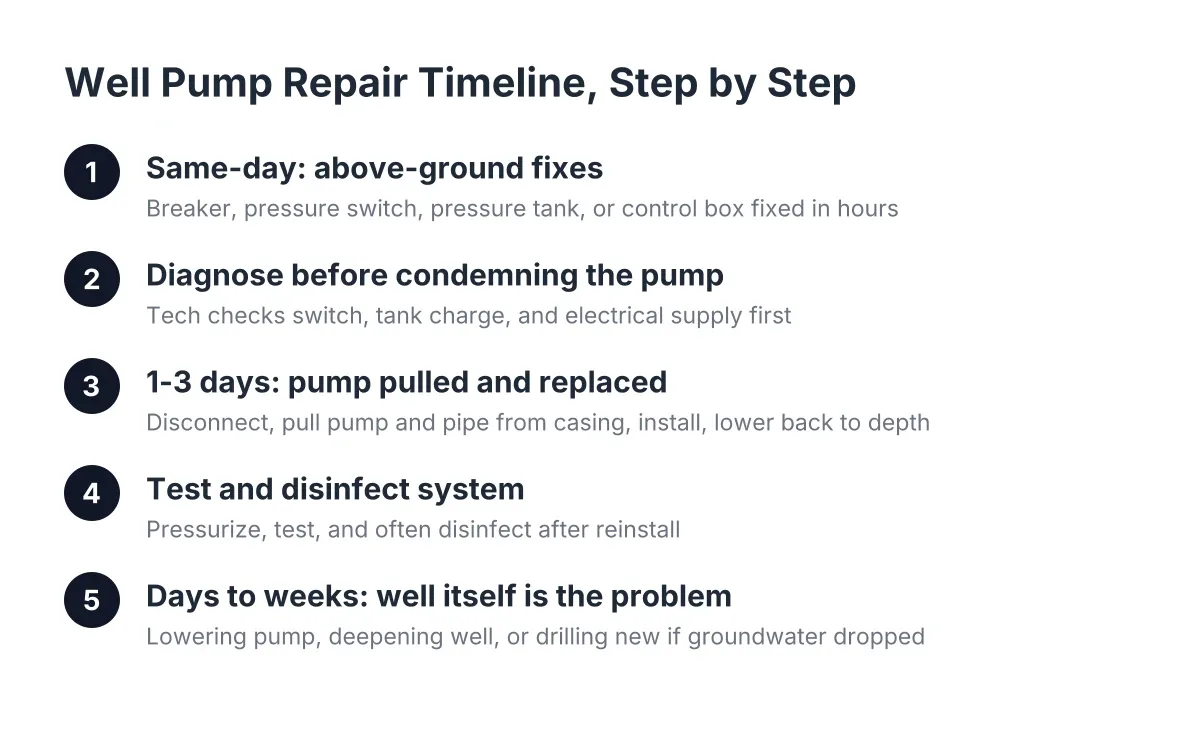
The well pump repair timeline for a typical Oregon home runs anywhere from an hour or two for a simple electrical fix to several days for a deep submersible pump replacement, and weeks in the rare case where the well itself is the problem. The single biggest factor is whether the failed part sits above ground or hundreds of feet down the well.
Above-ground components are fast. A pressure switch, a pressure tank, or a tripped breaker can usually be diagnosed and fixed in one visit. According to Indiana Department of Health, residential well systems typically use a submersible pump paired with a pressure tank, which may sit in the well, the house, or a crawl space. Everything in the house or pump house is reachable with hand tools.
Below-ground components are slow. Pulling a submersible pump means bringing equipment to the site, lifting the pump and its drop pipe out of the casing, replacing or repairing it, and setting it all back down. That is a half-day to full-day job in good conditions, and longer if the pump is deep, the access is tight, or a replacement pump has to be ordered.
Then there is the third category nobody wants: the well itself. If the pump is fine but the groundwater has dropped or the well is failing, no pump swap fixes it. The U.S. Geological Survey reported that about 1,220 domestic wells in Oregon went dry or fell below pumping capacity between June 2021 and December 2023, and the true number is likely higher since reporting is not mandatory. In that scenario you are talking about lowering the pump, deepening the well, or drilling new, and the timeline stretches from days to weeks.
Same-Day Fixes: The Failures That Resolve in Hours
Most no-water calls end with water restored the same day, because the most common failure points are the cheapest and most accessible parts of the system. If your well pump stopped working, these are the culprits a technician checks first:
- Tripped breaker or blown fuse. Sometimes it is that simple, though a breaker that keeps tripping points to a deeper electrical problem in the pump or wiring.
- Failed pressure switch. This small device tells the pump when to turn on and off. It is a frequent failure point and a fast swap.
- Waterlogged pressure tank. When the tank loses its air charge, the pump short-cycles, pressure surges and drops, and eventually something quits. Replacing a tank is usually a same-day job.
- Failed capacitor or control box. For many submersible setups, the control electronics sit above ground and can be replaced without touching the pump.
- Frozen or broken pipe between the well and the house. Common after a cold snap out toward Corbett or Estacada, and often fixable in a visit.
For example, say a landlord in Damascus gets a tenant call on a Monday morning: no water, breaker looks fine, pump was making a clicking noise before it quit. In that hypothetical, a burned pressure switch is the likely finding, and water is back on before the tenant gets home from work. The visit might run a couple hundred dollars in parts and labor, framed here as a rough illustration, not a quote.
The lesson for a multi-property owner is that a fast, accurate diagnosis is worth more than a fast promise. A tech who checks the pressure switch, the tank charge, and the electrical supply before condemning the pump can save you a four-figure replacement you did not need.
Multi-Day Repairs: When the Pump Itself Has to Come Out
Pulling and replacing a submersible well pump typically takes several hours to a full day of on-site work once the crew and parts are lined up, so a realistic start-to-finish window is one to three days from the first call. How long it takes to replace a well pump depends on pump depth, wire and pipe condition, and site access.
The physical work breaks down like this. First, the crew disconnects power and plumbing at the wellhead. Next, they pull the pump, drop pipe, and wiring out of the casing, which for a deep well is a serious lift that may need a pump hoist truck. Then the new pump goes on, gets wired and taped, and is lowered back to depth. Finally, the system is pressurized, tested, and often disinfected.
Scheduling is the hidden variable in well pump repair timelines. The pull itself might take four hours, but if the right pump for your well's depth and flow needs is not on the truck, ordering one adds a day or more. Rural access matters too. A well up a gravel drive outside Estacada in January is a different job than one beside a paved driveway in Gresham.
Two things people ask after the swap. What to do after replacing a well pump: run the water heavily to flush any disinfectant and sediment before drinking it, and consider a water test once things settle. According to CDC, it is standard practice to run a well extensively before sampling so the test reflects normal water quality rather than lingering disinfectant. And how long is a well pump warranty: manufacturer warranties vary by brand and model, commonly running a few years on the pump itself, so ask for the paperwork and keep it with your property records.
On cost, the national average well pump replacement runs $1,898 based on 1,339 verified projects, with most homeowners paying between $975 and $2,821, according to Angi. Your number depends on pump depth, pump type, and what else needs replacing while the well is open, such as aged drop pipe or wire.
Weeks, Not Days: When the Problem Is the Well, Not the Pump
A well problem instead of a pump problem stretches the timeline from days to weeks, because the fix may involve lowering the pump, rehabilitating the well, or drilling a new one. This is the outcome nobody wants to hear during a no-water emergency, but pretending it is a pump issue just burns money.
The tell is usually the pattern of failure. A pump that runs but delivers weak, sputtering, or intermittent water, especially in late summer, may be pulling from a well whose water level has dropped. Decreased pressure, inconsistent supply, or a pump that cycles and shuts off to protect itself are all signs worth taking seriously. Some modern constant pressure systems shut the pump down automatically when they sense the well running low, which protects the pump and gives the aquifer time to recover.
Oregon does watch its groundwater closely. The Oregon Water Resources Department maintains more than 400 state observation wells and measures more than 1,200 additional wells to track aquifer conditions across the state. However, conditions vary from one rural road to the next, so what your neighbor's well does is not proof of what yours will do.
If drilling new becomes the answer, budget both money and calendar time. Homeowners spend an average of $3,000 to $9,000 to drill a well, with an average around $5,500, according to HomeAdvisor. Drilling itself may take days, but permitting, scheduling, casing, pump installation, disinfection, and water testing add up, and the full process can span weeks or longer. According to San Diego County Department of Environmental Health, a newly drilled well is disinfected with chlorine and must be run heavily afterward to flush the residue before regular use, which adds time before the water is truly ready.
What This Means If You Are Buying or Renting Out a Well Property
For a buyer under contract or a landlord evaluating a rental, the timeline question flips: you are not asking how fast water comes back, you are asking how likely it is to go out. A documented well inspection before closing answers that. It tells you the pump's approximate age and condition, how the system performs under load, and whether the pressure tank and controls are near the end of their run.
That matters because pump age is the best predictor of your future repair calendar. Suppose you are inspecting a rental near Oregon City and the submersible pump is 18 years old with an original pressure tank. Nothing is broken today, but you are buying a multi-day pump replacement sometime in the next few years, and possibly a mid-tenancy no-water call. Knowing that before closing lets you negotiate or budget instead of guessing.
The cost of that certainty is modest against the alternative. A typical professional well inspection runs $250 to $550, according to Angi, and annual well maintenance for owners generally lands between $200 and $900. For a landlord with several well-served properties, an annual inspection cycle turns emergency well pump repair into planned well and pump service, which is the difference between a scheduled Tuesday visit and a vacant unit.
One honest limitation: no inspection can promise a pump's exact remaining lifespan, and no article can diagnose your specific well from symptoms alone. Electrical faults, low water, and mechanical wear can mimic each other, and working on well electrical systems is genuinely dangerous. If your water is out or fading, have a qualified pump and well repair professional put eyes on the system before you buy parts or agree to a full replacement.
How to Read Your Own Situation
Match your symptoms to the likely timeline before you panic:
- No water, pump silent, breaker tripped or clicking sounds before failure: likely electrical or pressure switch. Expect a same-day fix in most cases.
- Pressure surging and dropping, pump turning on and off rapidly: likely a waterlogged pressure tank. Usually same-day.
- Pump runs constantly but pressure is weak, or water sputters with air: could be a worn pump, a leak in the drop pipe, or a dropping water level. Expect a pulled pump and a one-to-three-day window, longer if the well itself is the issue.
- Water declines every late summer and recovers in winter: watch the well, not the pump. Get a well inspection and flow assessment before spending on hardware.
The pattern across all four is the same. The parts you can see fail fast and fix fast. Additionally, the parts down the well take days. Furthermore, the water under the ground takes weeks. Knowing which category you are in before anyone quotes you a repair is the whole game, and it is exactly what an honest diagnosis, whether during an emergency or a pre-purchase well inspection, should give you.
If you need well drilling, Clackamas Well Drilling can help.
Prefer to talk it through? Call (503) 782-5215 — a quick call is usually the fastest way to get a straight answer for your situation.