Well Drilling Permits and Regulations in Gresham, OR: Setbacks, Testing, and What to Expect
If you own land or a rental property on the rural edge of Gresham, OR, the paperwork side of a new well matters as much as the drilling itself. Well drilling permits and regulations decide where the well can go on your lot, how it must be built, and what testing has to happen before anyone drinks the water. Get them right and the project moves in order. Get them wrong and you can end up with a well the county flags during a sale, a tenant turnover, or a refinance. This guide walks through the permit process, the well setback rules that control well placement, the water testing requirements, and how all of it fits into your budget and timeline, written from how projects actually run in Clackamas and Multnomah County, not from a generic national checklist.
Why Permits and Regulations Shape the Whole Project
Here is the part most first-time well owners miss: the permit is not a formality you handle after you pick a drilling spot. In Oregon, the rules work the other way around. The regulations tell you where the well is allowed to be, and that location drives everything else, including how far the water line runs to the house, where the pressure tank sits, and sometimes how deep the drill has to go to find clean groundwater.
Oregon treats groundwater as a public resource. The state tracks it closely; according to the Oregon Water Resources Department, the Groundwater Hydrology Section maintains more than 400 state observation wells and measures more than 1,200 additional observation wells across the state to keep tabs on aquifer conditions. That level of oversight is why the paperwork exists. The state wants every new well built so it does not contaminate the aquifer that your neighbors, and your future tenants, also depend on.
For a landlord managing a Boring or Damascus rental from two hours away, this is actually good news. The rules create a paper trail. A well with a proper start card, a recorded well log, and a passing water test is a well you can verify without standing next to the rig. The documents do the supervising for you.
How Well Drilling Permits and Regulations Work in Oregon
Oregon handles well permitting differently than many states, and differently than the septic side of your project. For a standard domestic well, the state does not issue a permit to you, the property owner. Instead, the licensed well driller files a start card with the Oregon Water Resources Department before drilling begins, pays the state fee, and later files a well log that records how the well was built.
That has two practical consequences worth understanding before you sign a contract:
- The drilling company carries the state paperwork. You should never be asked to chase the state filing yourself; if a contractor suggests otherwise, that is a flag worth questioning.
- The well log becomes a permanent public record. It documents depth, casing, seal, and yield. For a rental property owner, that log is your proof the work happened as described, and it follows the property through every future sale.
County rules layer on top of the state rules. On the Gresham edge, that usually means Clackamas County or Multnomah County, depending on which side of the line your parcel sits. The counties get involved most heavily when a well and a septic system share the same parcel, which is nearly every rural property out here. Septic siting approval and well siting have to agree with each other, and the county reviews the distances between them.
In addition, most new domestic wells in this area use an exempt groundwater right. In plain English, Oregon lets a single household pump a limited amount of groundwater for domestic use without applying for a formal water right. Your driller can confirm your intended use fits the exemption. Larger projects, like a commercial well drilling job serving multiple buildings, can trigger more review, which is one reason to bring the well drilling company in early rather than after plans are drawn.
Well Setback Rules: Where the Well Can Actually Go
Setbacks are the distance rules that keep contamination sources away from your drinking water. They are the single biggest constraint on well placement for small rural parcels around Sandy, Boring, Damascus, and Estacada, where an acre lot has to hold a house, a driveway, a septic tank, a drainfield, and a well all at once. Understanding the well setback rules governing your property helps avoid costly placement mistakes.
The exact distances come from Oregon well construction standards and county health rules, and they vary by the type of hazard. Rather than memorize numbers that can change, understand the categories a siting review looks at:
- Septic tanks and drainfields, both yours and your neighbors'. The drainfield, including its designated replacement area, usually controls the layout more than the tank does.
- Property lines, so your well does not box in a neighbor's future septic repair area.
- Buildings, foundations, and sealed surfaces that would block access for future pump and well repair work.
- Livestock areas, barns, and manure storage.
- Fuel tanks, chemical storage, and old underground tanks on former farm parcels.
- Streams, ditches, ponds, and areas that flood, since surface water carries bacteria straight down an improperly sealed borehole.
Suppose you own a one-acre rental in Damascus with an aging septic drainfield near the back fence and a shop building on the side yard. On paper the lot has room for a well almost anywhere. Once you draw the setback circles around the drainfield, its replacement area, the neighbor's drainfield across the fence, and the fuel tank behind the shop, the legal drilling area might shrink to one corner of the front yard. In that scenario the setbacks just decided your well location, your trench route, and part of your cost, before a rig ever showed up.
This is why an experienced well contractor walks the property, or reviews the septic records and site plan, before quoting a drilling location. Siting the hole is a regulatory exercise first and a geology exercise second. A beautiful drilling spot that violates a setback is worthless.
What Happens If a Setback Cannot Be Met
On a tight parcel, sometimes no spot satisfies every distance on paper. Counties have variance processes for genuinely constrained lots, and well construction standards allow certain protective measures, like extra casing and deeper sealing, to compensate in specific cases. However, variances take time and are not guaranteed. If your parcel is small, oddly shaped, or surrounded by neighboring drainfields, build extra weeks into the schedule and confirm siting is approved in writing before you commit construction money that depends on the well.
Construction Standards the Driller Must Follow
Oregon's well construction standards control how the hole itself gets built, and they exist to protect the aquifer from surface contamination. You do not need to know the rulebook line by line, but you should know what the big requirements are so the well log makes sense when you read it.
First, the casing and seal. The upper portion of the borehole gets steel casing surrounded by a cement or bentonite seal, which blocks surface water from trickling down the outside of the pipe. When the drill passes through soil and loose rock and hits bedrock, standard practice is to continue into solid rock to create a proper socket for the casing; according to the New Hampshire Department of Environmental Services, drillers plan on at least about 10 feet into bedrock to get past dirty surface water and seat the casing correctly. Oregon's rules follow the same logic. Grouting the seal is often scheduled promptly once the borehole reaches a stopping point, especially when an inspection is expected.
Second, the wellhead. The finished well must stick up above grade with a sanitary cap, and the ground should slope away so rainwater drains off rather than pooling around the casing. Newly disturbed ground around the wellhead should settle for a few days before anyone grades or landscapes over it.
Third, identification and disinfection. Standard completion includes attaching a well identification tag and chlorinating the well before the final seal goes on. According to the San Diego County Department of Environmental Health, the driller disinfects the well and pump components with bleach or chlorine, and the well then gets run heavily to flush the chemical taste and residue out before regular use. If your tenant reports a chlorine smell the first week after a new well goes in, that is the disinfection doing its job, not a problem.
Finally, the pump system has its own code requirements. A typical setup on these parcels is a deep well submersible pump feeding a pressure tank; according to the Indiana Department of Health, residential systems typically pair a submersible pump with a pressure tank located in the well, the house, or a crawl space depending on the layout. Electrical work for the well pump motor has to meet code, and the pitless adapter, the fitting that lets the water line exit the casing below frost depth, must be installed to standard. There is no single best submersible well pump for every property; the right unit depends on well depth, yield, and household demand, which is why well pump installation is sized to the well log rather than picked off a shelf.
Water Testing Requirements Before the Well Goes Into Service
Water testing is the final regulatory gate, and for a landlord it is also your liability protection. A new well is not done when water comes out of the ground. It is done when a lab says the water is safe.
According to the CDC, it is standard practice after drilling a new well to take a water sample for testing, and the well should be run extensively first so the sample reflects normal water quality rather than lingering disinfectant. In practice that means the chlorination from completion gets flushed out, then a sample goes to a lab, typically checking at minimum for coliform bacteria, nitrates, and arsenic, which are the core concerns for Oregon domestic wells. Oregon also requires well water testing at the point of sale for properties with domestic wells, so the lab report you get now is the same kind of document a future buyer will ask for.
For a rental, do not stop at the legal minimum if the property has history. A parcel with decades of farm use, an old orchard, or a buried fuel tank justifies a broader test panel. The cost of extra lab work is small next to the cost of a tenant habitability complaint over water quality.
A Note for Owners Managing From a Distance
Everything in the regulatory process produces a document: the start card, the well log, the yield information, the lab report. Ask for all of them in writing, and ask the contractor to photograph the finished wellhead, the pressure tank installation, and the well tag. Then you can confirm the work matches the paperwork from your kitchen table two hours away, keep your tenant informed with specifics instead of guesses, and hand a clean file to your property manager or a future buyer.
What Permits, Testing, and Compliance Add to the Cost
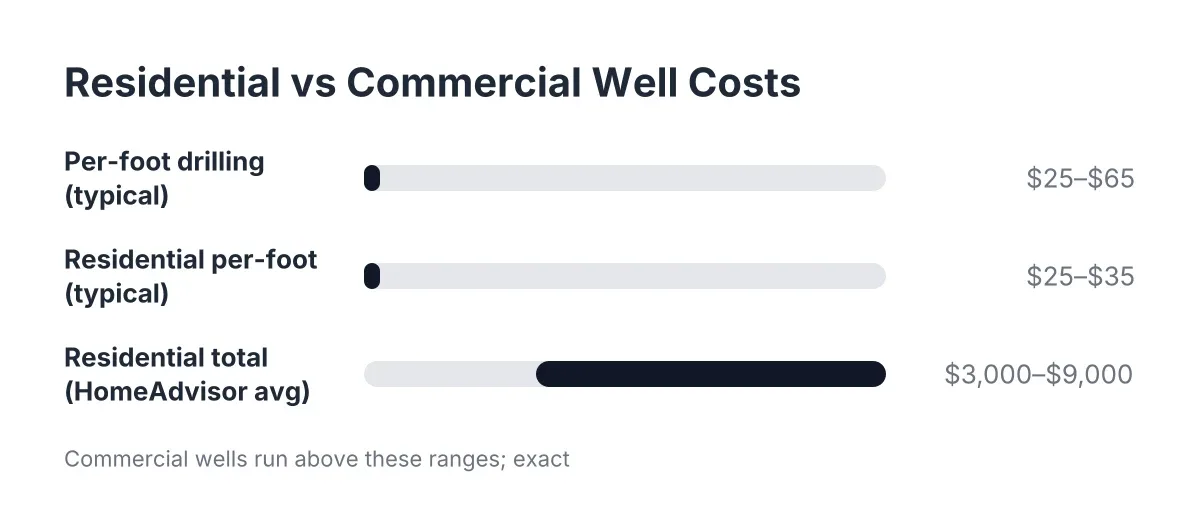
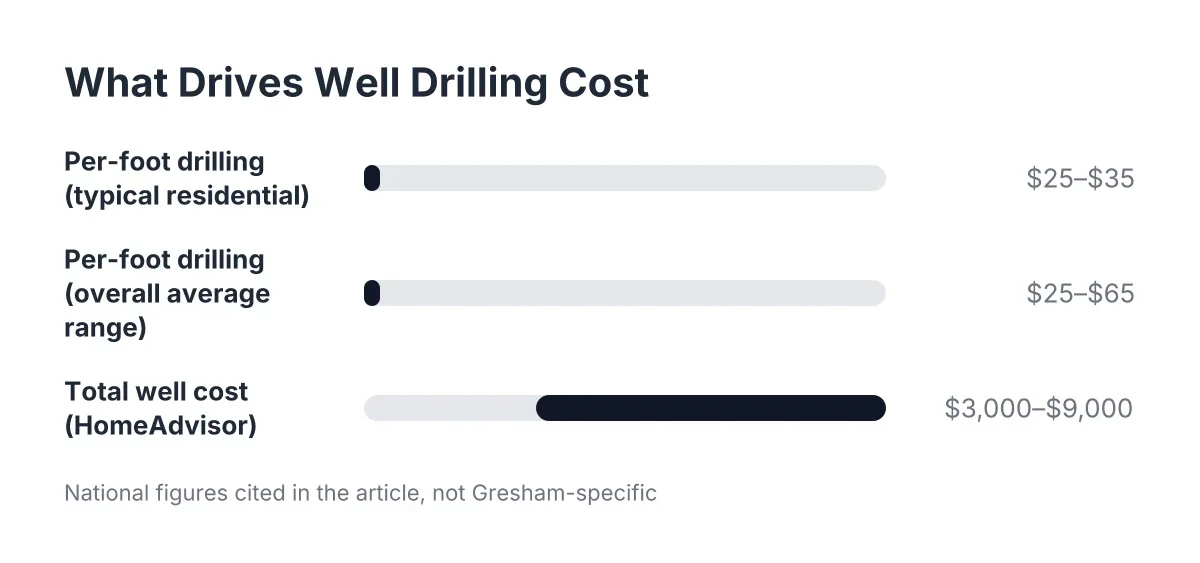
The regulatory items are a small slice of the total project, but they are real line items and they belong in your budget. For context on the whole number: homeowners spend an average of $3,000 to $9,000 to drill a well, with an average around $5,500, according to HomeAdvisor, and Angi puts typical drilling at $25 to $65 per foot, with $25 to $35 per foot as a common residential guideline. Forbes lands in the same range, with an average of $5,625 and most projects between $3,000 and $9,000. Treat those as national reference points; wells on the Gresham edge often run deeper than the national average parcel, and depth is the main cost driver, so local new well installation budgets frequently land above those figures.
Against that backdrop, the compliance costs are modest and predictable:
- The state start card fee, filed by the driller and usually built into the drilling quote.
- County siting or septic coordination fees, which apply when the well and septic layout need review together.
- Lab fees for the water test panel, which scale with how many contaminants you test for.
- Occasionally, variance application costs on constrained lots.
Where regulations really move the budget is indirectly, through placement and depth. A setback that pushes the well 150 feet farther from the house adds trenching, wire, and pipe. Rules that require deeper casing and sealing in loose ground add footage at the drilled rate. Therefore, when you compare quotes, make sure each well drilling company near you is bidding the same compliant location, not just the same hole. A cheaper bid based on a spot the county will reject is not cheaper.
How the Regulatory Steps Fit the Project Timeline
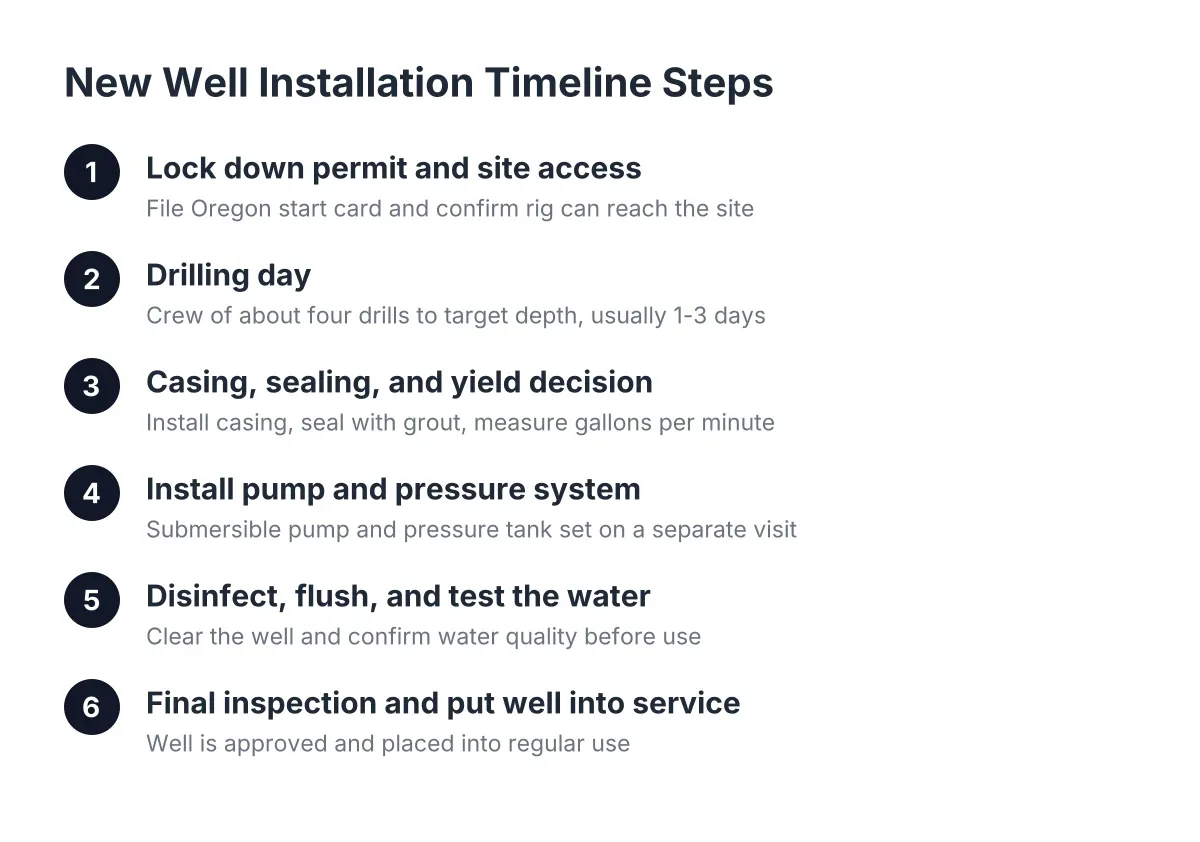
The paperwork threads through the whole job rather than sitting at the front. A realistic sequence for a parcel outside Gresham looks like this:
- Site evaluation. The contractor reviews septic records, walks the parcel, and identifies the legal drilling zone that satisfies every setback.
- Start card filed with the state before the rig arrives.
- Drilling and construction to Oregon standards, with casing, sealing, and grouting completed as the hole progresses.
- Completion. Well tag attached, well chlorinated, final seal installed, and the well log filed with the state.
- Pump system installation and yield confirmation.
- Flushing and water testing, with the lab report in hand before the water serves a household.
Plan for the full process to take longer than the drilling itself. Drilling may finish in days, but siting review on a tight lot, follow-up visits to finish the pump system, and lab turnaround stretch the calendar, and some projects span weeks or months end to end. On raw land, drilling the well before finalizing house plans is a sound move; proving water exists, and knowing what it cost to reach, tells you what the rest of the construction budget has to absorb.
One honest limitation: no article can clear your specific parcel. Setback measurements, county jurisdiction, septic records, and variance questions are property-specific, and the only reliable answer comes from a site evaluation by a licensed professional who can read your actual records and walk your actual ground. Use this guide to ask sharper questions, not to skip that step.
Questions to Ask Before You Sign a Drilling Contract
The regulations around well drilling, permits included, give you a ready-made checklist for vetting contractors. A company that handles Clackamas and Multnomah County wells regularly will answer these without hesitation:
- Who files the start card and the well log, and will I get copies?
- Have you confirmed the proposed location meets every setback, including the septic replacement area and neighboring systems?
- What does your quote assume about casing depth and sealing, and how does the price change if conditions differ?
- Is disinfection, flushing, and a lab water test included in the completion, and which contaminants does the panel cover?
- For a rental, will you coordinate access with my tenant and send me photos and documents directly?
Clear answers to those questions tell you more about a contractor than any advertisement. The well drilling permits and regulations in this area are not obstacles; they are the checklist that lets an owner in Gresham, or two hours away from it, know the water under their property was developed right, documented fully, and tested before anyone turned on a tap.
If you need well drilling, Clackamas Well Drilling can help.
Prefer to talk it through? Call (503) 782-5215 — a quick call is usually the fastest way to get a straight answer for your situation.