Gresham Well Drilling Depth: Why Costs Vary From Sandy to Boring to Damascus
If you are pricing a new well around Gresham, you have probably noticed that nobody wants to give you a straight answer. Here is the honest reason: Gresham well drilling depth changes from one road to the next, and depth is the single biggest line on the bill. A property near Sandy can sit over different ground than one in Boring or Damascus, and that difference shows up in how far the rig has to go before it finds reliable water. This guide walks you through how to plan a new well on your land, step by step, so you understand what drives the price before you commit.
This matters whether you own bare land and plan to build, or you are under contract on a home with a private well and you want to know what a replacement well would cost if the inspection turns up problems. Knowing the depth question gives you a real negotiating position instead of a guess.
Step 1: Understand Why Depth Drives the Price of a New Well
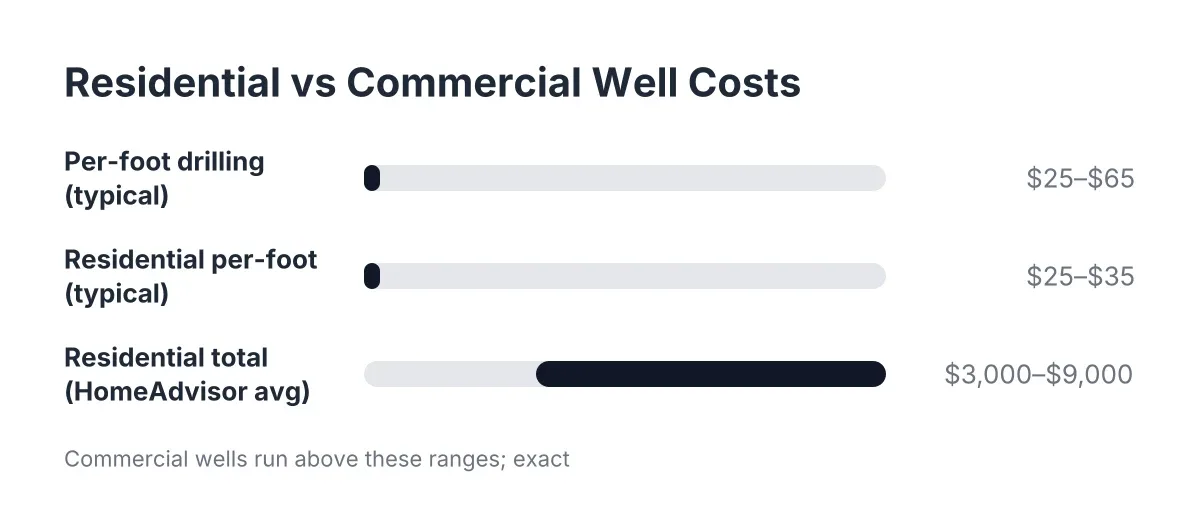
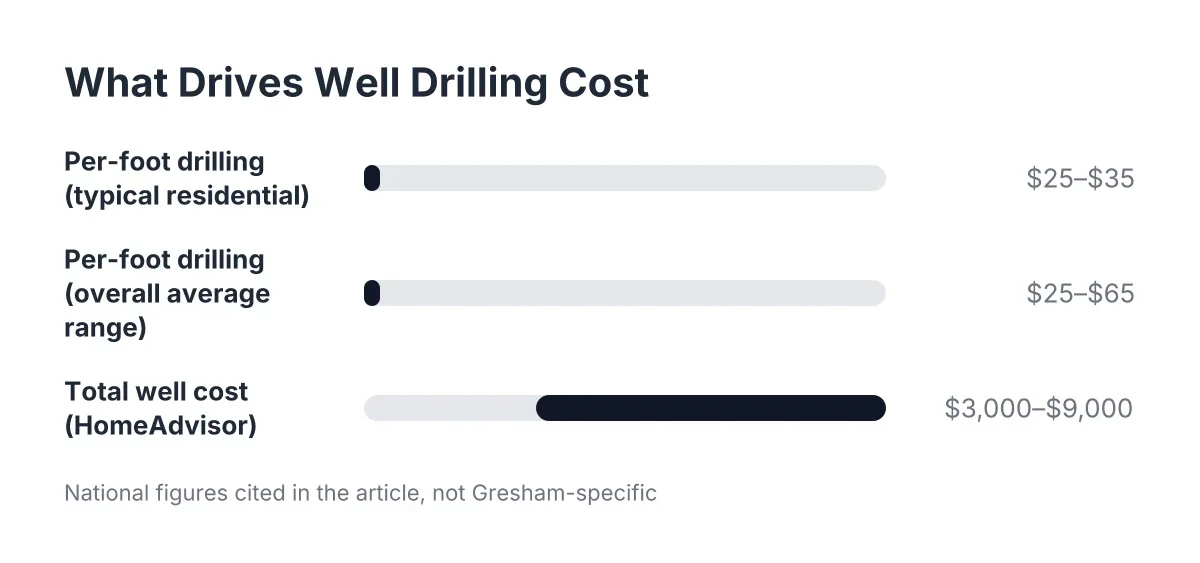
Before anything else, get clear on the math. Most well drilling is billed by the foot, so the depth to usable groundwater sets most of your cost. According to Angi, the average cost to drill a well runs $25 to $65 per foot, with $25 to $35 per foot as a typical guideline for most residential projects. HomeAdvisor puts the total for most homeowners between $3,000 and $9,000, with a $5,500 average. Forbes lands in the same range, with an average cost of $5,625.
Those are national figures, not Gresham quotes, but they show the pattern. Double the depth and you can come close to doubling the drilling portion of the bill. That is why two neighbors a mile apart can get estimates that look nothing alike.
Four variables set the final number on nearly every job:
- Depth to the water table at your specific site
- Site geology and access, meaning what the rig has to drill through and whether it can reach the spot
- Drilling difficulty, since soft soil drills faster than clay or solid rock
- The risk of a dry or low-producing hole that forces drilling deeper or moving the rig
Everything else in your planning flows from these four. Keep them in mind as you work through the next steps.
Step 2: Learn How Gresham Well Drilling Depth Varies by Location
The Gresham area is not one kind of ground. The rural edge of the east Portland metro, including Sandy, Boring, Damascus, Estacada, Corbett, and Oregon City, sits on a mix of volcanic rock, clay layers, and looser soils, and those layers change over short distances. One parcel might reach water through mostly soft material. The parcel down the road might require grinding through dense rock for a long stretch before the bore produces anything.
As a result, no honest driller can quote a firm total before knowing your site. What a good one can do is pull well logs from nearby properties. Oregon keeps records of drilled wells, and the Oregon Water Resources Department tracks aquifer conditions across the state through more than 400 state observation wells, plus more than 1,200 additional wells it measures. Neighboring well logs are the closest thing to a preview of your own Gresham well drilling depth, because they show what rigs actually hit a few hundred yards from your property line.
Therefore, your action item in this step is simple: before you sign anything, ask any well drilling company near me search turns up one question. What do the well logs on neighboring parcels show for depth and flow? A contractor who works this area regularly should be able to walk you through that answer in plain English.
Step 3: Confirm You Have Water on Your Property
"Do I have water on my property" is the question behind every new well, and nearby well logs are the best early evidence. However, the only way to know for certain is to drill. Groundwater does not follow property lines neatly, and a productive aquifer under one lot can thin out under the next.
If you are buying land for new construction, consider having the well drilled before you commit the rest of your building budget. Drilling first tells you what water access will cost while you can still adjust your plans. Suppose a buyer is looking at two similar lots near Damascus, and neighboring logs suggest one sits over shallower water than the other. In that scenario, drilling the well early on the chosen lot could confirm the budget before the foundation is ever poured, instead of discovering a deep, rocky bore after the house plans are locked in.
One honest caution here: even a borehole drilled to full planned depth can produce disappointingly little water if it has not reached a productive water-bearing zone. When a rig reaches its practical limit without adequate flow, the driller measures what the well produces and the decision to stop or keep going lands on you. Budget a cushion for that possibility rather than planning to the dollar.
Step 4: Handle Permits and Pick the Well Site
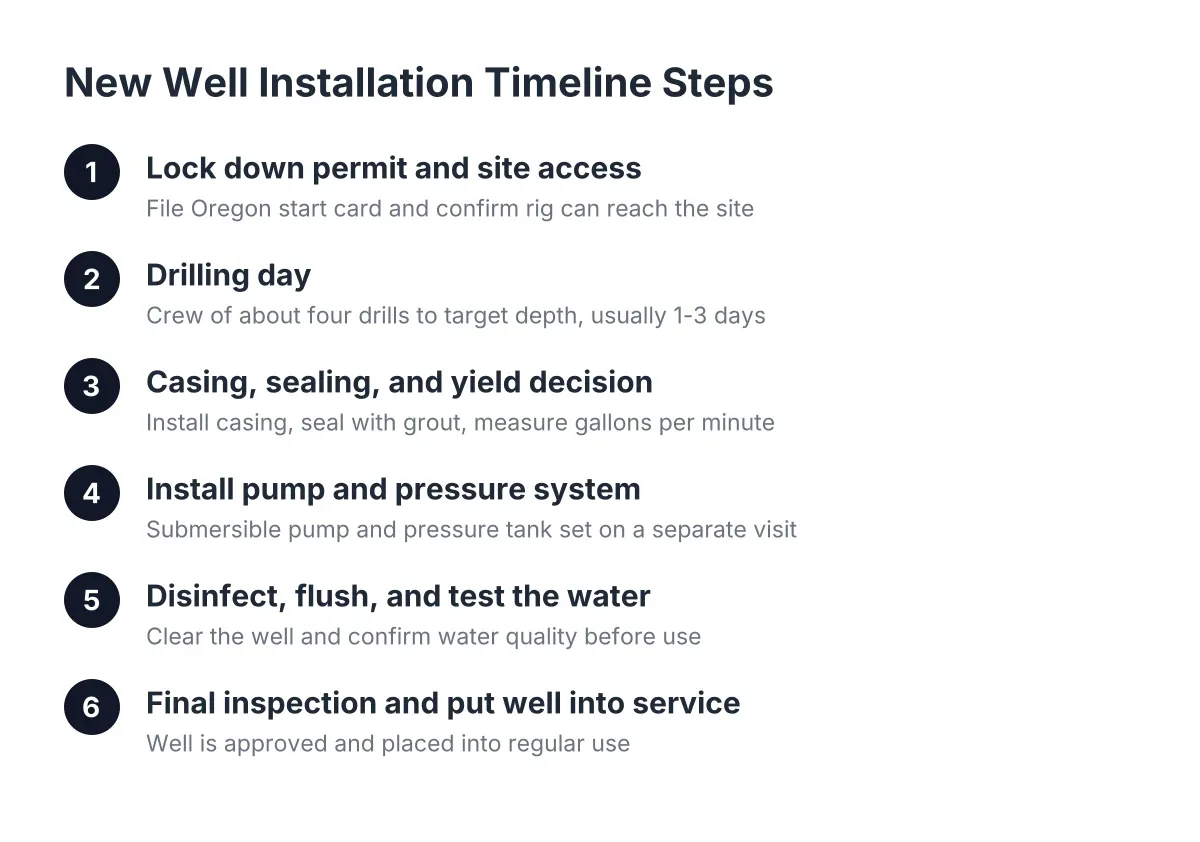
Oregon requires new water wells to be drilled by a licensed contractor and reported to the state, and your drilling contractor typically handles the start card and well report paperwork as part of the job. Confirm that paperwork is included in the quote, because the well log filed with the state becomes the permanent record of your well. If you ever sell the property, a buyer's well inspection will lean on that document.
Siting matters as much as paperwork. The well needs required setbacks from your septic system, property lines, and other contamination sources, and the rig needs room to set up and work. A typical residential crew is small, often around four workers with a standard drilling rig, but that rig is heavy equipment that needs real access. In addition, a flat, reachable site can shave cost, while a steep or tight site adds time and money.
If bedrock sits near the surface at the best legal spot, the driller may have to work through it rather than around it. That is a geology cost, not a contractor markup, and it is one more reason Gresham well drilling depth and difficulty vary parcel to parcel.
Step 5: Know What Happens During Drilling, and Why Drillers Go Past First Water
Hitting water is not the finish line. Drillers continue past the first water-bearing zone for two reasons: to confirm the flow rate holds steady rather than fading, and to add depth that gives sediment room to settle and leaves margin if the water table drops in a dry year.
That margin is not theoretical in Oregon. According to the U.S. Geological Survey, about 1,220 domestic wells in Oregon went dry or fell below pumping capacity between June 2021 and December 2023, and the true number is likely higher since reporting is not mandatory. A well drilled with extra depth and honest flow testing is cheaper than re-drilling a marginal one later.
There is also a structural reason depth matters. When the bit passes through soil and hits bedrock, standard practice is to drill at least about 10 feet into that rock, according to the New Hampshire Department of Environmental Services, to seal out dirty surface water and create a proper socket for the casing. Casing, the steel pipe lining the upper bore, is another per-foot cost that rises with depth.
Step 6: Plan the Pump, Pressure Tank, and Water Testing
Drilling the hole is roughly half the project. A working water system also needs well pump installation, a pressure tank, wiring, and a line to the house. Residential wells typically use a submersible pump paired with a pressure tank, which may sit in the well, the house, or a crawl space depending on the layout, according to the Indiana Department of Health. Submersible water well pump installation is sized to your well's measured depth and flow; drillers sound the well with a weighted tape to measure static water level and total depth before picking the pump. A deeper well generally needs a stronger pump, which is one more way depth feeds cost.
Ask your contractor to walk you through the system layout, including a pressure tank installation diagram, so you know where every component lives and what is included in the quote versus billed as extra. Trenching the water line to the house, electrical work, and any treatment equipment are common add-ons worth confirming up front.
Two finishing steps protect your water quality:
- Disinfection. After drilling, the driller treats the well and pump components with chlorine or bleach, then the well is run hard to flush the residue out, per the San Diego County Department of Environmental Health.
- Water testing. It is standard to take a water sample after the well has been run extensively, so the test reflects normal water quality rather than leftover disinfectant, according to the CDC. Keep that report. If you ever sell, a documented baseline test is exactly what a buyer's well inspection will ask for.
Step 7: Compare Quotes and Choose a Well Drilling Contractor
With depth, geology, and system scope understood, you can read quotes like someone who knows the trade. When you compare well companies near me results in 2026, judge them on specifics, not on who has the nicest truck.
Ask every contractor these three questions:
- What do nearby well logs show for depth and flow, and how did that shape your estimate?
- What is your per-foot rate, and what happens to the price if you hit rock or need extra casing?
- Does the quote cover the pump, pressure tank, disinfection, and a post-drilling water test, or is any of that extra?
A fair quote itemizes drilling per foot, casing, the pump system, and permits, and it explains how the total changes with depth instead of hiding behind one flat number. Vague answers on depth are a warning sign, because depth is the number the whole project hangs on.
Most of this project belongs to licensed professionals; Oregon does not allow DIY well drilling, and pump and well repair involves high-voltage wiring and heavy equipment down the bore. What you can do yourself is the homework in steps 1 through 3: pull neighboring well logs, walk the site, and get your questions ready. Edge cases, such as a site where every nearby log shows poor flow, deserve a professional aquifer and well depth assessment before you spend drilling money.
The Bottom Line for Gresham Area Landowners and Buyers
Gresham well drilling depth is not a mystery, it is just local. Sandy, Boring, Damascus, and the rest of the rural edge each sit over their own layers of rock, clay, and water, and the parcel-by-parcel difference in depth is why quotes vary so much. Do the homework on nearby well logs, budget around the four cost drivers, and insist on a quote that explains itself.
If you are planning a new well installation on land near Gresham, or you need a well inspection and water test before closing on a property, talk to a local well and pump contractor who drills this ground. Ask for an aquifer and well depth assessment for your specific parcel, and get an estimate built on what the rigs have actually found in your area, not a national average.
If you need well drilling, Clackamas Well Drilling can help.
Prefer to talk it through? Call (503) 782-5215 — a quick call is usually the fastest way to get a straight answer for your situation.