Residential vs. Commercial Well Drilling in Gresham: Equipment, Depth, and Pump Capacity
If you just bought land around Gresham, Sandy, Boring, or Damascus and the county wants proof of water before you can build, the first question is what kind of well you actually need. This guide covers the differences between residential and commercial wells—two different jobs with distinct requirements. A house well and a well for a shop, nursery, or small business use different rigs, different depths, and different pump systems, and those choices drive the final cost more than anything else. This guide walks you through the decision step by step, with real cost ranges instead of "it depends," so you can plan the project before you break ground.
Step 1: Residential vs Commercial Wells: Choose the Right Type for Your Water Demand
Start by matching the well to the actual water demand, not the label on the parcel. A residential well serves one household: kitchen, bathrooms, laundry, and maybe some lawn irrigation. A commercial well serves anything with steady, heavy draw, like a landscaping yard, a small farm operation, livestock, irrigation beyond a garden, or a business with public water use.
The difference matters because it changes everything downstream. A commercial well often needs a larger borehole, heavier casing, a higher capacity pump, and sometimes a bigger pressure tank or storage system. That means more rig time, more materials, and a higher total cost.
Suppose you bought five acres outside Boring and plan to build a house plus run a small plant nursery. In that scenario, you may be better served sizing the well for the nursery's irrigation load from the start, rather than drilling a household well and discovering it cannot keep up in August. Upsizing later usually costs more than doing it once.
Step 2: Confirm There Is Water Under Your Property
Before you commit money to the build, get an aquifer and well depth assessment for your parcel. No one can promise an exact depth from the road, but a driller who has worked your area can pull records from nearby wells and tell you what the neighbors hit and how deep they went. Groundwater conditions shift from Sandy to Corbett to Estacada, so nearby well logs are the most honest predictor you will get.
In addition, think about a test well if the stakes are high. Drilling a test hole before you commit to house plans tells you what water access will cost before the rest of the construction budget is locked in. For a land buyer, that is cheap insurance compared to designing a home around water that is not there.
Depth to water is one of the main variables in the total price. Site geology, access for the rig, and how much rock versus soil the bit has to chew through fill out the rest. Ask the driller to walk the site with you and flag anything, like a steep driveway or soft ground, that could complicate getting a water well drilling machine in and out.
Step 3: Understand How Residential and Commercial Well Drilling Costs Differ
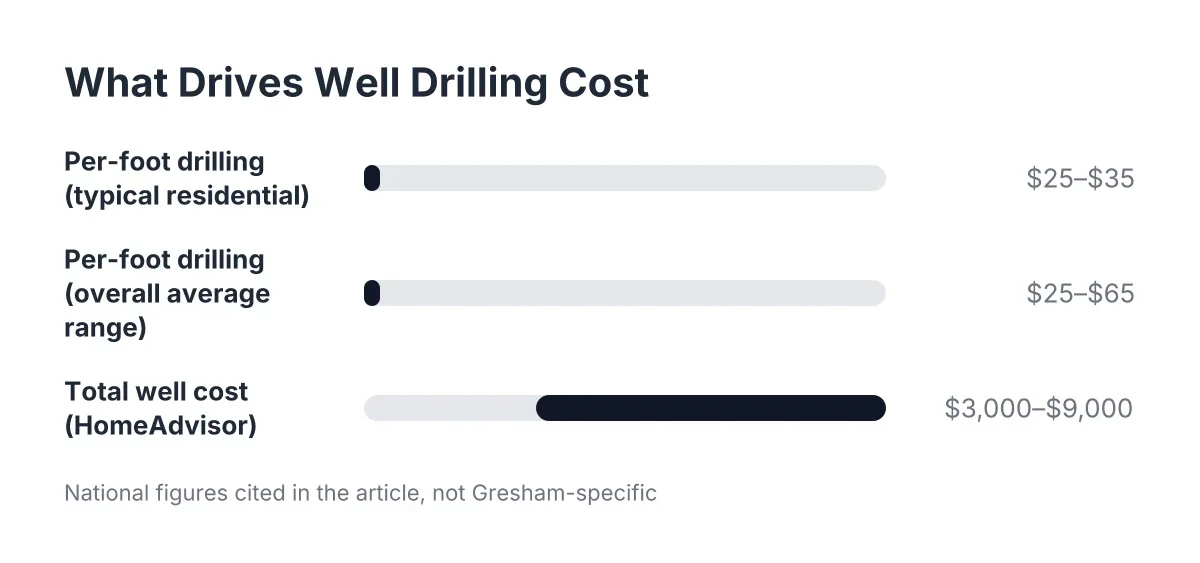
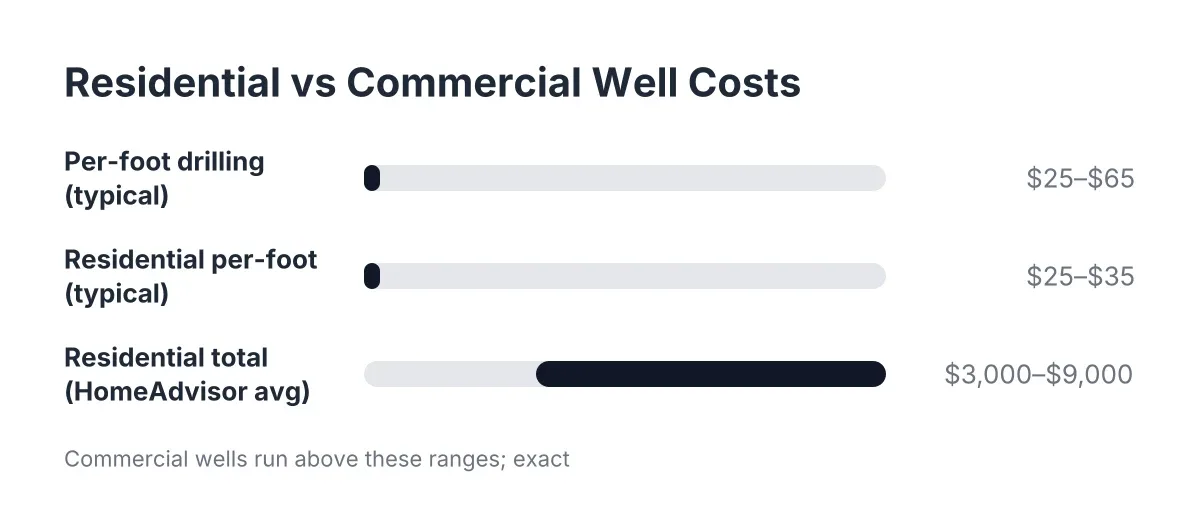
The honest answer on cost starts with per-foot pricing. According to Angi, drilling a well runs about $25 to $65 per foot, with $25 to $35 per foot as a typical guideline for most residential projects. HomeAdvisor puts the average total for a drilled residential well at $3,000 to $9,000, with $5,500 as the average; Forbes lands close to that at $5,625.
Commercial well drilling sits above those ranges because the job is bigger in every dimension. Expect these cost drivers to scale up:
- Borehole diameter and casing. Commercial wells often use a wider bore and heavier casing, which raises both material and rig costs.
- Depth and yield requirements. A business that needs sustained flow may have to drill deeper to reach an aquifer that can keep up, and every extra foot is billed.
- Pumping equipment. Higher horsepower pumps, larger pressure tanks, and sometimes storage tanks or variable speed controllers add to the equipment line.
- Testing and documentation. Commercial projects can carry extra flow testing and water quality requirements, depending on the use.
As a rough illustration, say a homeowner near Damascus drills a household well at a moderate depth; that project might land in the typical residential range above. A commercial irrigation well on the same road, drilled deeper with a larger bore and a high capacity pump, could run multiple times that. Treat these as planning estimates, not quotes; your actual depth and geology set the real number, and this is where a written estimate from a local well drilling company near me search earns its keep.
Step 4: Plan the Depth and What Happens Downhole
Nobody can promise your exact depth before the bit is turning, and anyone who does is guessing. What a good driller will explain is the process. The rig drills through soil and overburden until it reaches water or bedrock. According to the New Hampshire Department of Environmental Services, when a drill hits the top of bedrock, drillers plan to go at least about 10 feet into that rock to seal out dirty surface water and create a solid socket for the casing.
Hitting water is not the finish line. Drillers often continue past the first water to confirm the flow holds steady and to add depth below the pump. That extra depth gives sediment room to settle and can tap additional water-bearing zones, which protects you in dry years. For a commercial well, that margin matters even more because the draw never lets up.
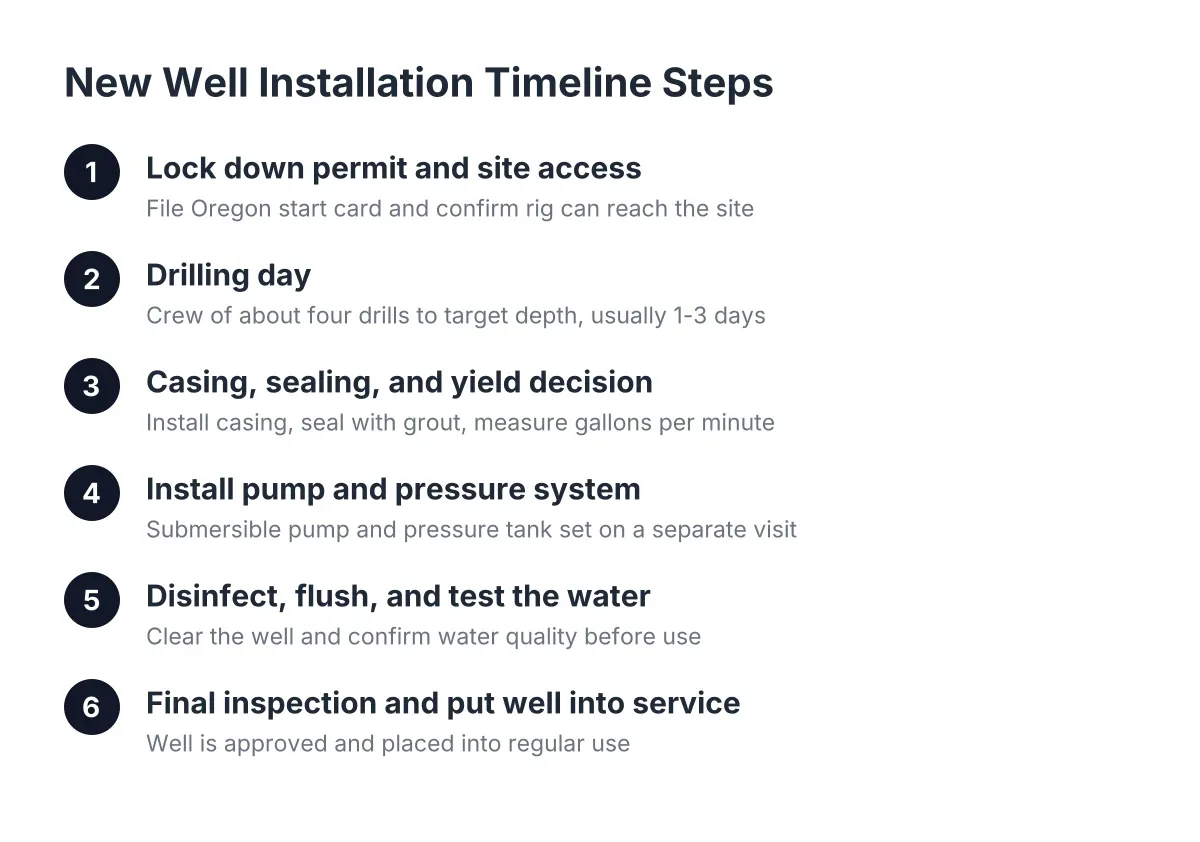
After the target depth is reached, the crew installs casing, sets the pump system, and tests the well for flow rate and water quality before it goes into service. A typical crew for a residential job is small, often around four workers with a standard drilling rig, so site access for one truck-mounted rig is usually the main logistical hurdle.
Step 5: Match the Pump System to the Well, Not the Other Way Around
The well's measured depth decides the pump, so do not buy equipment first. Drillers sound the finished well with a weighted tape to measure static water level and total depth, then size the pump from those numbers.
Here is how the equipment splits:
- Shallow wells can use a jet pump at the surface pulling water through a single suction line with a one-pipe well seal. If you have ever seen a shallow well pump installation diagram, that single pipe setup is what it shows.
- Deeper shallow-range wells need a two-pipe jet pump setup, with separate suction and pressure lines and a two-pipe well seal.
- Deep wells exceed what suction can lift, so they require a submersible pump that pushes water up from inside the well.
Most Gresham-area residential wells end up with a submersible pump paired with a pressure tank. According to the Indiana Department of Health, that tank may sit in the well, in the house, or in a crawl space depending on the layout. For a modest household at moderate depth, something like a submersible well pump 1/2 hp is a common size; a commercial well may need several times that horsepower plus storage. Let the measured depth and your real water demand set the spec.
If you already own land with an old well on it, pump sizing is also where repair questions show up. For reference, Angi reports a national average well pump replacement cost of $1,898, with most homeowners paying between $975 and $2,821. That is a separate budget line from new well installation, but it is worth knowing if the property came with an existing well of unknown condition; a well inspection, which Angi pegs at $250 to $550, will tell you whether that old well is an asset or a liability.
Step 6: Disinfect, Test, and Document the Water
Do not skip the finish work; your lender and the county may require the paperwork. After drilling, the driller disinfects the well and pump components with chlorine or bleach, and the well gets run hard afterward to flush the chemical taste out, per the San Diego County Department of Environmental Health. Then, according to the CDC, standard practice is to take a water sample for testing after the well has been run extensively, so the sample shows normal water quality rather than leftover disinfectant.
For a new construction loan, that water test result is often the proof of water your lender wants to see. Keep the well log, the test results, and the pump specs together; you will need them for permits, for the county, and for the next owner someday.
Step 7: Choose the Right Driller for the Job Size
Finally, hire for your specific project, not for a generic well. Residential and commercial well drilling call for different rigs and different experience, so ask direct questions before you sign:
- Have you drilled wells near my parcel, and what depths did those jobs hit? Local well logs beat guesses.
- Is your rig and crew set up for my project size, household or commercial capacity?
- What exactly does the quote include? A fair estimate spells out the per-foot drilling rate, casing, the pump and tank, disinfection, water testing, and permit handling, and it states what counts as extra, like hitting hard rock or needing more depth than estimated.
However, be realistic about the one thing no driller controls: geology. Even a careful aquifer assessment cannot guarantee depth or yield, which is why a clear per-foot structure and an honest conversation about dry hole risk matter more than a suspiciously firm flat price. For permit specifics, well placement near a septic system, or sizing a commercial system as of 2026 requirements, talk to a licensed well professional rather than working from general guides alone.
If you are planning a build on land around Gresham, Sandy, Boring, Damascus, Estacada, Corbett, or Oregon City, reach out for an estimate. A short site visit and a look at nearby well logs will tell you what your ground is likely to do, what the well and pump system should cost, and how to schedule drilling so water is ready when the builder needs it.
If you need well drilling, Clackamas Well Drilling can help.
Prefer to talk it through? Call (503) 782-5215 — a quick call is usually the fastest way to get a straight answer for your situation.