Well Water Suddenly Rusty? How to Tell Pump Problems From Aquifer Problems
If your well water is suddenly rusty, the first question to answer is not "what filter do I buy." It is "where is the rust coming from." Rusty or brown water from a private well traces back to one of two places: the pump and plumbing side of your system, or the groundwater itself. Understanding what causes rusty well water helps you identify whether those two problems originate in the plumbing or the aquifer, since they look identical at the faucet but call for completely different fixes, and one of them is much cheaper than the other.
This guide walks you through that diagnosis step by step. Whether you own an older well in Boring or Damascus, or you just bought acreage near Sandy or Estacada with a well of unknown condition, you can run these checks yourself in under an hour. By the end you will know whether you are looking at a pump issue, a well issue, or a water quality issue, and you will be able to describe the problem accurately before anyone quotes you a repair.
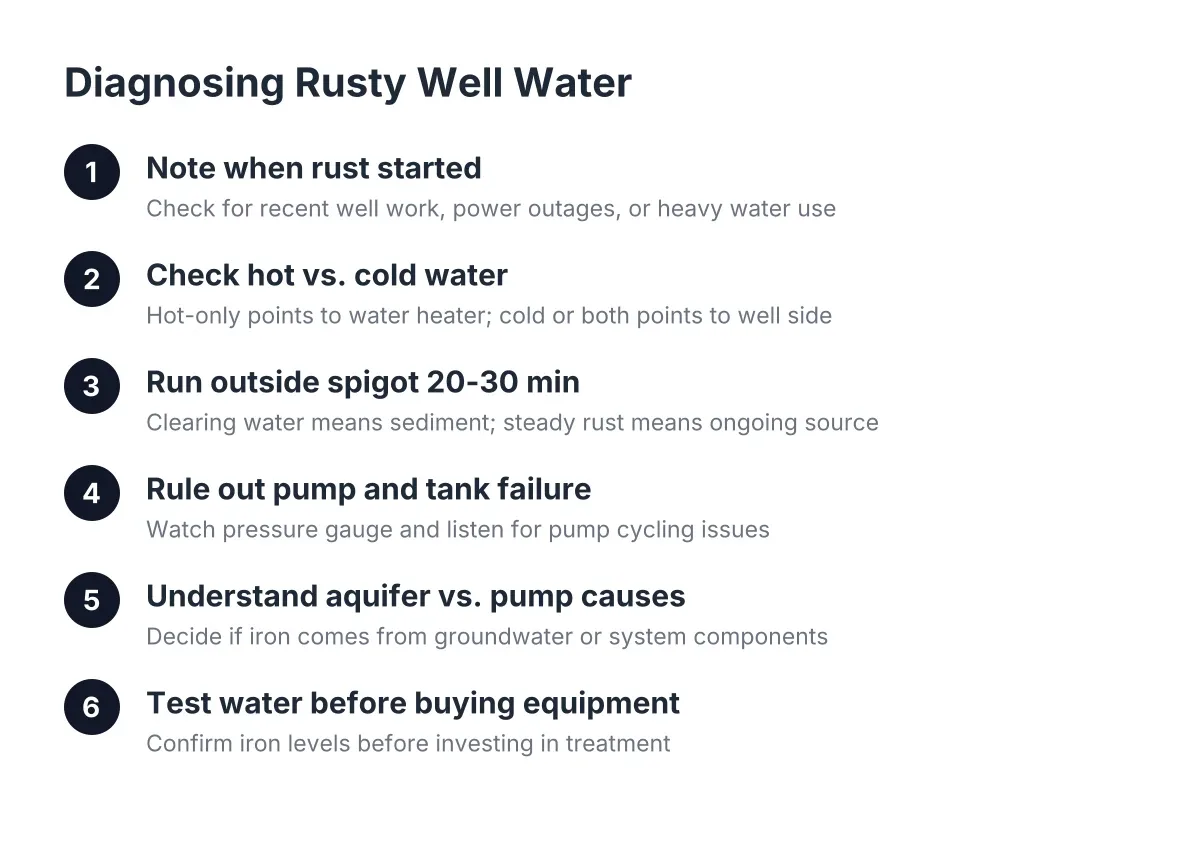
Step 1: Note Exactly When the Rusty Water Started
Timing is the single best clue for sudden rust in well water. Before you touch anything, write down when you first noticed the discoloration and what happened around your property in the 48 hours before it.
Ask yourself these questions:
- Did anyone work on the well recently, such as pulling or replacing the pump, servicing the pressure tank, or chlorinating the well?
- Was there a power outage that shut the pump off and restarted it?
- Did you run an unusual amount of water, for example filling a stock tank, irrigating, or hosting guests?
- Was there heavy rain, flooding, or nearby construction or drilling?
- Did the water change after a new pump installation, especially a switch from a jet pump to a submersible?
Each answer points somewhere specific. Recent well work almost always stirs up iron and manganese sediment that has been sitting quietly on the casing walls for years. That water can run reddish, burgundy, or even black, and it usually clears with repeated flushing. A power outage can have a similar effect because the pump restarting agitates settled sediment.
A pump swap matters more than most people expect. A submersible pump moves water inside the casing with far more force than a jet pump does. Suppose a buyer closes on a five-acre parcel outside Estacada, the old jet pump dies during inspection, and the new owner has a submersible installed. Two days later the water runs orange. In that scenario the iron was always in the well; the stronger pump simply dislodged buildup the old system never disturbed. That is a treatment question, not a failing well.
Step 2: Check Whether the Rust Is in the Hot Water, Cold Water, or Both
This step takes five minutes and can save you a service call. Run the cold water only at a tub or outside spigot for a minute, then fill a clear glass. Next, run the hot water only and fill a second glass. Compare them in good light.
Here is what the results mean:
- Rust in hot water only. Your well and pump are probably fine. The likely culprit is a corroding water heater tank or a failed anode rod inside it. That is a plumbing fix, not a pump and well repair.
- Rust in cold water only, or both. The discoloration is entering before the water heater, which points to the well, the pump, the pressure tank, or the piping between them. Continue to Step 3.
- Rust at one faucet only. Suspect corroded galvanized pipe or a fouled aerator on that fixture, not the well system.
In addition, check the toilet tanks. Lift a lid and look inside. Orange or brown staining that built up slowly suggests long-term iron in your well water. Clean tanks with suddenly rusty water suggest a recent, abrupt change, which fits a disturbed-sediment or pump event.
Step 3: Run an Outside Spigot and Watch Whether the Water Clears
Now test whether the rust flushes out or keeps coming. Connect a hose to the spigot closest to the pressure tank, run it away from your septic drainfield, and let it flow for 20 to 30 minutes. Fill a clear glass every 10 minutes and line the samples up.
If each glass looks cleaner than the last, you are flushing disturbed sediment, and the well will likely clear on its own with continued moderate use. This is the common pattern after pump work, chlorination, or a power outage. One caution: if the well was recently drilled or shocked with chlorine, run it heavily before judging the water. According to the San Diego County Department of Environmental Health, drillers disinfect new wells with bleach or chlorine, and the well should be run hard afterward to flush the residue out before regular use.
However, if the water stays equally rusty after 30 minutes, or gets worse, stop and move to Step 4. Steady discoloration that never clears means the source is continuous. Either the aquifer water itself carries high iron, or a component in the well is corroding or failing. Also stop if the flow weakens noticeably while you run the hose; pulling a marginal well down hard can draw in more sediment and, in a dry year, stress a low-producing well. The USGS reported about 1,220 Oregon domestic wells went dry or fell below pumping capacity between June 2021 and December 2023, so flow behavior during this test is worth noting, not ignoring.
Step 4: Rule Out Pump and Pressure Tank Failure
Rusty water that arrives together with pressure problems points at hardware, not groundwater. This is the heart of well pump troubleshooting, and you can check most of it without pulling the pump. Knowing how to test a well pump without pulling it mostly comes down to watching the pressure gauge and listening.
Stand at the pressure tank, usually in a pump house, garage, or crawl space, and watch the gauge while someone runs water inside. Residential systems typically pair a submersible pump with a pressure tank, according to the Indiana Department of Health. Look for these warning signs:
- Rapid cycling. The pump kicks on and off every few seconds. Combined with surging pressure at the shower, this usually means a waterlogged pressure tank with a failed bladder.
- Pressure that climbs slowly or never reaches cutoff. A worn pump, a drop pipe leak, or a well that cannot keep up.
- Sudden no water pressure in the house with the well pump still running. A serious sign; the pump may be damaged, or the water level may have dropped below the intake.
- Breaker trips when the pump starts. Electrical or motor trouble, which is a job for a professional. Do not keep resetting it.
- Grinding or rattling from the pump or piping. A failing pump can shed metal and stir sediment at the same time, which is why rusty water sometimes shows up right before a pump dies outright.
These same items cover the classic five causes of water pump failure: motor burnout, running dry, a failed pressure tank or switch, electrical faults, and plain wear from age. A pump that is deteriorating often announces itself with inconsistent pressure and dirty water together. If you see rust plus any symptom on this list, the pump system is the lead suspect, and well pump replacement may be on the table. For budgeting context, Angi puts the national average well pump replacement cost at $1,898, with most homeowners paying between $975 and $2,821.
Step 5: Understanding What Causes Rusty Well Water and When to Act
By now your observations sort into three buckets. Match your results:
- Water cleared during the flush test, pressure is normal. Disturbed sediment. Keep using the well moderately and recheck in a few days. No repair needed yet.
- Water stays rusty, pressure is normal. The groundwater itself likely carries iron or manganese, and what causes rusty well water in this case is dissolved iron picked up from the aquifer and surrounding rock, not a broken part. The fix is testing followed by treatment, usually an iron filter or whole-house filtration. Staining on fixtures or a rotten egg smell points the same direction.
- Water stays rusty and pressure is weak, surging, or cycling. Hardware. This could be a failing pump, a corroded drop pipe, a cracked casing letting surface water in, or a pressure tank at end of life. This bucket needs a professional well inspection.
The casing question deserves a mention for anyone buying land or evaluating an older well. A compromised casing or a shallow, poorly sealed well can let dirty surface water in after storms, which shows up as sudden discoloration following heavy rain. Proper drilling practice guards against this; according to the New Hampshire Department of Environmental Services, drillers who hit bedrock plan to drill at least about 10 feet into that rock to seal out dirty surface water and set casing properly. An old well that predates modern sealing standards may not have that protection, which is one reason a well inspection matters before you close on rural property.
Step 6: Test the Water Before You Spend Money on Equipment
Do not buy a filter based on color alone. Rusty-looking water can carry more than iron, and treatment equipment sized for the wrong problem wastes money. Get a lab water test that covers iron, manganese, hardness, and bacteria at minimum. Private well water is not regulated under the federal Safe Drinking Water Act, and more than 43 million people rely on it, according to the U.S. Geological Survey, so testing falls entirely on the owner.
The stakes are real. The EPA notes that a USGS study of 2,100 private wells found about one in five contained a contaminant above a human-health benchmark. If your rust showed up after flooding or alongside a change in taste or smell, test before drinking. In 2026, well water testing remains the cheapest step in this whole process compared to guessing wrong on a pump or a filter system.
For land buyers, fold this into due diligence. If you are evaluating a parcel near Corbett or Oregon City with an existing well of unknown age, a well inspection plus water testing answers two questions at once: is the hardware sound, and is the water usable. Angi reports a typical professional well inspection runs $250 to $550, which is small next to the cost of discovering an iron problem after you have built.
When Rusty, Iron-Bearing Well Water Means Calling a Pro
Call a well and pump professional when the water will not clear after extended flushing, when rust arrives with pressure loss or pump cycling, when the breaker trips, or when you suspect casing damage after a storm. Diagnosing a submersible pump hundreds of feet down, or pulling one safely, is not a homeowner job, and electrical faults at the pump can be dangerous.
The work you did in Steps 1 through 5 still pays off. When you can say "the water is rusty in both hot and cold, it did not clear after 30 minutes of flushing, and the pressure tank is short cycling," you have narrowed the diagnosis before the truck arrives. You will understand the quote you get, you will recognize whether the proposed fix matches your symptoms, and you will not be at the mercy of whoever answers the phone. That is the whole point of checking your own system first: well water that is suddenly rusty is a message, and now you know how to read it.
If you need well drilling, Clackamas Well Drilling can help.
Prefer to talk it through? Call (503) 782-5215 — a quick call is usually the fastest way to get a straight answer for your situation.