
Well Pump Troubleshooting — Complete Guide
Your taps went dry, or your pressure dropped to a trickle, and now you need answers before you pick up the phone. This guide covers well pump troubleshooting for homeowners in Gresham and the surrounding rural communities, walking you through the checks you can safely do yourself before calling a professional. You will learn how to narrow the problem to the pump, the pressure tank, or the wiring, and how to describe the symptoms accurately so any conversation about repair starts on solid ground. By the end, you will know which symptoms point to a quick fix and which ones mean it is time to bring in a well pump specialist. That knowledge changes the whole dynamic of the service call, because you arrive informed instead of guessing.
What You'll Find in This Guide
- Well Pump Troubleshooting Terms Explained: A Plain-English Glossary
- How Much Does Well Pump Troubleshooting Cost?
- Well Pump Not Working? Step-by-Step Submersible Pump Troubleshooting
- Jet Pump Troubleshooting: No Water, Weak Pressure, and Cavitation Noise Explained
- Well Pump Won't Prime? Step-by-Step Fixes to Restore Your Water Flow
Well Pump Troubleshooting: The First Five Minutes
When nothing comes out of the tap, resist assuming the worst. "No water" has a short list of causes, and several you can check yourself in minutes. The goal: determine whether the problem is electrical, mechanical, or down in the well.
Start at the breaker panel. A well pump tripping the breaker is one of the most common no-water scenarios—a single reset will tell you a lot. If the breaker trips again immediately, stop. Repeated tripping usually points to an electrical fault or seized motor; forcing the breaker on can worsen damage. If the breaker holds and water returns, note what happened and monitor it, since a breaker rarely trips without reason.
Next, confirm whether the pump is running. If your well has power but no water reaches the house, the fault often lives between the pressure switch and pump. Listen near the pressure tank. A clicking switch, humming motor that never builds pressure, or total silence each point to a different cause. Our step-by-step submersible pump troubleshooting guide walks through this checklist in order, starting with the cheapest fixes.
Above-ground jet pumps add complications. Because they pull water up rather than pushing it, they can lose prime, suck air, or make a distinctive rattling noise called cavitation. If your system sits in a well house or basement, the jet pump troubleshooting guide covers those failure modes.
Before calling anyone, write down what you observed: Did the breaker trip once or repeatedly? Does the pump hum, click, or stay silent? These details transform a vague "we have no water" call into a focused conversation, helping a technician arrive with the right parts.
Pressure Problems and Short Cycling: What Your System Is Telling You
Not every well problem starts with a dry tap. More often, the system sends warning signs for weeks before it fails outright. Learning to read those signs gives you the chance to fix a small problem before it becomes a no-water emergency.
Low water pressure from a well can come from several directions. Sometimes the pressure switch needs adjustment. Sometimes the pressure tank has lost its air charge and can no longer buffer the system. In other cases, a clogged sediment filter, a partially closed valve, or a failing pump impeller restricts flow. The pattern matters here. Pressure that drops only when two fixtures run at once suggests a different cause than pressure that fades slowly over months. With this in mind, pay attention to when the weakness shows up, not just how weak it is.
Why Well Pump Short Cycling Requires Attention
A well pump cycling on and off rapidly, sometimes called short cycling, is one symptom you should never ignore. Each start puts strain on the motor, so a pump that kicks on every minute or two wears itself out far faster than designed. The usual culprit is a waterlogged pressure tank that has lost its air cushion, though a leak in the plumbing or a faulty check valve can produce the same behavior. You can often spot a waterlogged tank yourself: tap the side, and if it sounds solid from top to bottom instead of hollow near the top, the bladder has likely failed.
Lost Prime and Air in the Lines
Sputtering faucets, air bursts, and pressure that comes and goes often trace back to a system losing its prime or drawing air through a leak on the suction side. For jet pump owners especially, this is a frequent and sometimes fixable problem. Our guide to restoring a pump that won't prime covers the common causes and the checks worth doing before scheduling a visit.
As a result of running these checks, you will usually know whether you are dealing with a tank issue, a switch issue, or something deeper in the well. That distinction is exactly what a repair professional needs to hear first.
Sudden Sediment, Diagnosis Costs, and Knowing When to Call
Water quality changes can be just as telling as pressure changes. Sudden sediment in well water, especially sand or grit appearing after years of clear water, deserves attention right away. It can mean the pump has dropped closer to the bottom of the well, the well screen has degraded, or the water level has fallen enough that the pump pulls in material it used to sit well above. Beyond the nuisance factor, sediment acts like an abrasive inside your pump and fixtures, so running the system hard while ignoring it tends to shorten the pump's life.
Cloudy water, a change in taste, or a new odor are slightly different signals. These point toward water quality rather than mechanical wear, and they call for testing rather than wrenches. This matters more than many homeowners realize. According to the U.S. Environmental Protection Agency, more than 23 million U.S. households rely on private wells for drinking water, and a USGS study of 2,100 private wells found that about one in five contained at least one contaminant above a human-health benchmark. Unlike city water, nobody tests your private well unless you arrange it. The EPA's private well resources are a useful starting point for understanding what to test for and how often.
Setting Cost Expectations Before the Call
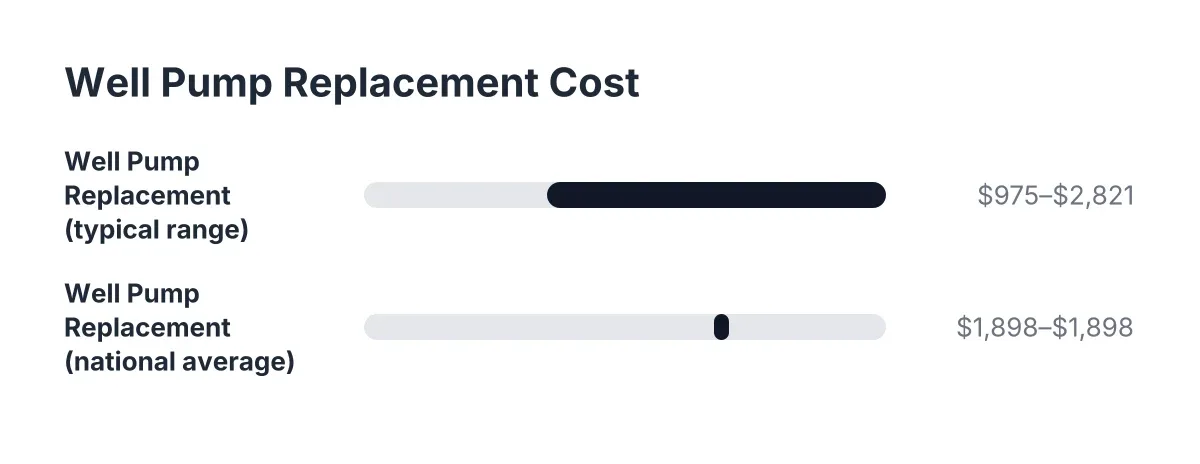
At some point in troubleshooting a well pump, you reach the edge of what you can safely check yourself. Pulling a submersible pump, testing down-well wiring, or opening the well head is professional territory. Before you make that call, it helps to understand what drives the price. The biggest factor is where the fault lives: a pressure switch at the tank is a very different job than a pump hundreds of feet down the casing. For context on replacement specifically, Angi reports a national average well pump replacement cost of $1,898 based on 1,339 verified projects, with most homeowners paying between $975 and $2,821. Your situation will vary with pump type, well depth, and access, which is why our well pump troubleshooting cost guide breaks down the factors rather than quoting a single number.
Finally, do not let unfamiliar vocabulary put you at a disadvantage. Terms like drawdown, pitless adapter, and pressure switch differential show up in nearly every repair conversation. The plain-English glossary translates them, so you can read a quote and actually understand what you are paying for.
Ready to Get Started?
We handle well pump repair, well pump replacement, well inspection, water testing, and well drilling for homeowners in Gresham, OR and the surrounding rural communities. If you have run the checks above and the problem points beyond a reset breaker or a simple fix, call us or send a request and tell us what you found. The symptoms you observed will help us understand your situation before we ever open the well head.