7 Signs Your Well Pump Is Failing Before It Quits Completely
A well pump rarely dies without warning. In most cases it sends up signs of a well pump failing for weeks or months first, and homeowners who catch them early get to plan a repair or replacement on their own schedule instead of waking up to dry taps. This list walks through the signs your well pump is failing before it stops working completely, what each one usually means, and how to tell the difference between a pump that can be repaired and one that has reached the end of its life.
That last point matters more than most articles admit. Plenty of "failed pumps" turn out to be a bad pressure switch or a waterlogged pressure tank, both far cheaper fixes. Knowing the signs your well pump is going bad, and which ones point somewhere else, is how you avoid paying for a new pump you did not need.
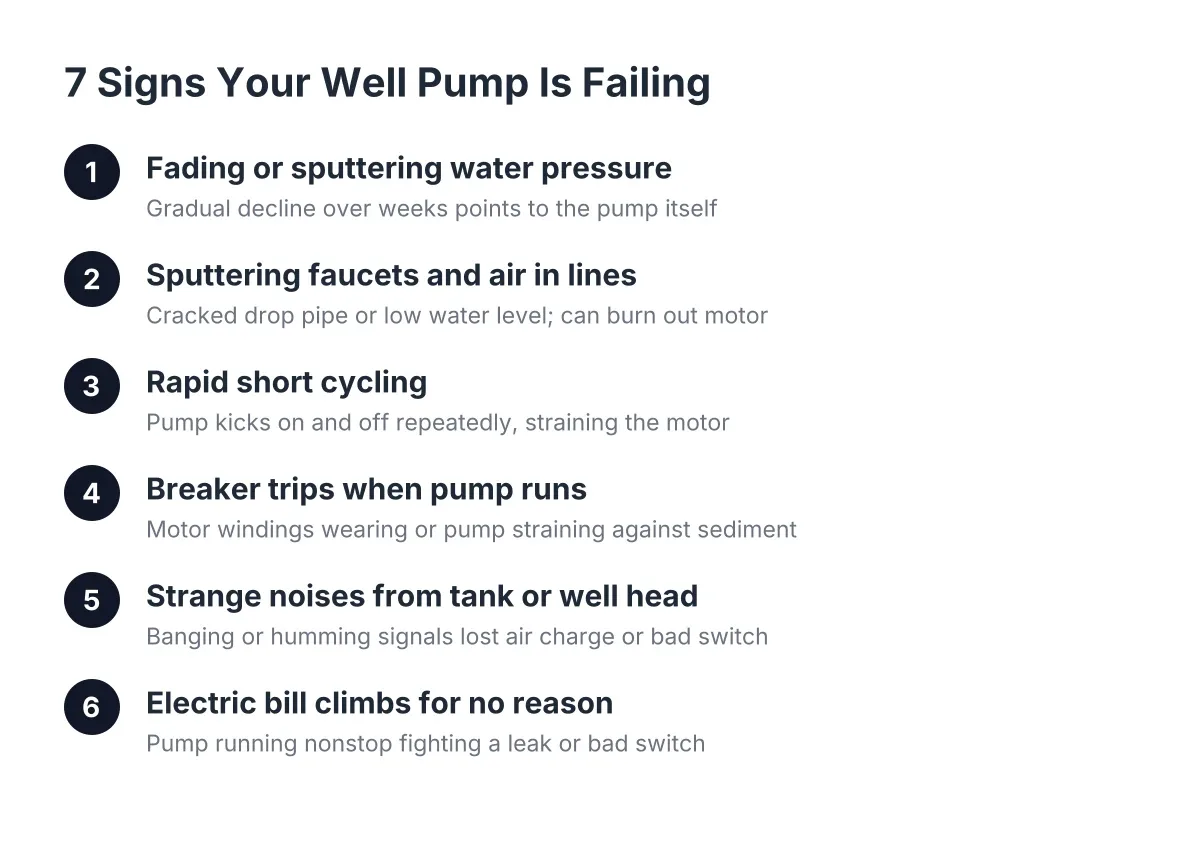
1. Water Pressure That Fades, Sputters, or Comes and Goes
Weak or inconsistent pressure is the most common early warning that a well pump is struggling. If your shower goes strong in the morning and drops to a trickle by evening, or pressure fades when two fixtures run at once, the pump may be losing its ability to move water at its rated capacity.
However, pressure problems have more than one cause. A failing pressure tank, a clogged sediment filter, or a leak in the line between the well and the house can all mimic a dying pump. The pattern to watch for is gradual decline over weeks. That trend points at the pump itself rather than a single failed part.
2. Sputtering Faucets and Air in the Lines
Faucets that spit air along with water usually mean one of two things: the drop pipe in the well has a crack, or the pump is pulling from near the top of the water column because the water level has fallen. Either way, air in the lines is not normal, and it will not fix itself.
This one deserves fast attention because a pump running with air instead of water is a pump destroying itself. Running dry burns out the motor, and that turns a moderate repair into a full well pump replacement. In Oregon this is not a rare event; about 1,220 domestic wells went dry or fell below pumping capacity between June 2021 and December 2023, according to the U.S. Geological Survey, and the true number is likely higher since reporting is not mandatory.
3. The Pump Turns On and Off Rapidly (Short Cycling)
Short cycling means the pump kicks on, runs for a few seconds, shuts off, and repeats, sometimes several times a minute. You can hear it as a rhythmic click near the pressure tank, or see it as pressure that surges and drops while you run water.
Rapid cycling is hard on the motor. Startup is the highest electrical load a pump ever sees, and a pump stuck cycling through that high-draw phase over and over wears out far faster than one that runs steadily. The usual culprits are a waterlogged pressure tank or a pressure switch with a failing contact. Both are repairable, but if short cycling has gone on for months, the pump motor may already be damaged.
4. A Breaker That Trips When the Pump Runs
A well pump that trips its breaker is drawing more current than it should. That extra draw usually means the motor windings are wearing, the pump is straining against sediment, or the motor is beginning to seize. Resetting the breaker once is reasonable. Resetting it daily is a countdown.
Do not keep resetting and hoping. Each overload event heats the motor further, and a motor that finally burns out underwater cannot be rebuilt in place; it has to come out of the well. In addition, never work on the pressure switch or wiring yourself without shutting off power to the well pump circuit first. Water and live electricity in the same pit is not a place to learn.
5. Strange Noises From the Pressure Tank or Well Head
Most residential systems use a submersible pump paired with a pressure tank, which may sit in the well, the house, or a crawl space depending on the layout, according to the Indiana Department of Health. Because the pump itself is hundreds of feet down, the noises you hear at the surface come from the tank and switch.
Listen for banging, clicking, or a humming that never stops. A tank that sounds hollow at the top and thuds like a full drum at the bottom has likely lost its air charge. A switch that clicks constantly is either failing or responding to a leak somewhere in the system. Either condition forces the pump to work harder than it was built to.
6. An Electric Bill That Climbs for No Reason
A well pump that never shuts off runs up your power bill quietly. If your usage jumps and nothing else in the house changed, walk out and listen near the pressure tank. A pump running around the clock is either fighting a leak, failing to build pressure, or stuck on because of a bad switch.
For example, suppose a homeowner outside Boring notices a $60 jump in the monthly electric bill in late 2026 and shrugs it off for a season. Three months later the pump motor burns out from continuous running, and a possible switch repair in the low hundreds becomes a full pump and labor job. In that hypothetical, the electric bill was the cheapest warning the system ever gave.
One clarification, because well owners often worry about the opposite problem: submersible pumps are built for heavy, frequent use. Normal household demand does not wear them out, so you do not need to ration showers to protect the pump. What hurts a pump is running dry, cycling rapidly, or running nonstop against a problem.
7. Cloudy, Sandy, or Off-Tasting Well Water
Sediment in your well water can mean the pump has dropped near the bottom of the well, the well screen is failing, or the aquifer level has fallen and the pump is pulling in silt. Sand is abrasive; it chews through pump impellers and shortens the life of everything downstream, from the pressure tank to your water heater.
Sudden changes in taste, smell, or clarity are also worth a water test on their own merits. A USGS study of 2,100 private wells found that about one in five contained at least one contaminant above a human-health benchmark, according to the U.S. Environmental Protection Agency. If the water changes at the same time the pressure does, mention both when you call for well pump repair; the combination narrows the diagnosis fast.
Signs of a Well Pump Failing: Diagnosis Before Repair
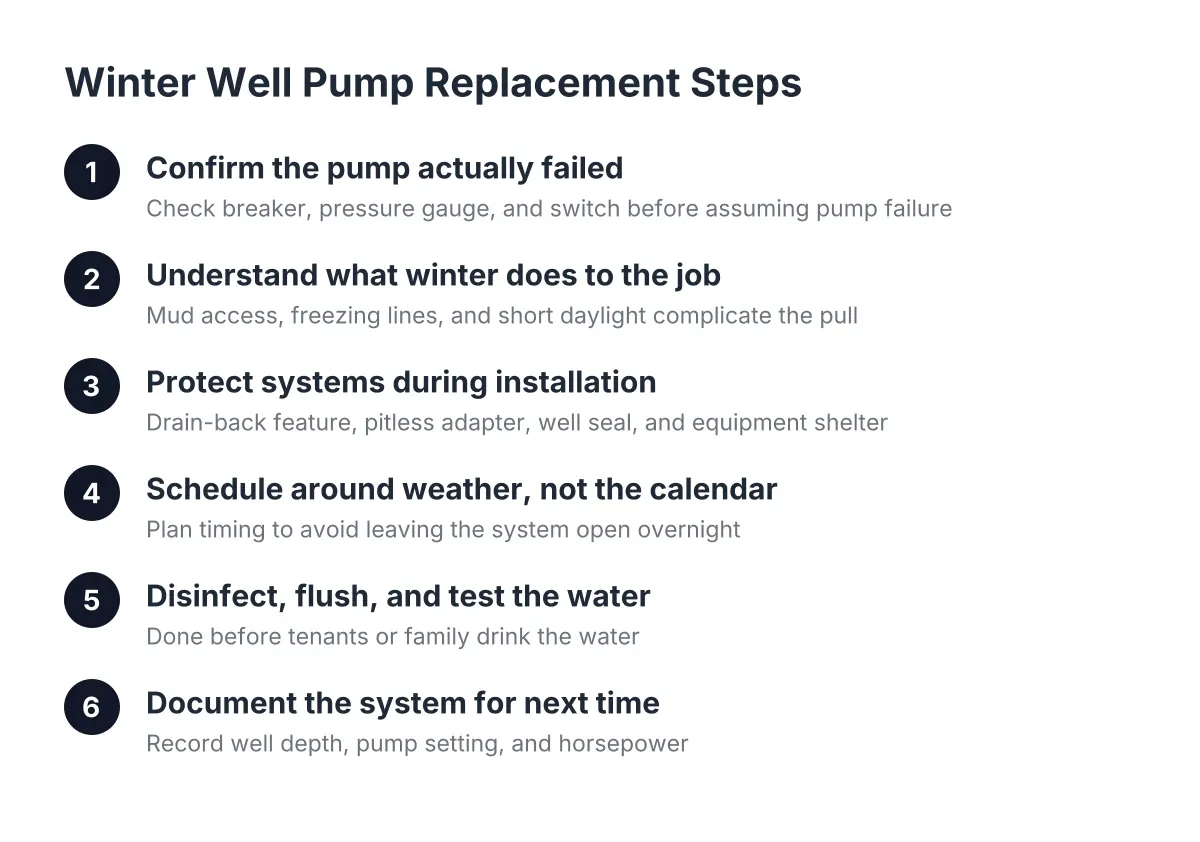
Before assuming the worst, rule out the inexpensive failures. A dead pump and a dead pressure switch produce the same symptom at the tap: no water. Here is the order a technician typically checks, and the parts you can safely look at yourself:
- Check the breaker panel first. A tripped well circuit is the simplest explanation for no water.
- Look at the pressure gauge on the tank. Zero pressure with the pump circuit on suggests the pump or switch; normal pressure with no flow points to a plumbing blockage.
- Listen for the pump. If you hear it running but pressure never builds, suspect a leak, a failing pump, or a dropping water level.
- Tap the pressure tank. A tank that is heavy and thuds all the way up is waterlogged, and that alone can mimic pump failure.
Anything past this checklist, especially pulling the pump or working on wiring, is professional territory. A submersible pump sits deep in the well on pipe, wire, and safety rope, and pulling it wrong can drop the whole assembly down the hole.
Repair or Replace: What the Signs of a Bad Well Pump Add Up To
A well pump showing one early symptom is usually a repair candidate; a pump showing several at once, or one past typical service age, is usually a replacement. Surface parts like pressure switches and tanks are the cheap end of well and pump work. The pump motor itself is the expensive end, mostly because of the labor to pull it.
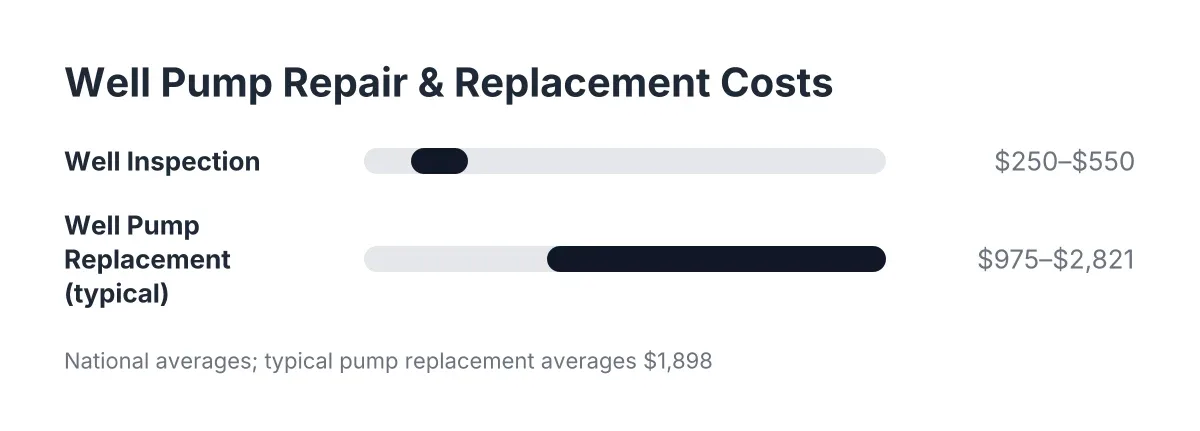
Age is the tiebreaker. Submersible pumps commonly serve well over a decade, and a pump in its later years with sediment wear or a tired motor rarely justifies a repair bill that approaches replacement. For 2026 budgeting, the national average well pump replacement cost is $1,898, with most homeowners paying between $975 and $2,821, according to Angi. Your water pump replacement cost depends heavily on well depth, pump type, and access; a deep submersible costs more to pull and set than a shallow jet pump, which is why quotes for the same size well water pump for a house can vary widely.
Therefore, the smart move is diagnosis before decision. A proper well inspection, which Angi pegs at $250 to $550, tells you whether you are looking at a switch, a tank, or the pump itself before anyone commits to pulling equipment. That is how you avoid replacing a pump that had years left, and how you avoid pouring repair money into one that did not.
What Early Attention Buys You
Around Gresham and the rural edge of Clackamas and Multnomah County, from Sandy and Damascus to Corbett and Estacada, most homes past the city water lines depend entirely on a private well. When the pump fails completely, there is no backup tap. Groundwater does not reach your kitchen without that one machine working.
Catching the signs your well pump is failing early converts an emergency into an appointment. You get time to compare a repair against a water pump replacement, schedule the work before the tank runs empty, and test the well water while you are at it. The homeowners who end up paying the most are the ones whose first symptom was no water at all.
If you need well drilling, Clackamas Well Drilling can help.
Prefer to talk it through? Call (503) 782-5215 — a quick call is usually the fastest way to get a straight answer for your situation.