Slug Test vs. Pump Test: Which Is Right for You?
If you need to know how much water your well can deliver, a slug test and a pump test are the two ways to find out, and the slug test vs pump test question comes down to how much certainty you need. Here is the short answer: a slug test is the quick, lower-cost check that gives you a rough read on the aquifer, while a pump test costs more and takes longer but tells you what your well will actually produce day after day. If you are buying a home, sizing a new well pump, or planning a commercial project, the pump test usually earns its price. If you just need a ballpark screening number, the slug test often does the job. Below is how each one works, where each one falls short, and which one fits your situation around Gresham.
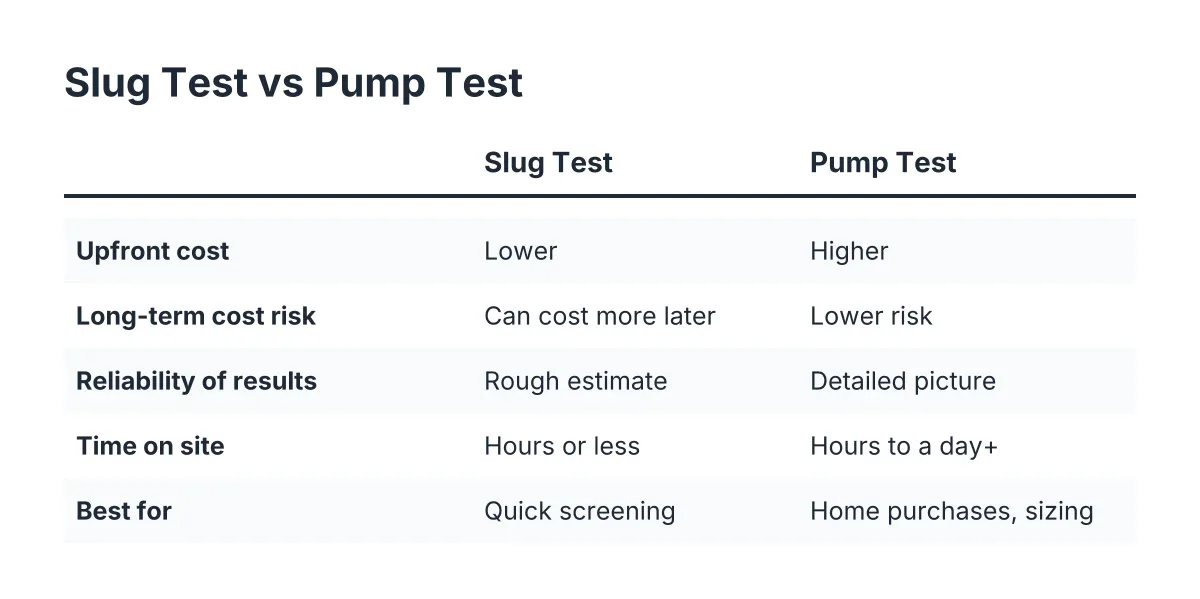
| Criteria | Slug Test | Pump Test |
|---|---|---|
| Upfront cost | Lower, less equipment and time on site | Higher, requires pumping equipment and longer field time |
| Long-term cost | Can cost more later if it undersizes or oversizes your pump | Lower risk of paying twice, data supports right-sized decisions |
| Reliability of results | Rough estimate, small snapshot of the aquifer near the well | Detailed picture of real-world yield over sustained pumping |
| Time on site | Short, often a matter of hours or less | Longer, often several hours to a full day or more |
| Best for | Quick screening, tight budgets, monitoring wells, early planning | Home purchases, pump sizing, new wells, commercial or high-demand use |
Slug Test: Strengths and Trade-offs
A slug test is simple. A technician drops a known volume, the "slug," into the well or pulls one out, then measures how fast the water level returns to normal. That recovery speed tells you how easily groundwater moves through the aquifer right around your well. No big pumping rig, no long wait, no large volume of water discharged on your property.
The strengths follow from that simplicity. A slug test is fast, it costs less, and it barely disturbs the well. If you are in the early stages of planning, comparing possible drilling sites, or you own a small monitoring well that a pump would overwhelm, a slug test gives you useful numbers without a big invoice. It pairs well with an aquifer and well depth assessment when you want a general read on what the ground under your property can do before committing to bigger decisions.
The trade-off is scope. A slug test only measures a small zone of aquifer immediately around the well bore. It cannot tell you how the well behaves under sustained demand, whether the water level will drop after hours of pumping, or how a neighbor's well might be affected. If you size a well pump off slug test data alone, you are guessing, and a wrong guess can mean a pump that burns out early or a well that runs dry under real household use. That is where the slug test disappoints people who expected more from it.
Pump Test: Strengths and Trade-offs
A pump test does what the name says. A pump runs at a controlled rate for an extended period, often several hours or longer, while someone measures how far the water level drops and how fast it recovers afterward. This is the closest thing to a dress rehearsal for real life: your well working under the kind of demand a household or business actually puts on it.
The strength is confidence. A pump test shows sustained yield, drawdown behavior, and recovery, which is exactly the information you need to size a well pump correctly, judge whether a well can support a home purchase, or plan for irrigation or commercial demand. Lenders and county reviewers often want this kind of data because it reflects how the well performs over time, not just in a snapshot. When a pump and well repair decision hinges on whether the well itself is the problem, pump test data settles the argument.
The trade-offs are cost and logistics. A pump test takes more equipment, more time on site, and a plan for the water being discharged. It also stresses the well more than a slug test does, which is usually fine for a sound well but is worth knowing going in. For a quick screening question, a pump test can be more test than you need.
Slug Test vs Pump Test: The Deciding Factors
Cost drivers
The slug test wins on upfront cost, but the pump test often wins on total cost. A slug test needs minimal equipment and a short site visit, so the bill stays small. A pump test costs more because of the pumping equipment, the hours of monitoring, and the analysis afterward. The catch is what happens next: if cheap data leads you to the wrong well pump installation or a well that cannot keep up, you pay for the fix on top of the original test. Our guide to aquifer and well depth assessment costs walks through the factors that move these numbers in general terms.
Reliability and lifespan of the data
Pump test data holds up longer and supports bigger decisions. Slug test results describe a small pocket of aquifer at one moment; they are fine for screening but thin for anything you will live with for years. A pump test measures the whole well system under load, which is why the results carry weight with lenders, inspectors, and anyone doing well pump replacement or sizing work. If the decision on the table lasts a decade, buy the data that lasts a decade.
Time and disruption on site
The slug test wins on convenience. It is typically done in a short visit with light equipment and no meaningful water discharge. A pump test occupies your property longer, runs equipment for hours, and pushes a large volume of water out that has to go somewhere. On a rural property near Sandy, Boring, or Estacada, that is usually manageable, but it is a real difference in what your day looks like.
What each test can actually answer
Match the test to the question, because neither test answers the other's question well. Ask "does groundwater move through this aquifer at a workable rate?" and a slug test answers it. Ask "will this well support my family, my irrigation, or my business through a dry August?" and only a pump test answers that. Homeowners get into trouble when they use the cheap test to answer the expensive question.
Situational fit
For most Gresham-area homeowners making a purchase or pump decision, the pump test is the right call; for early-stage or low-stakes questions, the slug test is enough. A well inspection before a home sale, a new well being brought online, or a well pump replacement where sizing matters all justify pump test money. Comparing two possible drilling spots on a parcel in Damascus or Corbett, or checking a monitoring well, does not.
Which Should You Choose?
Choose Slug Test if:
- You need a quick, low-cost read on the aquifer before committing to bigger decisions
- You are comparing possible well sites early in a well drilling project
- The well is a small monitoring well that sustained pumping would overwhelm
- Your budget is tight and the question is genuinely low-stakes
Choose Pump Test if:
- You are buying a home on well water and need to know the well can support it
- You are sizing a new well pump or planning a well pump replacement
- A lender, county, or buyer wants documented sustained yield
- The well serves irrigation, livestock, or a commercial property with steady demand
If you are unsure, here is the honest rule: the more money riding on the answer, the more the pump test is worth. A home purchase or a new pump system is pump test territory. A "what are we working with here" question is slug test territory.
Common Questions
Can a slug test replace a pump test before buying a home?
No. When you compare slug test vs pump test results for a home purchase, only the pump test shows whether the well keeps up under real daily demand. A slug test measures a small zone around the well for a short moment, which is not enough to bet a mortgage on. Most buyers, and many lenders, want sustained yield data before closing.
Will either test damage my well?
A slug test barely disturbs the well at all. A pump test works the well harder because it runs sustained pumping, but on a sound well that stress is normal and safe. If a pump test reveals a problem, that is the test doing its job; better to find a weak well before you depend on it than after. A well inspection alongside the test can catch structural issues too.
How long does each test take?
A slug test is usually done in a short site visit, often under an hour of actual testing. A pump test typically runs several hours and sometimes a full day or more, depending on what the data needs to show. Longer pumping gives a truer picture of how the aquifer behaves under sustained use, so the extra time is where the value comes from.
Do I need either test if my well already works fine?
Maybe not today, but situations change. If you are adding irrigation, expanding the household, troubleshooting a pump that keeps failing, or preparing to sell, fresh yield data tells you whether the well or the pump is the weak link. That can save you from paying for well pump repair when the real problem is the well, or from replacing a well when a pump swap would have fixed it.
If you need well drilling, Clackamas Well Drilling can help.
Prefer to talk it through? Call (503) 782-5215 — a quick call is usually the fastest way to get a straight answer for your situation.