8 Red Flags Your Well Pump Needs Maintenance Before It Fails Completely
Most well pumps do not die without warning. They send signals for weeks or months first, and homeowners who catch those signals early usually pay for a repair instead of an emergency replacement. This article covers the well pump warning signs—the red flags a well pump shows before it quits completely—written for owners around Gresham, Sandy, Boring, Damascus, and Estacada who cannot stand at the pressure tank every day and need to know what actually matters. If you have already lost water, some of these signs will also help you explain to a well pump repair company what happened in the days before the taps went dry.
One number worth keeping in mind: according to the U.S. Geological Survey, about 1,220 domestic wells in Oregon went dry or fell below pumping capacity between June 2021 and December 2023, and the true figure is likely higher because reporting is not mandatory. Not every pressure problem is a pump problem. Sometimes the well itself is struggling, and the pump is just the messenger. The red flags below help you tell the difference.
1. Water Pressure That Fades Through the Day
Falling or inconsistent pressure is the earliest and most common red flag a well pump gives before failing. If the shower runs strong in the morning but weak by evening, or pressure drops whenever two fixtures run at once, something in the pump, pressure tank, or well is losing ground.
The cause is not always the pump itself. A waterlogged pressure tank, a worn pressure switch, or a clogged sediment screen can all mimic a dying pump. However, a slow fade over weeks usually points at wear inside the pump or a drop in what the well can deliver. Either way, fading pressure is your cue to schedule well pump service and repair while the water is still flowing, not after it stops.
2. The Pump Runs Constantly or Cycles On and Off Rapidly
A healthy system pumps, fills the pressure tank, and shuts off. If you hear the pump kick on every minute or two, or it never seems to shut off at all, that is a system telling you it cannot hold pressure. Rapid cycling, often called short cycling, wears out the motor and pressure switch far faster than normal use.
Constant running is worse. A submersible pump that runs with little or no water moving through it can overheat and burn out, and that failure is sudden and total. In other words, a pump that will not shut off is not a quirk to live with; it is a countdown.
3. Sputtering Faucets and Air in the Lines
Air spitting from your taps means the pump is pulling in air somewhere it should only find water. That can mean a cracked drop pipe inside the well, a failing check valve, or a water level that has fallen close to the pump intake.
Around the rural edge of Clackamas and Multnomah County, late summer is when this one shows up most, because groundwater levels sit lowest after months of dry weather. If sputtering starts in August and clears up in November, the aquifer may be the story, not the equipment. A well inspection with an aquifer and well depth assessment can tell you whether the pump can be set deeper or the well is genuinely running short.
4. Grinding, Clicking, or Humming: Warning Signs of Well Pump Wear
New noises from the pressure tank area or the wellhead are a red flag that the well pump is wearing mechanically. Grinding often means bearings are going. Rapid clicking usually points at a pressure switch arcing as it fails. A hum with no water movement can mean a seized motor drawing power and going nowhere.
Many homeowners first notice the noise a week or two before the pump quits. If a grinding pump then goes silent and the taps go dry, you already know the likely diagnosis before anyone arrives. One safety note: if you plan to look at the pressure switch yourself, shut off power to the pump circuit first, every time.
5. The Electric Bill Jumps With No Change in Use
A struggling pump works longer to move the same water, and that shows up on your power bill before it shows up at the faucet. If your winter usage looks like your summer irrigation season and nothing else changed, the pump may be running far more hours than it should.
For a landlord managing a rental in Corbett or Oregon City, this is often the only early warning you get, because tenants rarely report a slightly weak shower. Therefore, a utility bill that climbs 20 to 30 percent with no lifestyle change is worth a service call. Recognizing these well pump warning signs early through utility tracking is one of the cheapest forms of well water pump maintenance available to an owner who is not on site.
6. Cloudy, Gritty, or Odd-Smelling Water
Sediment in the water means the pump is pulling sand or silt it should not be touching, either because the pump sits too low in the well, the screen has failed, or the well itself is degrading. Grit is hard on impellers and shortens pump life quickly, so this red flag damages the pump while it warns you.
Water quality changes matter beyond the equipment, too. According to the U.S. Environmental Protection Agency, more than 23 million U.S. households rely on private wells, and a USGS study found about one in five sampled wells had at least one contaminant above a human-health benchmark. If the water suddenly smells, tastes, or looks different, pair the pump checkup with well water testing. This is doubly true if you have young children in the house or a real estate transaction on the calendar.
When Discolored Water Is a Well Problem, Not a Pump Problem
Cloudy water right after a nearby well is drilled, or after your own well work, can be temporary. For example, after new well drilling, the driller disinfects the well and pump components with chlorine, and according to San Diego County Department of Environmental Health, the well should be run heavily afterward to flush the residue before regular use. Persistent discoloration with no recent work is the version that deserves a professional look.
7. Tripped Breakers on the Well Pump Circuit
A breaker that trips once might be a fluke. A well pump breaker that trips repeatedly is one of the clearest red flags that the pump motor is drawing too much current, usually because windings are failing or the motor is binding. Resetting it over and over does not fix anything; it just delays the diagnosis while stressing the motor further.
Suppose a homeowner in Damascus finds no water on a Saturday morning, resets the breaker, gets water for two days, and then loses it again. In that scenario, the pump motor is almost certainly on its way out, and the useful question shifts from repair to replacement. For context, Angi reports the national average well pump replacement cost at $1,898, with most homeowners paying between $975 and $2,821. Catching the breaker pattern early lets you plan that expense instead of absorbing it in an emergency.
8. The System Is Past 15 Years With No Service History
Age without records is a quiet red flag. A well pump that has run 15 or 20 years with no inspection is living on borrowed time, even if the water runs fine today. Components like check valves and pressure switches deteriorate on their own schedule, and a decades-old check valve may still work while sitting at high risk of failing without notice.
This matters most for anyone buying a home on a well around Gresham or the surrounding communities. If the seller cannot produce service records, budget for a well inspection before closing. Angi puts a typical professional well inspection at $250 to $550, and overall well maintenance at $200 to $900 per year, which is small money against a dry tap on moving day.
Which Red Flags Mean You Should Call Someone Today?
Call for well pump repair the same day if the pump runs without shutting off, the breaker trips repeatedly, or you hear grinding from the pump or pressure tank. These three warning signs on a well pump precede sudden, complete failure, and continuing to run the system can turn a repairable problem into a full replacement.
The other signs, fading pressure, sputtering, higher bills, and cloudy water, give you more room. Schedule a visit within a week or two and keep notes on what you observe. A short log helps whoever does the diagnosis:
- When the symptom started and whether it comes and goes
- Which fixtures or times of day are worst
- Any recent power outages, storms, or nearby construction or well drilling
- The age of the pump and pressure tank, if known
- Any recent changes in water taste, smell, or color
In addition, note that some no-water calls are not pump failures at all. Newer constant pressure systems often shut the pump off on purpose when they sense the well is running low, protecting the pump while the well recovers. If your system restores water on its own after a few hours, mention that pattern; it points toward well yield, not the pump.
Building These Checks Into a Routine You Can Actually Keep
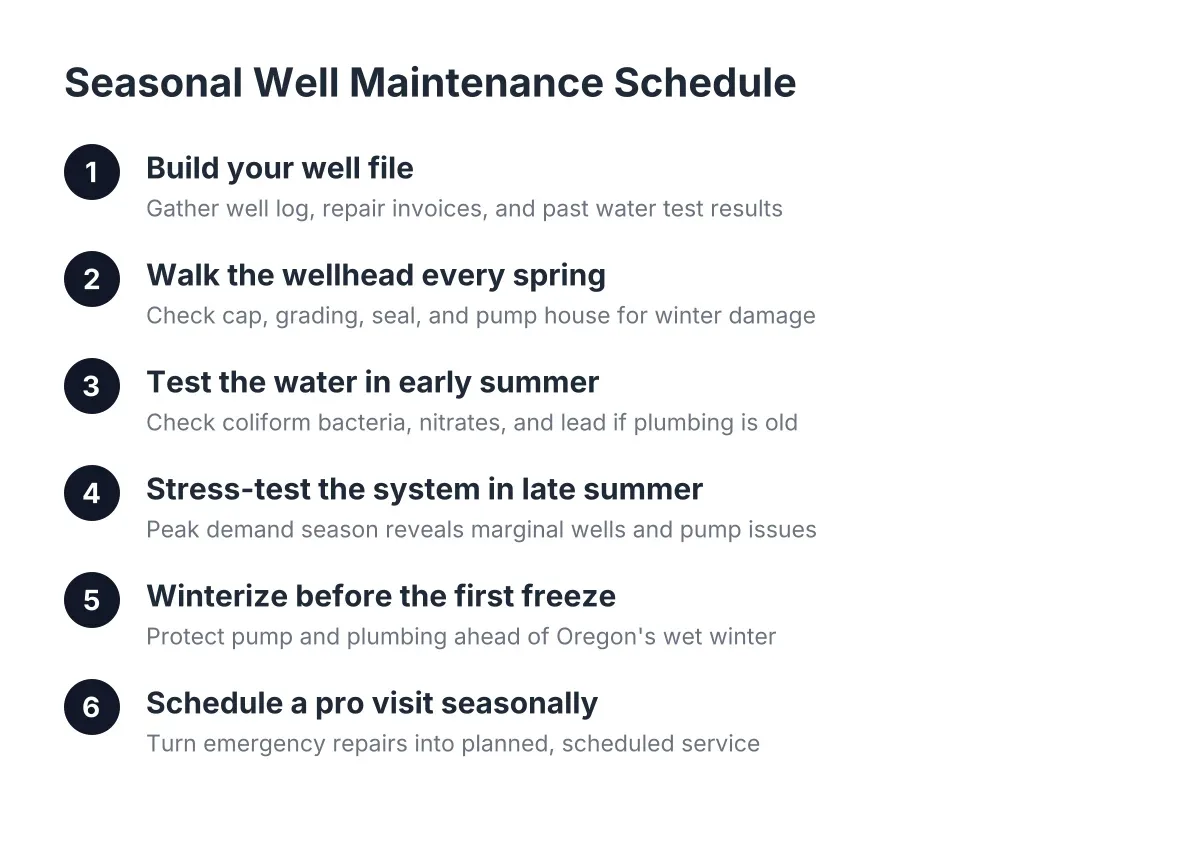
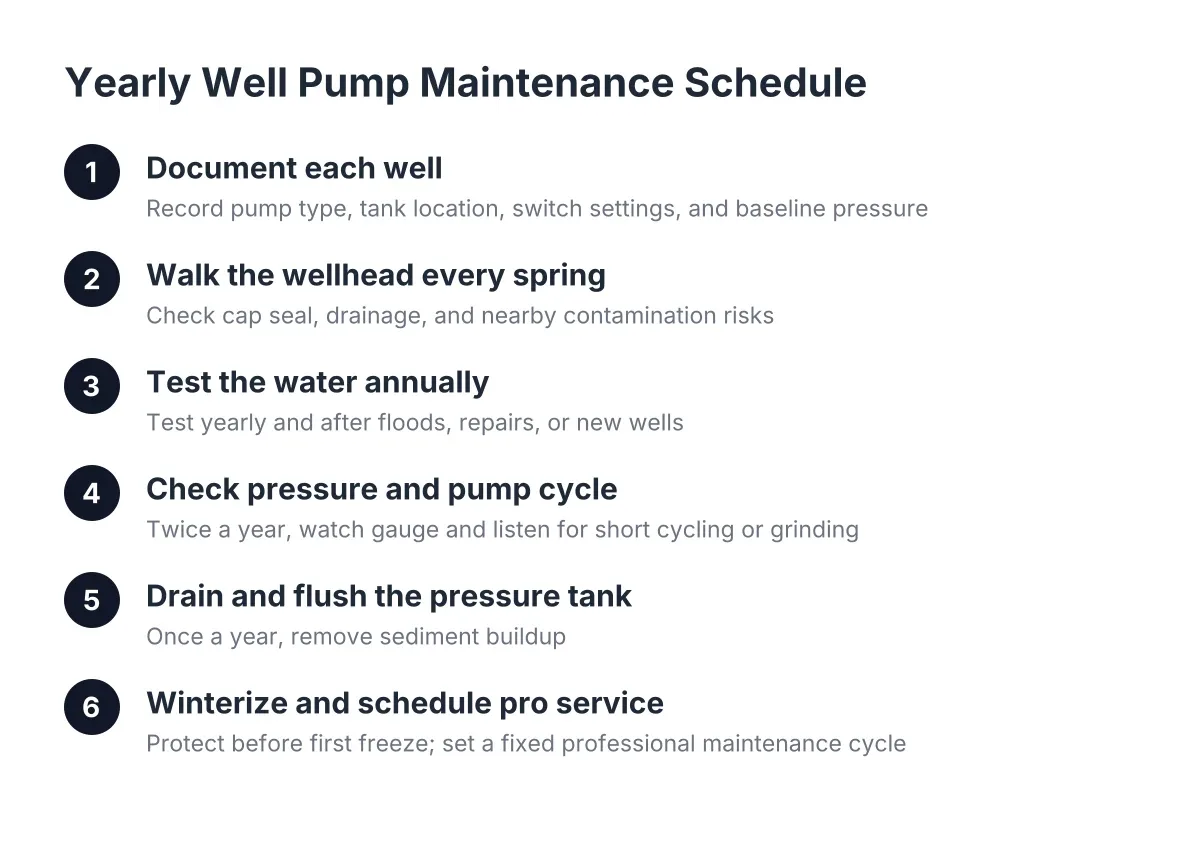
You do not need to babysit the wellhead. A workable well and pump maintenance routine for a busy owner, or a landlord with wells they cannot check weekly, comes down to a few habits: glance at the electric bill quarterly, listen near the pressure tank twice a year, ask tenants specifically about pressure and water color instead of waiting for complaints, and get a professional well inspection on a regular schedule. In 2026, some local companies offer well service agreements that bundle an annual inspection with priority scheduling, which is worth weighing if you own multiple properties or a property you rarely visit; the trade-off is paying for visits in years when nothing is wrong.
Two honest limits on all of this. First, you cannot see a submersible pump; it hangs far down the well, so surface symptoms are always indirect, and confirming a diagnosis takes someone pulling the pump or testing the system. Second, if the well itself is losing yield, no pump work fixes that, and the conversation moves to deepening the well or new well drilling. Also worth knowing: heavy water use does not wear out a submersible pump, since they are built for continuous running, so there is no need to ration showers to protect the equipment.
The pattern across all eight red flags is the same. Pumps announce their failures early, in pressure, sound, current draw, and water quality. Owners who treat those announcements as scheduling prompts rather than annoyances stay off the emergency list, and when they search for well repair services near me, they do it on a normal Tuesday with water still in the tank.
If you need well drilling, Clackamas Well Drilling can help.
Prefer to talk it through? Call (503) 782-5215 — a quick call is usually the fastest way to get a straight answer for your situation.