Gresham Well Maintenance by Season: A Step-by-Step Plan for Sandy, Boring, and Damascus
If you own a well outside Gresham, in Sandy, Boring, Damascus, or anywhere along the rural edge of Clackamas and Multnomah County, the pump does not care whether you drive past it every day or once a month. This guide lays out a seasonal well maintenance schedule for Gresham, step by step, built for people who cannot personally check on the well every week. That includes landlords with tenants on well water, buyers who just closed on a property with a private well, and anyone whose last pump failure came as a total surprise.
The goal is simple. Work through these steps once per season and you turn most emergency well pump repair calls into planned, scheduled service. According to Angi, well maintenance costs homeowners $200 to $900 per year. Compare that with the national average well pump replacement cost of $1,898, with most homeowners paying between $975 and $2,821, also according to Angi, and the math on routine upkeep is not hard.
One note before we start. This plan assumes you already have a working well and pump. If you are mid-crisis, no water at the tap and a breaker that keeps tripping, skip the checklist and call a well pump service near me search into an actual phone call. The steps below are for preventing that day, not surviving it.
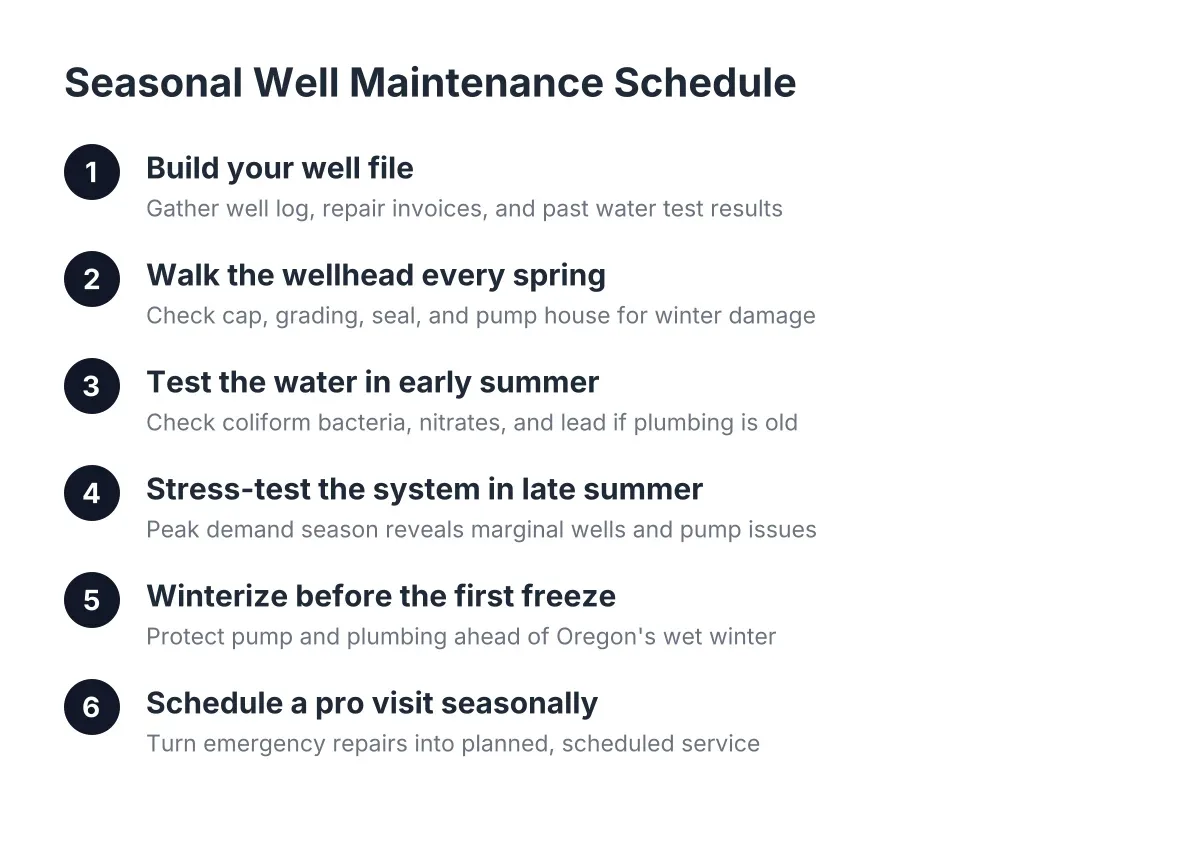
Step 1: Build Your Well File Before Anything Else
Before you touch the wellhead, gather the paperwork. You cannot maintain what you cannot describe. Pull together the well log from the original well drilling if you have it, any past well pump repair or well pump replacement invoices, and any water test results.
If you bought the property recently, this file may already exist from your pre-purchase well inspection. If you skipped that inspection, or the seller handed you nothing, start the file now with what you can observe. Note the pump type, the pressure tank location, and the age of anything with a date stamp on it.
For example, most residential well systems use a submersible pump paired with a pressure tank, and that tank may sit in the well, in the house, or in a crawl space, according to the Indiana Department of Health. Knowing which layout you have changes what you inspect each season and what you tell a technician on the phone.
Your file should answer four questions:
- How old is the well and the pump, even roughly?
- Where is the pressure tank, and where is the pump's breaker or disconnect?
- When was the water last tested, and what did it show?
- Who serviced the system last, and what did they do?
If you manage rental properties, keep a copy of this file for each address. A tenant reporting "no water" at 7 a.m. is far easier to handle when you can tell a well repair near me contractor the pump age and tank location from your phone.
Step 2: Walk the Wellhead Every Spring
Spring is the season for a full visual inspection, because Oregon's wet winter is what does the damage. Once the ground dries enough to walk the property, go look at the well itself.
Check these items in order:
- The well cap. It should be tight, undamaged, and sitting above grade. A cracked or loose cap lets insects, rodents, and dirty surface runoff into your well water.
- Grading around the casing. Water should drain away from the well, not pool against it. Winter rain in the Sandy and Boring area is relentless, and standing water at the wellhead is a contamination path into the aquifer your well draws from.
- The well seal. It should be firm. A loose seal on a shallower installation is more than a contamination issue; a shallow-set pump vibrates, and a loose seal lets that movement stress and eventually break plumbing connections.
- Any pump house or shelter. Look for winter damage, rodent nests, and chewed wiring around the pressure tank and any filtration equipment.
In addition, listen. Stand near the pressure tank while someone runs a faucet. A pump that clicks on and off rapidly, a condition called short cycling, is one of the clearest early signs your well needs servicing. Catching it in April is a scheduled repair. Ignoring it until August is often a burned-out motor.
Step 3: Test the Water in Early Summer
Test your well water at least once a year, and early summer is a practical time to do it. The spring runoff season has ended, so results reflect your normal groundwater quality rather than a temporary seasonal swing.
At minimum, test for coliform bacteria and nitrates. If the property has older plumbing, add lead. If you notice staining, odor, or taste changes, tell the lab or your well contractor, because those symptoms point the testing in the right direction.
There is a useful precedent here from new construction. After a well is drilled, standard practice is to run the well extensively before sampling so the test reflects normal water quality rather than lingering disinfectant, according to the CDC. The same logic applies to a rental that sat vacant; run the water thoroughly before you sample, or the result tells you about stagnant pipe water, not the well.
For a landlord, an annual documented water test does double duty. It protects your tenants, and it builds the paper trail that makes the property easier to sell later. Buyers and their agents now routinely ask for a well and pump inspection report during escrow, and a folder of annual tests answers most of those questions before they are asked.
Step 4: Stress-Test the System in Late Summer
Late summer is when Oregon wells work hardest and when marginal wells reveal themselves. According to the U.S. Geological Survey, about 1,220 domestic wells in Oregon went dry or fell below pumping capacity between June 2021 and December 2023, and the true number is likely higher because reporting is not mandatory. Irrigation season is when most of those problems surface.
Therefore, use August as your pressure check. Run water the way peak demand would, sprinklers plus indoor use, and watch for pressure drops, sputtering faucets, or cloudy water. Those are signs the pump is drawing the water level down faster than the aquifer refills the well.
One reassurance here, because well owners get this backward. A submersible pump is built for heavy, continuous running; normal use does not wear it out, so you do not need to ration water to protect the pump. The concern in late summer is the water level, not pump fatigue. A properly matched pump will only draw what the well can supply.
If you see summer symptoms, book a well inspection with an aquifer and well depth assessment rather than guessing. A typical professional well inspection runs $250 to $550, according to Angi, and it tells you whether you are looking at a pump problem, a water level problem, or both. Those two problems have different fixes and different price tags.
Step 5: Winterize Before the First Freeze
Fall is the season that prevents the most emergency calls in the Gresham area. Cold snaps east of Portland, especially out toward Corbett and up the foothills near Sandy, freeze exposed pipe fast. Before the first hard frost:
- Insulate exposed piping between the wellhead, the pressure tank, and the house.
- Check that any pump house door closes and seals. A three-sided shelter or partial cover over exposed equipment beats nothing, though the pressure tank and piping need real freeze protection.
- Confirm any heat tape or heat lamp actually works. Plug it in and check it in October, not during the first freeze warning in December.
- For seasonal or outdoor lines, know whether your setup has a drain-back feature that empties the line after use. If it does, water cannot sit in the pipe and freeze; if it does not, drain those lines manually.
For rental properties, this step is worth a scheduled visit rather than a text to the tenant. A frozen line that splits can run the pump continuously against a dead-headed or wide-open system, and now a $40 insulation fix has become a water well pump repair bill.
Seasonal Well Maintenance Schedule Visit from a Pro
A professional seasonal well maintenance schedule visit in the Gresham area typically covers a wellhead and cap inspection, a pressure tank check including air charge, pump amp draw and cycling tests, a flow check, and a water sample if requested. Water lab fees and any actual repairs, such as a pressure switch or well pump replacement, are billed separately from the inspection itself.
That scope matters when you compare quotes. A fair quote names what gets inspected, what gets tested, and what counts as extra work. Be cautious of anyone who jumps straight to recommending a new well before assessing the pump, the tank, and the water level; drilling is a different budget entirely, averaging $5,500 with a typical range of $3,000 to $9,000, according to HomeAdvisor.
Timing works in your favor here. During cold, wet months when well drilling slows down, contractors have more room in the schedule for service and repair calls. Booking your annual checkup in late fall or winter is often the easiest appointment of the year to get, and it puts a professional's eyes on the system right before the hardest season.
There are also limits to what any checklist can catch. Pump condition below ground, wiring inside the well, and true static water level all require pulling equipment or specialized measurement, so an annual professional visit belongs in the plan even if you do every seasonal step yourself.
How Often Should a Well Be Serviced with a Seasonal Maintenance Schedule in Gresham?
A private well in the Gresham area should get a professional service visit once a year, plus your own seasonal walk-through four times a year. Annual water testing for bacteria and nitrates is the baseline, with a full well inspection any time you buy, sell, or notice a change in pressure, taste, or clarity.
That annual rhythm is the core of good well and pump maintenance. Some owners with older equipment, multiple rental properties, or a history of water level problems go further and set up well service agreements, a standing arrangement where the same contractor inspects each system on a fixed schedule. For a landlord juggling three wells across Boring and Estacada, one scheduled route visit per year per property is simpler than three separate emergencies.
A Seasonal Plan in Practice: One Illustrative Year
Suppose a landlord in Damascus owns a rental on a well of unknown age, bought in early 2026 with no well records from the seller. Here is what the first year of a Gresham well maintenance seasonal routine might look like in that scenario.
In spring, she walks the wellhead, finds the cap loose, and has it resealed during a baseline well inspection that also dates the pump at roughly twelve years old. In early summer, the water test comes back clean, and the report goes in the well file. Additionally, in August, a deliberate high-demand test shows steady pressure, so no aquifer concern this year. Furthermore, in October, she insulates the pipe run to the pressure tank and verifies the heat tape.
Total spend in that scenario lands within the normal $200 to $900 annual maintenance range Angi reports. More important, she now knows the pump is in the back half of its likely lifespan, so she can budget for a planned well pump replacement instead of getting the no-water call from a tenant some February morning.
Signs That Mean Call Now, Not Next Season
The seasonal schedule handles prevention. However, some symptoms should never wait for the next season's checklist:
- No water, or pressure that drops off and does not recover
- The pump breaker tripping repeatedly
- The pump running constantly, or short cycling every few seconds
- Sudden cloudy, gritty, or foul-smelling well water
- A humming or grinding pump motor
Any of these means stop troubleshooting and search well pump service and repair near me, or better, call the well contractor already in your well file. Electrical faults, a failing pressure switch, and a dying motor can all present the same way at the tap, and diagnosing them safely means confirming power is off and testing components; that is work for a licensed pump technician, not a weekend project.
When you make that call, ask two questions. First, will they diagnose the actual failure before quoting a well pump replacement, since a bad pressure switch costs a fraction of a new pump? Second, will they document what they find? That report becomes the next entry in your well file, and the whole seasonal cycle starts again from a stronger position.
If your well in Gresham, Sandy, Boring, Damascus, Estacada, or Corbett is due for its annual checkup, or you want a documented baseline inspection on a property you just bought, reach out to a local well and pump specialist and get the first seasonal visit on the calendar before the weather picks the timing for you.
If you need well drilling, Clackamas Well Drilling can help.
Prefer to talk it through? Call (503) 782-5215 — a quick call is usually the fastest way to get a straight answer for your situation.