
Well and Pump Maintenance — Complete Guide
Well pump maintenance is the difference between a planned service visit and a tenant calling you at 6 a.m. about dry faucets. This guide covers the routine upkeep that extends the life of your well and pump system, from annual inspections to seasonal tasks to the warning signs that tell you a failure is coming. It is written for owners who cannot check on every well in person, whether that means one home on acreage outside Gresham or several rentals spread across Sandy, Boring, Damascus, and Estacada. You will find a practical maintenance framework here, plus links to detailed guides on schedules, costs, red flags, and the terminology on your next service quote.
What You'll Find in This Guide
- Well and Pump Maintenance Terms Explained: A Plain-English Glossary
- How Much Does Well and Pump Maintenance Cost?
- Well Pump Maintenance Schedule: What to Do Every Year Before It Breaks
- 8 Red Flags Your Well Pump Needs Maintenance Before It Fails Completely
- Gresham Well Maintenance by Season: A Step-by-Step Plan for Sandy, Boring, and Damascus
Why Well Pump Maintenance Beats Emergency Replacement
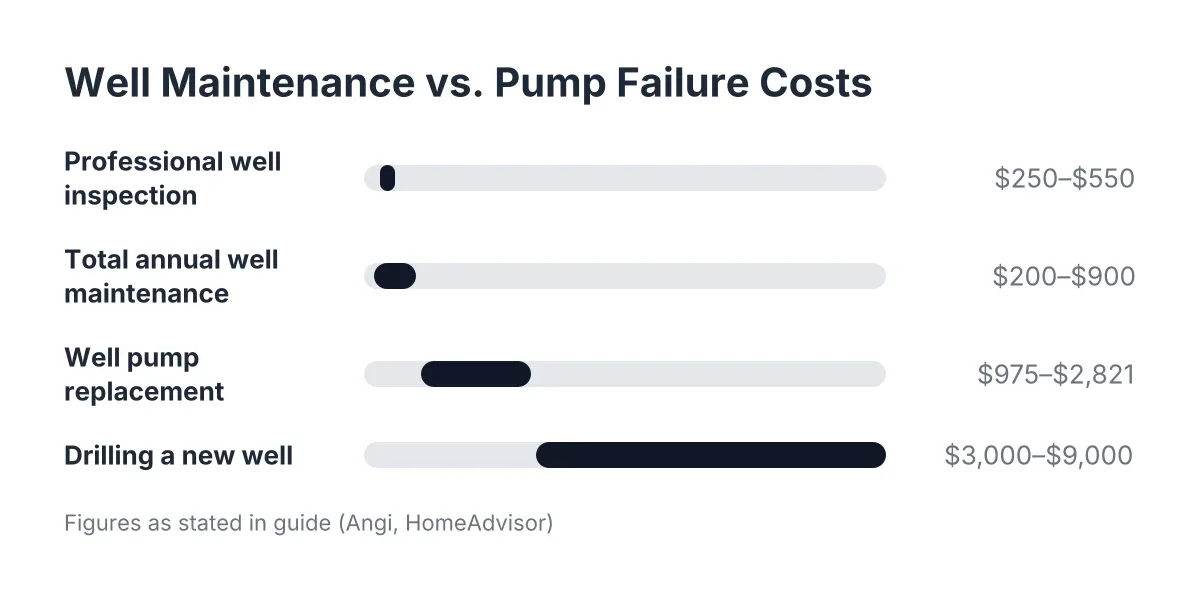
The math on proactive maintenance is not close. According to Angi, a typical professional well inspection costs $250 to $550, while the national average well pump replacement runs $1,898, with most owners paying between $975 and $2,821. That gap gets wider when you factor in what a failure costs beyond the invoice. A dead pump means no water at the property. For a homeowner, that is an uncomfortable few days. For a landlord, it can mean a habitability issue, a rent concession, or a tenant who starts looking at other listings.
Beyond the pump itself, maintenance protects the well. In Oregon, about 1,220 domestic wells went dry or fell below pumping capacity between June 2021 and December 2023, according to the U.S. Geological Survey, and the true number is likely higher because reporting is not mandatory. A pump that runs dry or cycles constantly against a failing pressure tank wears out fast. Worse, it can mask a declining water level until the well itself becomes the problem. At that point you are no longer pricing a repair. HomeAdvisor puts the average cost to drill a well at $5,500, and most wells need drilling or re-drilling every 10 to 20 years. Good maintenance pushes that timeline out. Neglect pulls it in.
What Routine Well and Pump Maintenance Involves
In practice, a maintenance visit is not complicated. A technician checks the pressure tank and pressure switch, measures drawdown and recovery, inspects wiring and the well cap, and tests water quality. Additionally, they document amp draw and cycling behavior, which creates a baseline. That baseline matters because most pump problems show up as a change from normal, not as an obvious defect. If you want to know what each of those line items means before you see them on a quote, the plain-English maintenance glossary walks through all of it. For the full picture on what each piece of service costs locally, see the well and pump maintenance cost guide.
Building a Maintenance Calendar for Wells You Don't Drive Past
Most maintenance advice assumes you live at the property. You walk past the wellhead, you notice the pump short-cycling, you hear the pressure switch clicking too often. However, that assumption breaks down for landlords and rural investors. If you own three rentals on wells in Boring, Damascus, and Estacada, you might see each wellhead twice a year. Your tenants use the water every day, but they do not know what normal sounds like, and they rarely report small changes.
The fix is a calendar, not vigilance. Instead of relying on someone to notice a problem, you schedule service at fixed intervals and treat the well like any other building system. As a general rule, every well deserves a professional checkup once a year. The yearly well pump maintenance schedule lays out exactly what that annual visit should cover and what you can delegate to a tenant checklist between visits.
Timing service around Oregon seasons
Timing matters as much as frequency here. Oregon's wet winters and dry late summers stress wells differently. For example, late summer is when static water levels drop and marginal wells show their weakness, so a capacity check in August tells you more than one in March. Meanwhile, winter brings freeze risk to exposed pipes, pressure tanks in unheated pump houses, and wellheads without proper insulation. The seasonal maintenance plan for Gresham-area wells breaks the year into quarters with specific tasks for each one, which makes it easy to drop into a property management calendar.
With this in mind, multi-property owners should stagger inspections rather than bunching them. Schedule one property per quarter if you own four, or pair properties by location so a single service trip covers two wells. That said, keep every well on at least an annual cycle. Skipping a year to save a few hundred dollars is how a $400 repair becomes a $2,000 replacement with a vacancy attached.
Warning Signs, Water Testing, and Service Agreements
A maintenance calendar catches most problems. The warning signs catch the rest. Pumps rarely die without notice, and the signals are consistent: pressure that surges and fades, a pump that cycles on and off rapidly, air spitting from faucets, cloudy or gritty water, a climbing electric bill, or a pressure switch that clicks constantly. Each of those symptoms points to a specific cause, and most are cheap to fix early. The 8 red flags your well pump needs attention covers each signal, what it usually means, and how urgent it is.
For remote owners, the practical move is turning that list into a tenant-facing version. Put four or five symptoms in plain language on a one-page sheet, tape it inside a kitchen cabinet, and tell tenants to report any of them immediately. As a result, your tenants become your early warning system. You will not catch everything, but you will catch the slow failures that cause most emergency calls.
Why annual water testing is non-negotiable
Water testing belongs in the same conversation. Private wells get no municipal oversight, so testing is entirely on the owner. The Oregon Health Authority recommends regular testing for coliform bacteria, nitrates, and arsenic, and you can find their domestic well guidance at healthoregon.org/wells. For rental properties, Oregon also requires a well test when a property with a domestic well sells. Therefore, keeping annual test results on file protects your tenants, documents your diligence, and smooths a future sale.
When a service agreement makes sense
Finally, consider a well service agreement if you own more than one well or live far from the property. A service agreement bundles the annual inspection, water test, and priority scheduling into one predictable line item. To put it simply, you trade a small fixed cost for the certainty that someone qualified looks at each well every year without you remembering to call. Angi pegs typical well maintenance at $200 to $900 per year, and an agreement keeps you at the low end of that range by catching problems while they are still repairs. For landlords, it also creates a paper trail of professional maintenance, which matters if a habitability question ever comes up.
Ready to Get Started?
If you own a well anywhere on the rural edge of the metro, from Gresham out to Sandy, Boring, Damascus, Estacada, Corbett, or Oregon City, the best time to schedule service is before anything breaks. We handle well inspections, pump repair and replacement, water testing, and ongoing maintenance for single homeowners and multi-property owners alike. Reach out and we will put your well, or your whole portfolio, on a schedule that ends the surprise emergency calls.