Well Repair Quotes: Questions to Ask Before Hiring a Well Drilling Company Near You
When you search for well drilling near me, you get a page full of bare homepages, brand-only profiles, and directories that tell you nothing about what the work should cost. That is a bad place to be when you are standing on a piece of land in Gresham, Sandy, or Boring with a lender asking for proof of water, or a rental property with a dead pump and a tenant calling twice a day. This guide breaks down what a fair quote looks like, what an itemized cost breakdown should include, and the exact questions to ask before you hire anyone.
The goal is simple: by the end, you should be able to look at any quote for well drilling or well pump repair and know whether the number is built on real information about your property, or pulled out of the air.
Why Most Well Quotes Feel Like Guesswork
Well work has a reputation for surprise costs, and the reputation is partly earned. Unlike replacing a water heater, nobody can see the whole job before it starts. The aquifer is underground. The pump is at the bottom of the well. Additionally, the wiring runs through casing you cannot open without equipment.
However, that uncertainty is not an excuse for a vague quote. A good well drilling company handles the unknowns the honest way: by itemizing what is known, pricing the variable parts per unit, and telling you in advance what would change the number. A bad quote hides everything behind one lump sum and a shrug.
The difference matters most for two kinds of readers. If you are a land buyer planning new construction, drilling is likely the largest single unknown in your site budget, and your county may require proof of water before it will permit the home. If you are a landlord managing several well-served rentals around the Clackamas and Multnomah County rural edge, you are buying this service repeatedly, and a vendor who quotes clearly on the first job is worth keeping for the next ten.
What a Complete Well Job Actually Includes
Before you can judge a quote, you need to know the full scope of work. Whether it is a new well or a repair, the job is bigger than the hole or the pump.
New well drilling installation scope
For new well drilling, a complete quote should account for:
- Site evaluation and well placement, including access for the drilling rig
- Permitting with the state and county before any drilling starts
- Drilling itself, usually priced per foot
- Steel or PVC casing, also typically priced per foot
- A well seal and grouting to keep surface water out
- The well pump, pressure tank, wiring, and drop pipe
- Water well testing after the well has been run long enough to give a true sample
- A drill log documenting depth, water production, and clarity
That last item is easy to overlook and worth insisting on. Drillers keep a log of what they hit at each depth. For a land buyer, that log is your proof of water for the lender and the county, and it becomes the baseline record for every future well inspection on the property.
In addition, know that a new well is rarely a one-day event. The full process can stretch across weeks or months once you count permitting, the drilling itself, and follow-up visits to set the pump, plumb the pressure system, and collect a clean water sample. Build that into your construction timeline before you schedule the foundation pour.
Well pump repair scope
For pump and well repair, the scope is different but should be just as clear. A proper well pump repair visit includes diagnosing whether the problem is the pump, the pressure tank, the pressure switch, the wiring, or the well itself. Pulling a submersible pump takes equipment and time, and the quote should separate the labor to pull and reset the pump from the cost of the parts.
Watch for what is usually extra: replacing the drop pipe if it is corroded, upgrading undersized wiring, a new pitless adapter, or water well testing after the repair. None of those are padding if they are needed, but you want them listed, not discovered on the invoice.
What Drives the Cost of Well Drilling Near You
The cost of well drilling near you in the Gresham area comes down to four variables: depth to water, site geology, access for the rig, and the risk of a dry or low-producing hole. Every honest quote is a statement about those four things, and every question in the next section exists to pin them down.
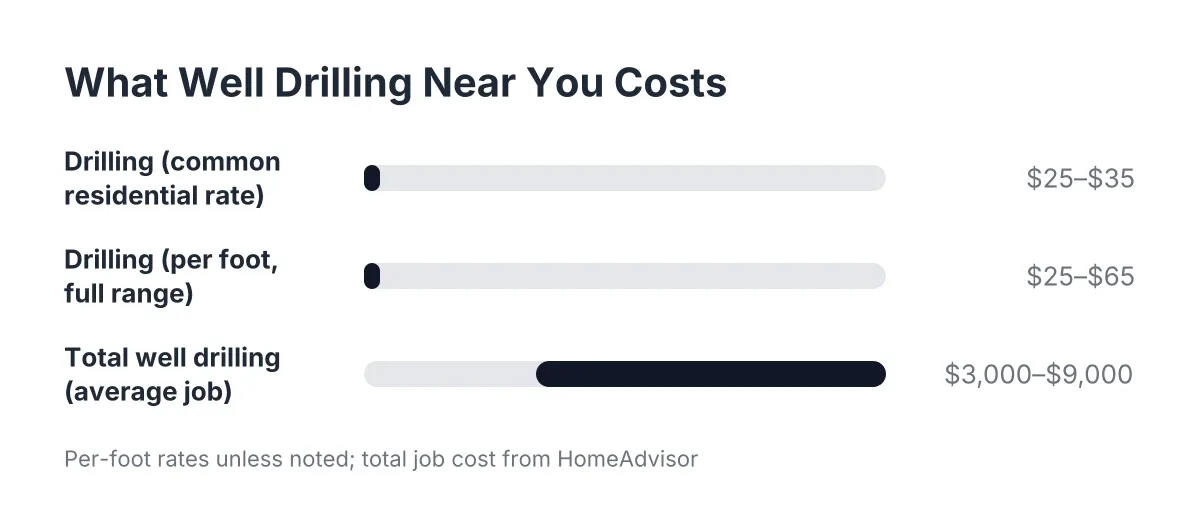
Depth is the biggest lever because most drilling is priced per foot. According to Angi, drilling typically runs $25 to $65 per foot, with $25 to $35 per foot as a common guideline for residential projects. Since depth to groundwater varies from one property to the next, even between neighboring parcels, per-foot pricing is how the industry deals with the unknown.
Geology decides how hard each of those feet is. Drilling through soft soil goes faster than punching through dense clay or rock. When the rig reaches bedrock, standard practice is to drill at least about 10 feet into that rock to get past dirty surface water and create a proper socket for the casing, according to the New Hampshire Department of Environmental Services. Rock work is slower and often priced at a higher per-foot rate, and your quote should say so up front.
Access matters more than most buyers expect. A drilling rig is a heavy truck that needs a clear path to the well site and room to work once it gets there. A build site off a paved road in Damascus is a different job than a steep, wooded parcel outside Estacada. If the crew has to clear access or work a tight site, that time shows up in the price.
For overall budget context, homeowners spend an average of $3,000 to $9,000 to drill a well, with an average around $5,500, according to HomeAdvisor. Forbes puts the average at $5,625 with a similar range. Treat those as national reference points, not local promises; your depth and geology set your actual number.
The Questions to Ask Before You Sign Anything
Here is the working checklist. Ask these questions of any well drilling company near you before you commit, whether the job is a new well or a repair.
- Is the drilling priced per foot, and what is the rate? Per-foot pricing is normal and fair. Get the rate in writing, and ask whether the rate changes if the rig hits rock.
- What happens if you have to go deeper than expected? You want a driller who tells you the plan before it happens, not after. A common honest practice: if the well reaches the limit of what the rig can do without adequate water, the driller measures the flow rate and lets you decide whether to stop or continue. That decision should be yours, at a known cost per foot.
- What exactly is included in this number? Casing, seal, permit fees, pump, pressure tank, wiring, and water testing should each be listed or explicitly excluded. "Complete well" means nothing until it is itemized.
- Who pulls the permit, and is the fee in the quote? In Oregon, wells are regulated and reported to the state. The driller should handle the paperwork, and the quote should say whether the fee is included.
- Will I get the drill log? Yes should be the only answer. Depth, water production, and clarity at each stage belong in your records.
- Have you drilled in this specific area? Not the metro region, the area. A driller who has worked wells around Corbett, Boring, or Oregon City has a feel for what the ground does there, which makes their per-foot estimate of likely depth more useful than a stranger's.
- For repairs: what is the diagnostic charge, and does it apply to the repair? A fair shop tells you the trip and diagnosis cost up front and how it folds into the work if you proceed.
- For repairs: are you quoting repair or replacement, and why? If the answer is always replacement, ask what specifically failed. Sometimes a pressure switch or wiring fix restores water for a fraction of a new pump.
None of these questions require technical knowledge. They require the contractor to show their reasoning, which is the whole point.
Reading a Repair Quote: Is the Number Fair?
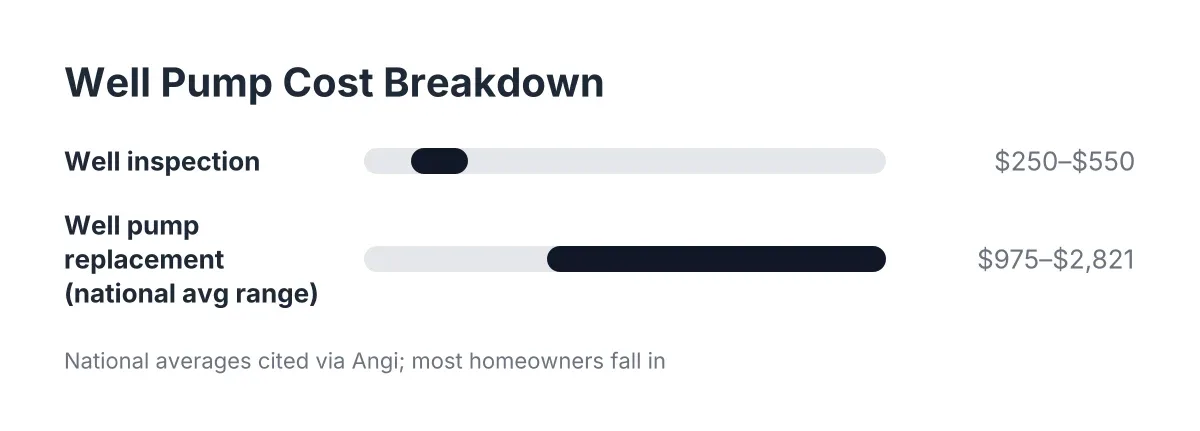
A fair well pump repair or replacement quote separates diagnosis, labor, parts, and any extras, so you can see what each dollar buys. For a benchmark, the national average well pump replacement cost is $1,898, with most homeowners paying between $975 and $2,821, according to Angi. A repair quote far outside that band deserves an explanation, and a good contractor will have one.
The explanation usually lives in the details. A deep well with a submersible pump costs more to service than a shallow well with a jet pump, because pulling hundreds of feet of drop pipe takes equipment and hours. Corroded fittings, old wiring, or a failing pressure tank found during the pull can add legitimate cost. The test of fairness is not whether extras appear; it is whether the contractor priced them before touching them and gave you the choice.
For example, suppose a landlord with a rental near Sandy gets a tenant complaint of no water. A fair sequence looks like this: a stated diagnostic fee, a phone call after diagnosis explaining that the submersible pump has failed, an itemized quote for water well pump replacement including the pump, labor to pull and reset it, and any drop pipe that needs swapping, and a recommendation to test the water afterward. In that scenario the landlord can compare the itemized number against the Angi benchmark, ask the questions above, and approve the work the same day without wondering what the invoice will say.
This is also where understanding well repair costs across failure types pays off for anyone managing more than one property. The same "no water" symptom can trace to a tripped pressure switch, a waterlogged tank, a failed pump, or a well that has silted in, and those four problems sit at wildly different price points. A contractor who quotes the fix without naming the failure is asking you to pay for a mystery.
One honest caution: not every well problem has a repair-sized answer. If a well is collapsing, contaminated beyond treatment, or no longer producing, the conversation shifts from well pump repair to drilling a new well, and no checklist substitutes for a professional well inspection at that point.
Local Ground Truth for Gresham-Area Wells
Searching for well drilling near me from Gresham puts you in a specific situation: the city itself is largely on municipal water, but the rural edge, including Sandy, Boring, Damascus, Estacada, Corbett, and parts of Oregon City, runs on private wells. That split shapes both the market and the quotes you will see.
First, it means local experience is not optional. Depth to the aquifer, the mix of soil and rock, and how wells behave through the dry late summer all vary across this area. A contractor who has drilled and serviced wells on this ground can estimate your likely depth range with real basis; one who has not is guessing at the biggest line item on your quote. Ask directly where they have worked.
Second, timing matters. Drilling is outdoor, weather-dependent work. Crews in this region tend to shift toward repair calls and shop work in the wet, cold months, which can affect scheduling for new well installation. If your build timeline is tight, get on the drilling schedule early rather than treating the well as a last step.
Third, budget for the ongoing side, especially if you are a landlord. Well maintenance runs $200 to $900 per year, and a professional well inspection typically costs $250 to $550, according to Angi. Against a vacancy or a failed water test blocking a re-rent, an annual inspection across your properties is cheap insurance, and it gives you a paper trail on every well you own.
For Land Buyers: Getting Proof of Water Before You Build
If you are buying land to build on, the smartest money you can spend is on answering the water question before you commit the construction budget. Drilling the well early, sometimes as a test well before the house plans are final, tells you what water access will cost while you can still adjust the rest of the project around it.
Therefore, treat the aquifer and well depth assessment as step one, not a detail for later. A well contractor evaluates the parcel for the best well location, weighing geology, setbacks from septic systems and property lines, permitting requirements, and rig access. Where you can put the well affects the driveway, the septic layout, and sometimes the house placement itself.
Then insist on documentation at every step. The permit, the drill log, the measured flow information, and the water test results together form the proof of water your lender or county wants in 2026, and they set the baseline for every future well and pump service call on the property. A driller who volunteers this paperwork without being asked is telling you something about how they run the rest of the job.
The Bottom Line Before You Call
A fair quote for well drilling or well pump repair is not a low number; it is a transparent one. Per-foot rates in writing, an itemized scope, a plan for the unknowns, and paperwork you keep. Any contractor doing honest work in the Gresham area can meet that standard, and the questions in this guide will show you within one phone call whether they do.
If you are planning a new well on land around Gresham, Sandy, Boring, Damascus, Estacada, Corbett, or Oregon City, or you have a well or pump problem on a property you own, reach out for an estimate. Bring the checklist. A straight answer on scope, per-foot pricing, and what could change the number is exactly what you should expect from the first conversation.
If you need well drilling, Clackamas Well Drilling can help.
Prefer to talk it through? Call (503) 782-5215 — a quick call is usually the fastest way to get a straight answer for your situation.