DIY Well Maintenance Tasks vs. Professional Service: What’s Actually Safe to Do Yourself
If you own a property on a private well near Gresham, and especially if you do not live there, you need a clear line between DIY well maintenance for landlords and other owners who cannot visit weekly, and work that belongs to a professional. Get that line right and you catch small problems early, cut down on emergency calls, and know exactly when to pick up the phone. Get it wrong and you can turn a $300 service visit into a dead pump and a tenant with no water.
This guide draws that line plainly. It is written for owners who cannot walk out to the wellhead every weekend, whether that means a landlord two hours away from a rental in Boring or a homeowner in Estacada who travels for work. The goal is a maintenance framework you can run mostly from a distance, with a short list of hands-on checks anyone can do, a clear list of jobs to leave alone, and a way to decide fast when a tenant calls saying the water quit.
Why the DIY Line Matters More When You're Not On-Site
A well and pump system fails quietly. Pressure drops a little, the pump cycles more often, the water gets a faint smell, and then one morning there is nothing at the tap. A homeowner who lives at the property notices those early signs. A landlord managing from a distance usually hears about the final stage only, when the tenant calls and the fix is now urgent.
That is why the DIY question matters so much for remote owners. The right do-it-yourself tasks are not about saving money on service. They are about building an early warning system, partly through your tenant, partly through an annual professional visit, so you are never choosing between an overnight emergency rate and a tenant hauling water.
There is also a damage risk. Allowing a pump to run with no water moving through it can burn it up. A well-meaning tenant who keeps flipping the breaker on a dry or airlocked system can destroy a pump that a professional could have saved. Knowing what not to touch is half the value of this guide.
DIY Well Maintenance Tasks for Landlords and Remote Owners
Plenty of well upkeep requires no tools, no electrical work, and no opening of the well itself. These are the tasks that are safe for an owner, or for a tenant following simple written instructions.
The Walk-Around: What Anyone Can Check Monthly
A monthly walk-around of the wellhead and pressure tank catches most developing problems before they become failures. It takes ten minutes, needs no tools, and a tenant can do it with a one-page checklist and a phone camera. The point is observation, not repair.
Here is what that walk-around covers:
- Wellhead condition. The well cap should sit tight and level, with no cracks, rust-through, or gaps where insects or surface water could get in. Nothing should be stored on or leaning against the casing.
- Grading and drainage. The ground should slope away from the well casing. Standing water around a wellhead is how surface contamination reaches groundwater.
- Setbacks. No fertilizer, fuel, paint, or chemicals stored near the well. On rural acreage around Sandy or Damascus, that includes equipment fuel cans and livestock activity creeping closer over time.
- Pressure tank and pump area. Look and listen. Note rust, moisture, or a pump that clicks on and off rapidly while a single faucet runs. Short cycling is one of the earliest signs a system needs service.
- Water itself. Any new taste, smell, cloudiness, or sputtering at the faucets gets written down with the date.
For a remote owner, the move is simple: turn this list into a photo checklist. Ask the tenant to walk it once a month and text you five photos, including the wellhead, the ground around it, the pressure tank, the gauge reading, and anything that looks off. You now have a dated visual record of the system without driving out.
Simple Hands-On Tasks for the Owner's Visits
A few tasks go slightly beyond looking but are still safe for a careful owner. Save these for your own visits to the property rather than assigning them to a tenant.
First, check the pressure gauge behavior. Watch the gauge while water runs; note the pressure where the pump kicks on and where it shuts off. Write those numbers down once, and every future check becomes a comparison. A system that used to cycle between its normal range and now cycles faster, or struggles to reach shutoff, is telling you something.
Next, keep records. Pump model and install date, well construction report if you have it, past repairs, and water test results. When you eventually call for well pump repair, a company that knows the pump's age and the well's history can diagnose faster and quote tighter. For a landlord, this file is also what lets you authorize work by phone with confidence instead of guessing.
In addition, arrange annual water testing. You can collect the sample yourself with a kit from an accredited lab, or have it done during a professional well inspection. According to the U.S. Environmental Protection Agency, more than 23 million U.S. households rely on private wells for drinking water, and a USGS study found about one in five sampled wells had at least one contaminant above a human-health benchmark. Nobody regulates your well water but you. Annual testing for bacteria and nitrates is the minimum, and it is cheap insurance for a rental where someone else's family drinks the water.
Finally, protect the system from weather. Insulate exposed pipe before winter, and keep the pressure tank area dry and ventilated. A pump itself can live without a dedicated well house, and a simple open-sided shelter over exposed equipment adds protection without trapping moisture the way a sealed enclosure can.
Where DIY Well Maintenance Ends and Risk Begins
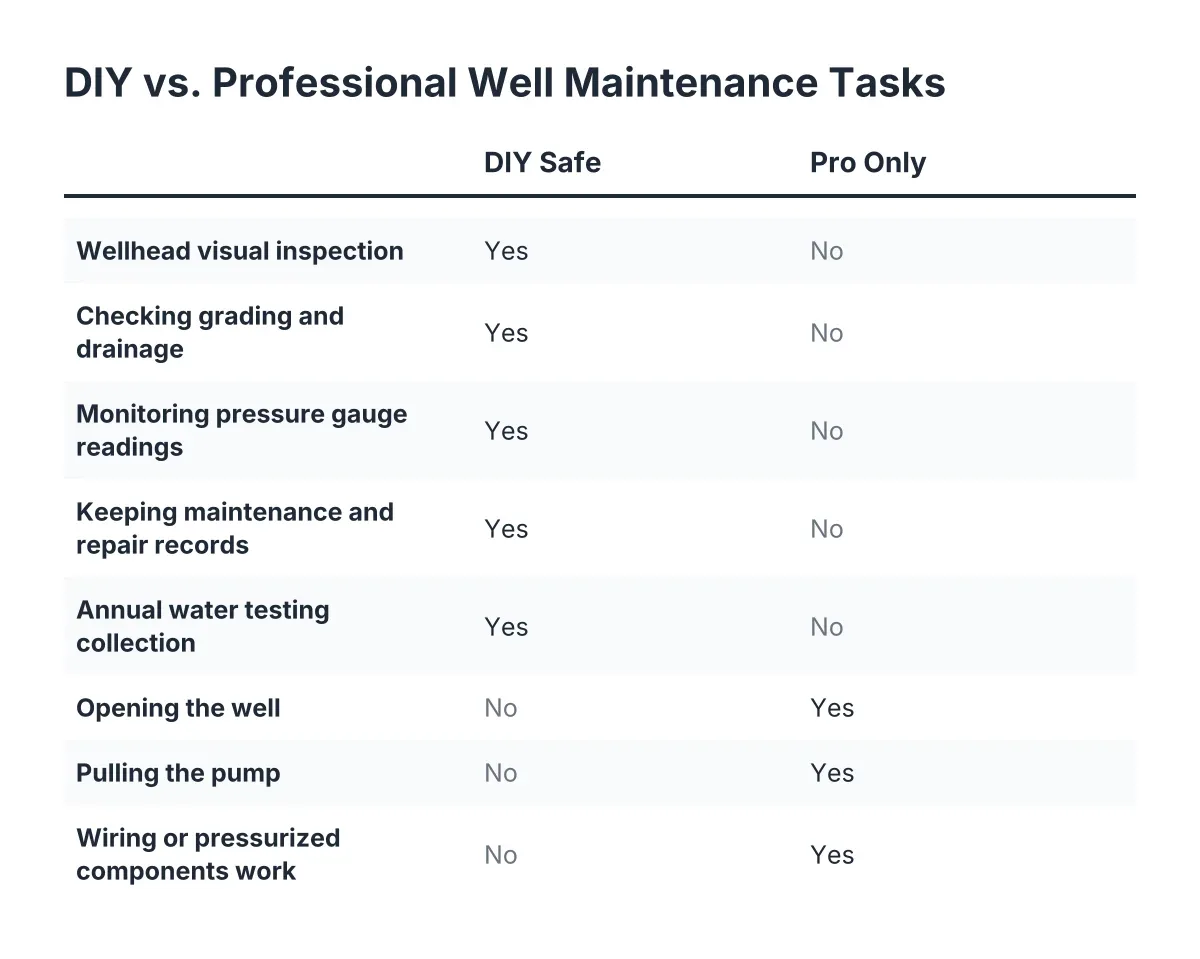
The line is simpler than most articles make it: if the task involves opening the well, pulling the pump, or working on wiring or pressurized components, it is not a DIY job. Everything on the safe list above is observation, recording, and basic weather protection. Everything below involves ways to hurt the system, the water, or yourself.
Jobs to Leave to a Well and Pump Professional
- Anything inside the well casing. Removing the well cap or seal opens the aquifer to contamination. A loose or poorly re-seated seal also creates mechanical risk; on shallower installations a pump can jump under load and break plumbing connections if the seal is not tight.
- Pulling or setting a pump. A submersible pump hangs on pipe, wire, and safety rope down the casing. Pulling it without the right equipment drops pumps down wells, kinks pipe, and nicks wire insulation. Well pump replacement is a professional job, full stop.
- Electrical diagnosis beyond the breaker. Pressure switches, control boxes, and pump wiring carry enough current to be dangerous, and misdiagnosis here is how good pumps get replaced for a bad $40 switch, or the reverse.
- Pressure tank repair or replacement. A waterlogged tank makes the pump short cycle, which shortens pump life. Confirming and fixing it involves pressurized components and should be part of a professional pump service visit.
- Disinfection and chlorination. Shocking a well sounds like a bucket-of-bleach job. Done wrong, it leaves residue in the system or fails to kill the problem. After drilling a new well, the driller disinfects the well and pump components and the system gets flushed heavily before use, according to the San Diego County Department of Environmental Health; the same care applies to disinfecting an existing well.
- Low-yield diagnosis. If a well seems to be producing less water, resist the urge to tinker. A declining deep well can often be rehabilitated rather than replaced, but figuring out whether the problem is the aquifer, the pump, or a clogged screen takes an aquifer and well depth assessment, not guesswork.
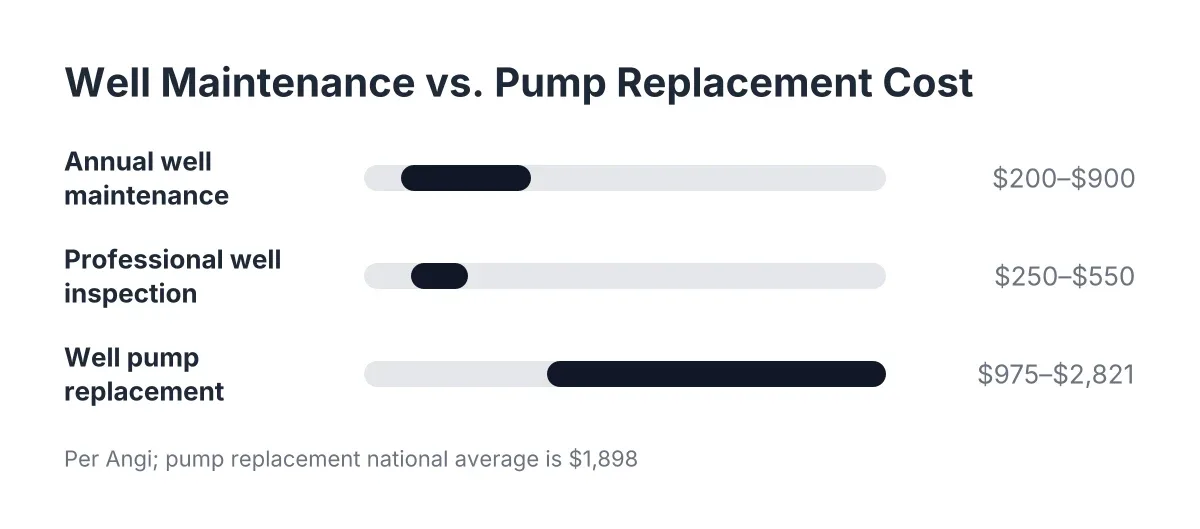
One honest trade-off: hiring out this work costs money, and a handy owner will be tempted to try some of it. According to Angi, a professional well inspection typically runs $250 to $550, while the national average well pump replacement cost is $1,898, with most homeowners paying between $975 and $2,821. The math favors the inspection. The jobs on this list are exactly the ones where a mistake converts a service-call problem into a replacement-level problem.
The One Rule for Tenants and No-Water Calls
Teach your tenant one rule: if the water stops, do not keep running faucets or repeatedly resetting the breaker. A pump running dry, or running against a blockage, can cook itself in a short time. Some modern constant pressure systems include dry-run protection that shuts the pump off automatically, but older systems, which is most rentals on 20-plus-year-old wells, have no such safeguard.
Instead, give the tenant a short script: shut off water-using appliances, check whether the breaker tripped, reset it once only, and report what happened. Then the call goes to a well and pump service, not back to the breaker panel. One correct phone call protects a pump that two hours of tenant troubleshooting can destroy.
A Remote Owner's Maintenance Framework, Month by Month
Suppose you own a rental on acreage outside Sandy with a well drilled in the late 1990s. You live in Beaverton and get out there a few times a year. Here is what a realistic maintenance rhythm looks like in that scenario.
- Monthly, by tenant. Photo walk-around using your checklist. Five photos texted to you: wellhead, grading, pressure tank, gauge, anything unusual. Two minutes of your time to review.
- Quarterly, by you remotely. Review the photo log for trends. Is the gauge reading drifting? Is the ground around the casing getting wetter each winter? Ask the tenant two questions: any pressure changes, any change in taste or smell.
- Twice a year, by you on-site. Do the hands-on checks. Watch the pump cycle, listen at the pressure tank, update your records, and winterize exposed pipe before the first hard freeze. East of Gresham toward Corbett, freeze protection is not optional.
- Annually, by a professional. A full well inspection with water testing. The technician checks the things you cannot: pump amperage draw, pressure switch condition, tank air charge, well cap integrity, and flow. This is also when developing problems get caught; say the inspection finds the pump drawing high amps, a sign of a motor on its way out. In that scenario you schedule a planned well pump replacement for a day that works for the tenant, instead of fielding a no-water emergency during the holidays.
- Every three to five years, or at tenant turnover. A deeper look at water quality beyond bacteria and nitrates, and a review of whether the system still fits the property's use. New tenants with a bigger household draw more water than a retired couple did.
This framework shows why consistent well maintenance for landlords pays off disproportionately for remote owners. According to Angi, routine well maintenance costs homeowners $200 to $900 per year. Compare that with an unplanned pump failure, a vacancy risk, and a tenant who starts shopping for a new rental the week they went without water.
How Often Should a Well Be Serviced Professionally?
A private well should get a professional inspection once a year, with water testing at the same visit. Older systems, rentals, and wells with any history of problems benefit from the same annual schedule plus a service call whenever symptoms appear between visits. Annual service is the standard most well professionals recommend as of 2026.
Between those visits, the monthly DIY checks are your tripwire. Searchers typing "pump service near me" or "water pump repair near me" at 9 p.m. are usually people who skipped both layers. The annual visit catches wear you cannot see; the monthly walk-around catches changes between visits. Together they make the emergency call rare.
Some owners formalize this with a service agreement, a standing arrangement where the same company handles the annual inspection and any repairs. For a landlord, the practical benefit is continuity: one company that knows the system, communicates directly with the tenant, and sends you photos and a written estimate before any work gets authorized. You are not re-explaining the property's history to a stranger during an emergency.
Signs It's Time to Stop DIY and Call for Service
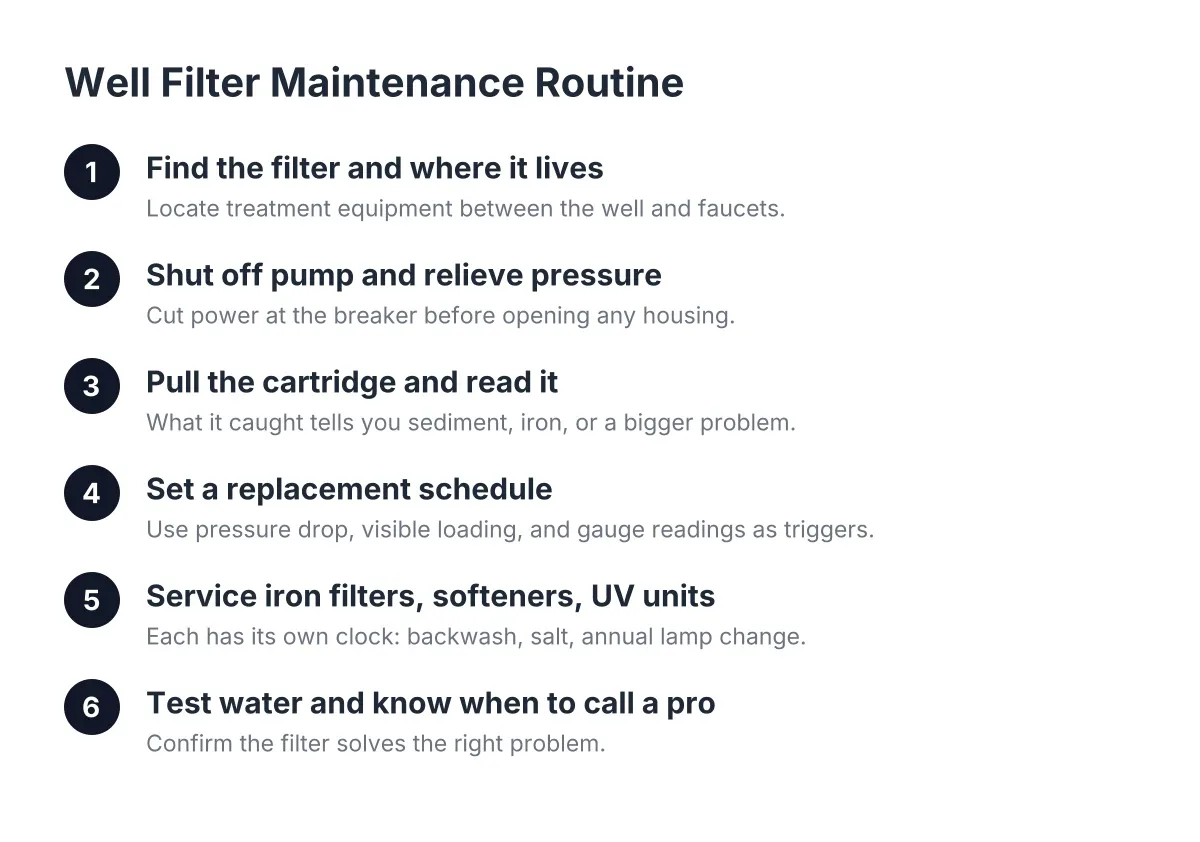
Certain symptoms mean the observation phase is over and diagnosis should happen professionally. Searching "well servicing near me" at the first of these signs, rather than the fifth, is usually the difference between a repair and a replacement.
- No water at any fixture, or water that comes and goes
- Sputtering or air spitting from faucets, which can signal a drop in water level or a failing drop pipe
- A pump that runs constantly or clicks on and off rapidly
- A sudden jump in the electric bill at the property, often the first remote-visible sign of a struggling pump
- New sediment, cloudiness, odor, or taste in the well water
- A failed or questionable bacteria test
- Pressure that recovers slowly or never reaches its old shutoff point
One more point of honesty: even a disciplined owner following every item in this guide will eventually face a failure that no checklist predicted. Pumps are machines down a hole full of water. The framework does not make you immune; it makes failures rarer, cheaper, and scheduled on your terms more often than the pump's.
The Bottom Line on DIY Well Maintenance for Landlords and Remote Owners
The safe DIY well maintenance for landlords and property owners are the ones built on eyes, records, and routine: monthly walk-arounds, gauge readings, water test samples, freeze protection, and a written history of the system. The jobs that belong to a professional are the ones involving the open well, the pump, the wiring, and the pressurized parts of the system. For an owner managing from a distance, the winning setup is a tenant with a photo checklist, an annual professional well inspection, and one trusted local company that will talk to the tenant directly and put estimates in writing before work starts.
Around Gresham, Sandy, Boring, Damascus, and Estacada, where private wells are the norm and many systems are decades old, that split between DIY observation and professional repair is what keeps a rental's water running without you standing in the driveway. Do the free parts faithfully, pay for the annual visit, and let the no-water emergency become something that happens to other people's properties.
If you need well drilling, Clackamas Well Drilling can help.
Related guide: well and pump maintenance — Complete Guide
Prefer to talk it through? Call (503) 782-5215 — a quick call is usually the fastest way to get a straight answer for your situation.